Barkald
Out Stealing HorsesBarkald is the valley’s largest landowner, a farmer whose fields and forest form the setting for Trond Sander and Jon’s horse-stealing adventure and whose practical dealings with Trond’s father reveal a warmer connection than Trond first understands. To the boy, Barkald’s property marks a sharp divide between the man who owns much of the district and the smallholders who live by their farms, dairy deliveries, and seasonal logging. Later, the same land becomes a place of work, accommodation, and trust, linking Barkald’s ordinary public standing to the concealed history of the Norwegian Resistance.
Identity and Estate
Barkald owns a large farm near the forest and the river, only a few kilometres from the Swedish border. His fields produce oats and barley in alternate years; beyond them, he keeps four horses in a broad forest enclosure bounded by two strands of barbed wire. The scale of his holdings makes him the district’s biggest landowner. Most neighboring families are smallholders, dependent on their own produce and milk sales, and many also work as lumberjacks during the logging season. The local economy has little money in circulation, a condition Trond associates with Jon’s father and his own father, but not with Barkald.
That economic contrast shapes the boys’ response to him. Trond recalls that neither he nor Jon could stand Barkald, although he cannot identify anything the farmer had done to earn their hostility. Barkald had never spoken an unfriendly word to him, as far as he knew. Their dislike seems to arise instead from the visible inequality between Barkald’s extensive property and Jon’s family’s smallholding. Trond also assumes that his father shares this resentment, an assumption he will later have reason to revise.
The Farm and the Horse Theft
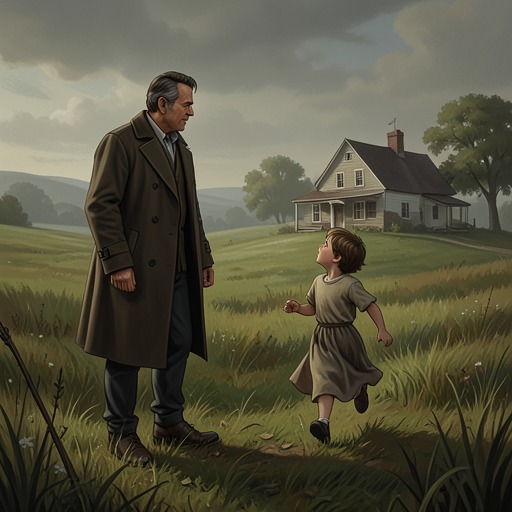
Barkald’s house stands at the edge of the forest, grey and heavy-looking to the boys as they approach his land to steal horses. Trond and Jon believe their guilt shows in their faces and the way they walk. Their reading of cowboy magazines has turned the theft into a matter of life and death: if caught, they imagine, they will be hanged. In that heightened vision Barkald’s dark-windowed house seems more threatening still, as though he might be watching and already know what they intend.
The enclosure is reached through Barkald’s fields and a dark stretch of spruce forest. Inside, the boys see a clearing among spruce stumps, with young pine and birch trees standing exposed to the wind; some have fallen with their roots lifted into the air. Beyond the bushes, the horses are at first visible only by their hindquarters and swishing tails. Jon presses down the lower wire and crawls under it; Trond rolls beneath it after him. They emerge without tearing their clothes and move cautiously through the grass toward the animals. Barkald is not present in the scene, but his ownership makes the boys’ passage across the fields and through the fence feel like a transgression against an entire local order.
The forest surrounding the enclosure also enlarges the episode beyond a simple prank. Trond imagines it running north through Sweden and Finland and onward toward Siberia, vast enough for a person to disappear in it. That sense of distance and possible disappearance accompanies the boys as they enter Barkald’s land. Their adventure is directed toward the horses, but the setting carries a more unsettling possibility that Trond, at the time, does not yet understand.
Work, Bargaining, and Trust
Barkald’s relationship with Trond and his father is also conducted through work. After a thunderstorm, when the grass dries within a few days, he comes over with his hair newly brushed and asks them to spend several days haymaking with a hayfork. He praises the strength they put into the previous year’s work, especially Trond’s, but Trond recognizes the practical purpose beneath the compliments: Barkald wants their labor without having to pay for it. The request is nevertheless grounded in a real history of hard work, and the exchange develops into a negotiation rather than a simple refusal.
When Trond’s father asks what he thinks, Trond proposes bartering a horse with harness for a few days’ work in the following week or the week after. The horse matters for a separate plan: Trond has been considering how the timber will be dragged to the river, since the logs cannot be hauled by hand. Barkald listens as father and son work their way toward the offer and agrees that they may have Brona. He appears bewildered by the circuitous conversation and seems reluctant to ask what they need the horse for. Trond’s father praises his son’s ingenuity, while Trond keeps to himself how carefully he has been thinking through the logging operation.
The arrangement shows Barkald as more than the distant owner whose property the boys fear violating. He can be bargained with, and he responds to the proposal by granting them access to a horse. Later, when Trond’s father plans a three-day ride, he secures two horses from Barkald for exactly three days. Trond is surprised by the loan because his earlier view of Barkald had made him seem possessive and forbidding. He comes to understand that Barkald likes his father and that their confidence in one another is stronger than he had supposed. Trond even wonders whether his father paid for the cabin or whether Barkald let him have it because the two men had become such close friends through what they experienced during the war; the precise arrangement remains uncertain to him.
Property as Cover During the Occupation
Barkald’s farm holdings include a smallholding whose cabin had stood empty for four years after foreclosure. Barkald had bought the property cheaply and had little use for it; its cow byre had already collapsed. Franz showed the vacant cabin to Trond’s father, who took an immediate interest in its position on the east bank of the river, a twenty-minute walk from the nearest bridge and with no other building behind the farmsteads until well beyond the Swedish border. The cabin’s isolation made it useful, while Barkald’s ownership gave Trond’s father a credible reason to be there.
Trond’s father repaired the place and its surroundings: he cleared the remains of the byre, fixed roof tiles, cleaned the riverbank, renewed the gable boards, replaced broken windowpanes, repaired the stove and chimney, and made two chairs. These necessary improvements helped make his presence look ordinary. When German personnel inspected the cabin three times, they found tools and two books by Hamsun, Pan and Hunger, but nothing suspicious. They had asked Barkald about the assignment, and he confirmed that Trond’s father was putting the cabin back in order. His confirmation supported the harmless explanation for the work, though the account does not specify how much Barkald knew about the secret traffic that used the route.
The cover also depended on village routines. Trond’s father kept the line going for two years, while people from the village sometimes completed the final leg across the border when he was away. Jon’s mother rowed upriver once or twice a week, carrying food or, at times, the concealed mail. The public explanation, repeated by Barkald at the shop, was that she was cooking for the handyman so that he would not become weak from the poor meals of a man living alone. That familiar pretext helped make her visits appear routine. Barkald’s farm and his account of the cabin’s maintenance thus formed part of the visible everyday life behind which the dangerous work could proceed.
Changing Perspective
Trond’s understanding of Barkald changes through details that once seemed to confirm the farmer’s wealth and authority. When the family first arrives, the forest, river, bridge, and Barkald’s yard are all unfamiliar; Trond regards the landowner with suspicion and assumes his father feels the same. Later, the loan of the horses forces him to reconsider. Barkald’s willingness to lend them, and Franz’s account of the men’s closeness after the war, reveal a trust that Trond had not noticed when he measured people chiefly by what they owned.
The loan also reopens the summer’s unfinished promise. Trond’s father had proposed a three-day horseback outing when they arrived, but Trond and Jon’s earlier ride among Barkald’s horses had gone badly. When two horses—a bay and a black one—appear grazing in the meadow, Trond recognizes them as the same animals. Their return is not simply a sign of Barkald’s continuing generosity: it reconnects Trond to the earlier adventure and to the friendship with Jon that was later broken by the shooting of Odd. By the time the horses arrive, the heaviness Trond felt after the timber was launched has lifted, and he is eager to use the remaining summer days. Barkald’s presence in this change is indirect but consequential: his animals, land, and trust help bind the boy’s separate memories of danger, friendship, work, and the time left before the return to Oslo.