Barkald horses ride
Out Stealing HorsesBarkald horses ride is the episode in which fifteen-year-old Trond Sander and his summer companion Jon enter Barkald’s land and ride away on horses. Recalled from later life, the adventure moves from a private boyhood ritual into real danger: Trond is thrown from his horse, yet the two boys continue into the forest together. The scene’s significance lies in that shift, and in the older narrator’s awareness that what once felt like play also carried a risk he could not then understand.
Invitation and Circumstances
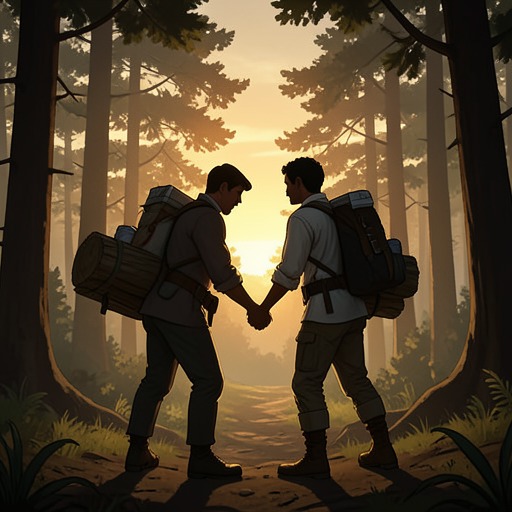
In 1948, on one of the first days of July, Jon appears at the cabin where Trond is spending the summer with Trond’s father and proposes that they go stealing horses. Trond is fifteen. The phrase gives their expedition the shape of a shared game, but the boys intend to take actual horses, and Jon’s invitation is not an offer of a larger group outing: as usual, he wants Trond’s company alone. Trond understands that Jon would go without him if necessary, though the undertaking would be less enjoyable and harder to manage by himself.
The episode belongs to a summer already defined by the boys’ repeated excursions. Jon comes to the cabin at varied hours to ask Trond to shoot hares, walk through the forest, fish for trout, or balance on the logs carried by the river. Trond accepts these invitations and keeps their activities from his father. The horse expedition is thus a new and more perilous extension of their established companionship, rather than an isolated encounter between strangers. Jon and Trond are the same age; Jon’s younger twin brothers, Lars and Odd, are not part of this particular adventure.
The remembered year also sits against an absence. Germany had left Norway three years earlier, but Trond recalls that the boys no longer talked about the Germans, and that his father never spoke about the war. This detail does not explain the horse theft, but it places the boys’ unspoken, energetic summer alongside an adult silence about the recent past. The adventure is narrated from the perspective of a much older Trond, who knows that the summer will trouble him again after many years.
Crossing onto Barkald’s Land
As Jon and Trond leave the meadow path and walk along the road, Trond imagines that their wrongdoing has already altered them. He thinks they look like criminals and pictures the unforgiving justice of the cowboy stories they have read: capture would mean hanging. The imagined punishment is not an actual threat reported from the scene; it is the measure of how seriously, and theatrically, the boys invest in the danger of what they are doing. Barkald’s heavy grey house seems more threatening to Trond than before, and he wonders whether Barkald might be watching them.
They do not turn back. After the house disappears around a bend, they cross another field belonging to Barkald and enter the forest. They reach a clearing where felled spruce has left young birch and pine trees exposed to the wind. Horses stand beyond two strands of barbed wire. Jon crawls between the wires, pressing down the lower strand, while Trond lies down and rolls beneath it; both get through without tearing their clothes. The crossing makes the change from imagined criminality to physical trespass precise: they have entered the enclosed land and are now close to the animals they came for.
Jon directs Trond to climb a birch apart from the horses. Trond takes off his shoes, climbs the trunk, and settles on a branch above the clearing. They coordinate across the space with a brief exchange of readiness, including Jon’s boy-scout salute. Their method depends on timing and on Trond’s ability to drop onto a moving horse; the boys’ confident preparation cannot make the attempt safe.
The Ride and the Fall
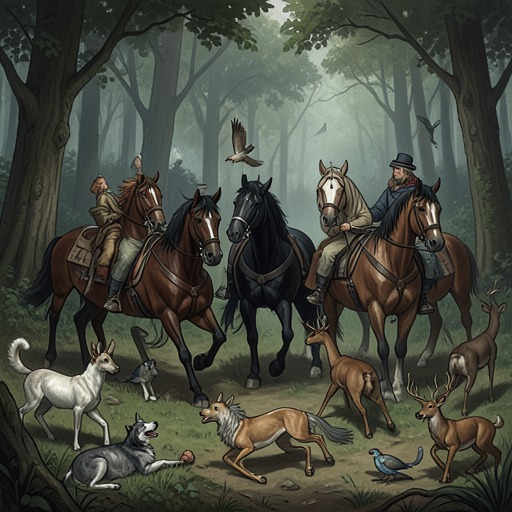
When the horses come beneath him, Trond drops from the branch onto one horse’s back. The landing goes badly: he is too close to its neck, becomes nauseated, and has to hold on as the animal accelerates. The second horse follows, carrying Jon behind him. The sudden ride takes them through the trees and across the clearing. For a short interval, Trond’s fear gives way to an intense feeling of happiness, which he experiences in the silence that follows the diminishing hoofbeats and hears as he rides on.
That brief exhilaration does not lead to a successful escape from the enclosure. Trond sees the barbed wire ahead and expects the horse to jump; instead, both horses turn sharply before reaching it. The movement throws him off, and he passes over the fence. The reversal is abrupt: the boys’ carefully staged approach has produced a ride they could scarcely control, and the boundary they crossed on foot becomes the point at which Trond is cast away from his horse.
Jon remains mounted and unhurt. Trond finds that he can stand, though his back and one side hurt and his arm has been cut; he tears away the damaged sleeve and ties it around the wound. Jon has collected Trond’s shoes. When Trond says he does not think he can ride again, Jon dismounts, removes the rope from his horse’s muzzle, and lets the animal go. He then comes through the fence and returns the shoes. The episode ends not with the boys mastering the horses but with Jon helping Trond prepare to walk.
Aftermath and Retrospective Meaning
Trond puts on his shoes without tying them, to avoid bending, and follows Jon deeper into the forest. He is sore and stiff, drags one leg slightly, and holds his injured arm close to his body. Even as they continue away from the clearing, he doubts that he will manage the walk back. The expedition has changed from a thrilling violation of rules into a practical test of whether he can keep going; Jon leads, and Trond follows at his heels.
On that walk, Trond thinks of a different task from the same summer. His father had asked him to cut the tall grass behind the cabin with a short scythe, a tool new to him. Trond had worked hard, imitating the way his father moved, but had deliberately made a wide arc around a patch of tall nettles. The memory links the risky ride to the father’s ordinary instruction and to Trond’s impulse to avoid a difficult patch rather than deal with it. In both recollections, physical effort and the father’s example shape the boy’s understanding of what he can do, though the horse ride has immediate consequences the mowing does not.
The older narrator frames the excursion as part of a summer whose meaning has returned to trouble him. The boys’ familiar closeness, their secrecy from Trond’s father, and their elaborate imagining of outlaw punishment make the theft at once an adventure and an act with real consequences. The contrast between Trond’s moment of happiness on horseback and his painful walk afterward keeps the memory from resolving into uncomplicated triumph: he survives the fall, Jon stays beside him, and the two continue together, but the ride has exposed the limits of their control.