David Copperfield
Out Stealing HorsesDavid Copperfield matters to Trond Sander as more than a Dickens novel: it is a book he once read aloud at home, a memory shared with a visitor, and a lens through which both of them consider whether a person can lose the place that should be theirs in their own life. Its opening lines offer the comfort of a story that reaches an ending, while bringing into focus questions about the past that Trond cannot answer.
A book remembered from home
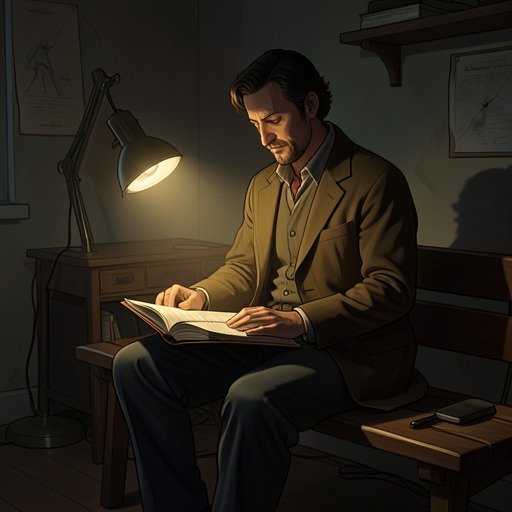
In the present, Trond tells his visitor that he listens to the radio in the mornings when he is indoors and reads in the evenings, mostly Dickens. The habit connects his solitary routine to the domestic past. When she remembers him reading, she recalls not simply a book but his absorbed posture: he sat in his chair, miles away, and at first seemed not to recognise her when she came over and pulled his sleeve to ask what he was reading.
His brief reply, “Dickens,” stayed with her. As a child, she did not know Dickens was the author’s name. She understood it as the name of a special kind of book, perhaps something only their household possessed. That misunderstanding gives the recollection its particular intimacy: the book’s identity is first established not through literary knowledge but through the repeated sight of Trond reading and the child’s effort to enter his attention.
She also remembers that he sometimes read aloud. When she later grew up and read the books herself, she recognised the passage as coming from David Copperfield, a novel he had seemed never to tire of. Trond is less certain of the detail at first, asking whether he really did read aloud, but accepts her account. The remembered reading thus belongs to both of them: he supplied the voice, while she retained the scene and eventually discovered which book it had been.
The return of the novel
The conversation turns from childhood memory to the book’s present availability. Trond confirms that he still has a copy. His visitor encourages him to read it again, resting her chin on one hand as she recites its opening sentence: “Whether I shall turn out to be the hero of my own life, or whether that station will be held by anybody else, these pages must show.” The remembered words return the book to the table between them, no longer only an object from home but a means of speaking about the ownership of a life.
For the visitor, the sentence had always seemed frightening. It implied that people might not necessarily be the leading characters in their own lives. She imagines the terror as a kind of ghost-life: someone has fallen out of her life and can only watch another person take her place, unable to return. Her image is sharply specific. The displaced person is thrown out of an aeroplane into empty space, while someone else sits fastened into the seat that was hers; she still holds the ticket. The book’s question gives form to a fear of losing one’s place without losing the awareness that it belonged to oneself.
Trond’s parallel fear
Trond cannot easily answer her. He had not known that she had thought this way, and she had never told him. He recognises, however, that he was absent when she needed to talk. Her account is therefore both a disclosure and a reminder of a gap in their shared past: they were close enough to have the book in common, but not so close that he knew what its words had come to mean to her.
Her fear also reaches into Trond’s own reading history. He has repeatedly returned to the opening lines and then continued page after page, almost rigid with terror, needing to see whether everything would fall into its rightful place in the end. In the novel, it did, though only after a long wait before he felt safe. The book’s ordered conclusion offered a reassurance he could experience while reading; Trond distinguishes that reassurance from real life, where the same questions remain unresolved.
Fiction and the unanswerable past
The opening question becomes, for Trond, a way of approaching Lars without yet being able to speak to him. Trond has not found the courage to ask whether Lars took the place that should have been his, or whether Lars lived years that Trond should have lived. The question shifts the novel’s language into the unsettled reality of their relationship: the issue is no longer simply who narrates a life, but whether another person’s choices or presence have displaced someone from his own history.
That uncertainty also touches Trond’s thoughts about his father. He is certain that his father did not leave to make a new life in distant countries or towns, and that he stayed by the river because that was what he wanted. Yet Lars has never mentioned Trond’s father during the time they have known one another. Trond can understand the silence without knowing precisely what it means: Lars may want to spare him, or may be unable, like Trond himself, to bring their thoughts about the people involved together into words. The novel cannot supply the missing explanation. Its ending can restore order within its pages, but the lives surrounding Trond remain difficult to arrange into a settled account.
Narrative significance
David Copperfield binds together a small domestic memory and a larger question of personal identity. The visitor’s childish misreading of “Dickens” as a special kind of book, her recollection of pulling Trond’s sleeve, and his present admission that he still owns the novel make the object a durable trace of their shared past. Its opening lines then expose a likeness between their private fears, even though neither had known the other carried that fear.
The book’s importance lies partly in this contrast between narrative and life. Reading allows Trond to endure uncertainty because he can turn the page and eventually reach an ending in which things fall into place. In his actual past, he cannot make the relevant people and years resolve into a clear pattern, and he has not asked Lars the question that might alter his understanding. The novel is thus both a childhood possession and an instrument of recognition: it helps Trond name the possibility of displacement, but cannot tell him whether it happened.