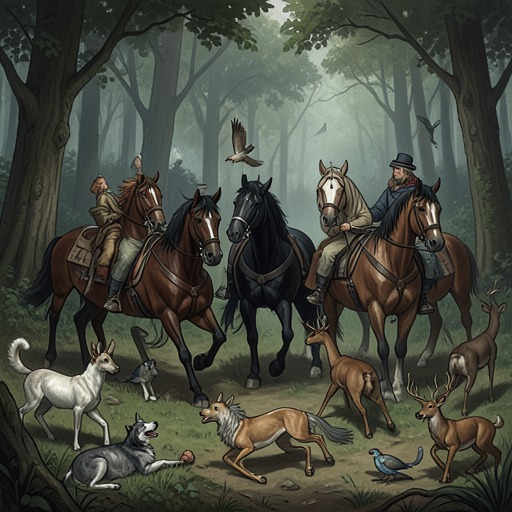
Dogs
Out Stealing HorsesDogs in the novel are companions, wanderers, and sometimes dangerous animals whose behavior exceeds the human plans made for them. Through Lyra’s quiet place in Trond Sander’s daily life, Poker’s nighttime absences, and Lars Haug’s account of shooting an Alsatian, dogs connect ordinary rural routine to questions of loyalty, vulnerability, and responsibility for violence.
Dogs in the Rural Setting
Dogs belong to the intimate scale of life around the house and the forest: they accompany walks, sleep near the stove, and may leave home without warning. Their presence is not simply decorative. A dog’s movement can organize a person’s night, and its behavior can change the atmosphere between people. The human characters interpret dogs through affection, worry, and memory, but the animals also act according to their own impulses, sometimes cooperating and sometimes resisting control.
The different dogs are not interchangeable. Lyra is the narrator’s female companion, though her breed is uncertain and explicitly not important to him. Poker is Lars Haug’s dog, identified as a border collie and described by Lars as exceptionally intelligent. The Alsatian in Lars’s recollection is neither man’s pet: it is a large dog whose pursuit of young roe deer prompts the shooting that Lars still remembers. The episodes therefore present companionship, disobedience, and danger as distinct parts of the human relationship with dogs.
Lyra and Everyday Companionship
Lyra is woven into the narrator’s daily routine rather than introduced through a dramatic event. Before the day begins, the two have already gone out with a torch along their usual path beside the lake. A few millimetres of ice lie against the bank, where dead rushes have turned yellow with autumn. Snow falls heavily and silently from the dark sky, and Lyra sneezes with delight. When the walk is over, she sleeps close to the stove as the snow stops and the rising thermometer indicates that it will melt.
The scene gives Lyra a bodily, immediate presence: she responds to the snow with pleasure, then settles into warmth. The narrator does not define her by breed or usefulness; he says that her type would be difficult to identify and that this does not matter. What matters is their shared routine and her nearness. This settled companionship stands in quiet contrast to the narrator’s long-standing longing for solitude. He has wanted a place like this even during periods when life was going well, and now Lyra shares the secluded home without cancelling its stillness.
Poker’s Nighttime Absence
Poker enters the narrative not by appearing at the narrator’s door but by being missing. After midnight, Trond Sander wakes to a loud, repeated sound from near the river. Looking through the window, he sees a torch beam moving along the road and gradually understands that Lars Haug is using a dog whistle to call Poker. The sound’s unfamiliarity first makes the search strange; recognition gives it a domestic cause, but does not remove the unease of a man alone in the dark trying to find his dog.
Lars explains that Poker has run off again and usually comes back. The possibility of wolves in the forest makes the absence frightening, yet Lars also says he cannot keep the door shut. His worry is therefore paired with a willingness to let Poker move beyond the safety of the house. Lars describes the border collie as more intelligent than himself and fears that the dog is about to take charge. The remark is partly rueful, but it also acknowledges a real imbalance: the owner cannot fully govern an animal whose choices repeatedly take it away.
The search ends when Trond Sander and Lars Haug sense something behind them. Poker stands stiffly on guard just beyond Trond, who recognizes the dog’s posture as an expression of guilt. When Lars addresses him in an almost childlike tone and steps closer, Poker growls and flattens his ears. Lars stops, lowers his torch, and does not force the approach. The dog’s return has not restored easy obedience; its warning makes the reunion a moment of uncertainty. Poker is present and visible, but his response still sets the terms of the encounter.
The Alsatian and Lars’s Memory
Poker’s growling prompts Lars to recall another dog and an earlier crisis on the farm where he grew up. His mother first saw an Alsatian chasing two young roe deer at the edge of the forest. The exhausted fawns had been seen grazing in brushwood near the north meadow; now the dog encircled them and bit at their hocks. Unable to keep watching, Lars’s mother telephoned the bailiff, who told her that the dog would have to be shot. She then asked Lars to do it.
Lars was reluctant and says he rarely handled the gun. His older brother was away at sea, his stepfather was felling timber in the forest for a neighboring farmer, and no one else was at home. He took the gun across the meadow but initially could not see the Alsatian. After listening in the clear autumn air, he looked back toward the house and knew that his mother was watching from the window. Then the two fawns ran straight toward him, passing within a hand’s breadth of his shoulder, with the Alsatian following about thirty metres behind.
Lars fired three times as the large dog kept running. The first shot did not stop it; after the next, it fell to its knees, rose, and continued. The third brought it down at his feet, paralyzed but still alive. Lars felt sorry for the animal and bent to pat its head, but it growled and snapped at his hand. In anger, he fired two more rounds through its head. The account preserves both the immediate stakes of stopping the pursuit and the escalation of Lars’s violence: pity does not prevent the final shots once the wounded dog threatens him.
Lars says he was eighteen and has never forgotten what happened. He had promised himself never to shoot a dog again, but Poker’s growl brings that promise into doubt. The memory is not an abstract confession: its details—the frightened fawns, his mother watching, the dog’s continued movement after being shot, and its final snap—explain why the present encounter unsettles him. When Trond Sander says he understands why Lars would not want to shoot another dog, Lars does not confirm that the promise will hold. He says they will see, then takes Poker inside.
Animal Agency and Human Responsibility
The dogs’ actions repeatedly complicate the idea that people can decide what an animal will do. Lyra’s pleasure in the snow is her own response; Poker leaves, returns, stands guard, and growls; the Alsatian pursues the fawns and then resists Lars’s attempt to touch it. The narrative remains closely filtered through human perception, especially the narrator’s reading of Poker’s posture and Lars’s recollection, so it does not claim access to the animals’ inner thoughts. Yet their movement and resistance have consequences that the people cannot simply dismiss.
The contrast between Lyra beside the stove and Poker in the dark marks two different forms of closeness: one made secure through routine, the other tested by an animal’s freedom to leave and by the dangers of the forest. Lars’s story extends that tension into a remembered act from which he cannot retreat. The dogs are not only symbols of human feeling; their physical presence, needs, and behavior set limits and demands for the people around them. In the present, Poker comes home alive, but the old memory remains unresolved, and Lars’s promise is left uncertain.