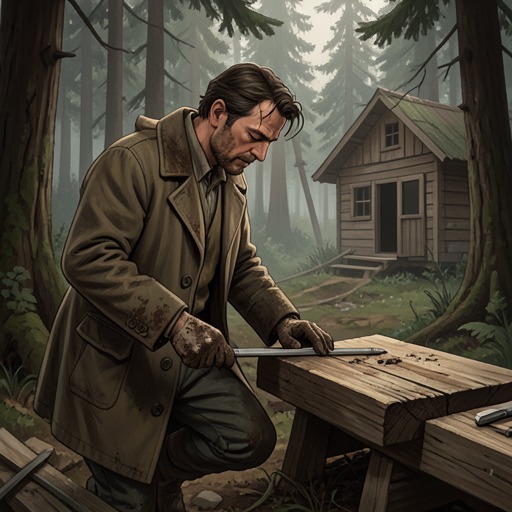
Franz
Out Stealing HorsesFranz is a strong-armed woodsman and river watcher whose house stands near the bridge, but his apparent place in village life conceals a crucial part in the wartime Resistance. In the narrator’s account, he is at once a practical guide to timber work, a trusted ally of the narrator’s father, and the person who finally gives the son access to a history his father has kept from him.
Identity and Place in the Village
Franz lives in a small house beside the bridge and watches the river pass every day of the year. He knows the water and its traffic intimately, an expertise that makes him useful to people moving between the village and the border. The narrator first identifies him by his powerful forearms and the red star tattooed low on his left arm. The star prompts the boy to guess that Franz is probably a communist, as many lumberjacks were; the text presents this as the narrator’s inference, not as a confirmed declaration of Franz’s politics.
Franz’s life is rooted in practical work. He has a house on a rise by the river, keeps his stove alight in both summer and winter, and has made his kitchen furniture himself. When the narrator arrives there after witnessing a private encounter between his father and Jon’s mother, he calls through the open doorway asking whether there is breakfast. Franz answers warmly and tells him to come in. The kitchen, with its blue-painted walls, bright kettle, coffee and sunlight on the table, becomes a place where the boy can sit with him and hear what the adults have concealed.
Work Alongside the Narrator and His Father
During the summer logging, Franz works with the narrator and his father among the felled spruces. The days begin shortly after seven and continue until evening; the work leaves the boy exhausted, resin-scented, and reluctant even to rest. Franz shares the strenuous labor and its rough humor. When a falling branch knocks his cap away, he turns with his arms spread like a dancer and exclaims, “I have mixed my blood with Fate and welcome whatever comes with open arms!” His flourish makes the others laugh, but it also belongs to a job in which carelessness around falling timber can be dangerous.
Franz is not merely a strong worker: he understands the risks in the plan. During a break he tells the boy that felling timber at midsummer and sending it downriver immediately is a gamble. The logs are full of sap and weigh roughly twice as much as at other times of year; Brona, the horse hauling them, consequently cannot pull as many. Franz adds that the river is low and falling, so the timber might sink. His warning is specific, but he accepts the decision: the father is in charge, and if he wants the work done then, Franz will do it then.
The work also lets the boy see his father as a leader among adults, not only as a parent. Franz acknowledges that the father is the boss, while the men defer to his directions even though they may have more experience. When the growing timber pile becomes difficult to build higher, the father and another man strain to haul more logs into place with hooks rather than using the safer rope method Franz had demonstrated. Franz calls mock-despairingly for coffee as the men persist in the heat. His knowledge, humor, and willingness to work within the father’s authority make him a distinct presence in the crew: he can warn, teach, and joke without displacing the man in command.
The Alliance with the Narrator’s Father
Franz’s connection with the narrator’s father began during the war, although the two men already knew of one another before they met. In 1942, the father came through the forest looking for a place near the border where he could think and make repeated trips to Sweden with papers, letters, and sometimes films for the Resistance. He did not act like a fugitive. He was open and friendly, and his explanation that he needed a quiet place to think seemed plausible to the people he encountered. Franz alone understood what the cabin was really for.
The first meeting was arranged through a code phrase: “Are you coming? We’re going out stealing horses.” A message had reached Franz by bus from Innbygda, and he knew what the visitor would say. Franz remembers taking to the father at once. He later explains that he was the one who showed him a vacant summer cabin, left empty for four years after a foreclosure and bought by Barkald along with the smallholding. Its position on the river’s east bank, a twenty-minute walk from the nearest bridge, made it useful as a discreet base close to Sweden.
The father also made the cabin look like an ordinary undertaking by repairing and maintaining it. He cut grass, cleared and burned the remains of the collapsed cow byre, repaired the roof and stove, replaced broken windowpanes, cleaned the riverbank, renewed the gable boards, and made chairs. Those tasks were genuine work, but they also gave a credible explanation for his presence. Franz understood both sides of the arrangement: the father enjoyed the practical labor, and the labor helped make the secret purpose of his visits less conspicuous.
The route depended on more than one person. The father maintained it for two years, through summer and winter; when he was away, villagers sometimes carried the final part of the journey across the border. Franz did so once or twice, and Jon’s mother also helped when she could. The village’s close observation of one another made any unusual departure or change of routine liable to notice. To protect the traffic, ordinary appearances mattered: the father could be seen carrying an empty bag to the shop, while food brought to the handyman helped explain why Jon’s mother rowed upriver. Franz’s part in the network rests on local knowledge, discretion, and the ability to make exceptional work look like everyday life.
The Bridge and the Detonator
Franz’s account also shows what that quiet preparedness could require. One evening, after working in the forest, he stands smoking by the open window of his hot kitchen, lost in thoughts about why he never married. The sound of a motorcycle approaching across the river breaks into his solitude. He sees a helmeted rider speeding toward the crossroads and recognizes the danger before there is time to discuss it.
Franz throws away his cigarette, runs inside, and uses a knife to prise up four floorboards fastened together beneath a rag rug. Hidden in the space below is a detonator. He checks that its leads are in place and untangled, grips the handle, and sets it off. The explosion shakes his house. He immediately returns the device to its hiding place, replaces the boards, and rolls the rug back, restoring the room before looking out at the bridge.
The wooden bridge has been shattered. On the far side, a guard lies face-down in the snow, while the motorcycle slows near him. The rider dismounts, takes off his helmet, and approaches as if going to a funeral; he is only a boy, and he kneels beside the guard, who proves not to be dead. The scene gives Franz’s resistance work a human and perilous dimension: the bridge is destroyed, but the people at its far end are not reduced to symbols of victory or defeat. Franz’s decisive action is followed by the image of a boy beside a living, vomiting guard.
The Keeper of a Belated Account
Years later, Franz tells the narrator the history of his father’s wartime work in the blue kitchen. The boy asks why Franz is telling him what his father will not discuss. Franz replies that the father asked him to do so when an opportunity arose, and that the opportunity has come. His role therefore extends beyond the practical assistance he gave during the war: he has been entrusted to pass the suppressed history to the son.
The framing of the account matters. The narrator does not learn about the Resistance through his father’s own explanation, but through the testimony of a man who watched the river, shared the work, and knew the hidden purpose of the cabin. Franz connects the boy’s present summer labor with the father’s earlier acts of repair and concealment, making the visible landscape legible in retrospect. The cabin, the bridge, the bus, the river crossings, and even the ordinary business of bringing food acquire a second meaning. Franz is both participant and witness, and his decision to speak turns his local knowledge into the means by which a family secret can finally be understood.