German occupation of Norway
Out Stealing HorsesGerman occupation of Norway is remembered through two scales of experience: the shock of German troops arriving in Oslo in 1940 and the quieter, sustained danger of occupation in a border village. For Trond Sander, the war’s decisive meaning emerges only later, when Franz reveals that his father’s apparent repairs to a small farmstead had concealed a courier route for the Norwegian Resistance.
Arrival and Childhood Memory
Three weeks after German soldiers arrived in Oslo, Trond and his sister began an annual ritual of swimming in the cold water of the Bunnefjord. The ritual had begun when Trond was seven, before the invasion, as a deliberate test of endurance: one child jumped while the other stood ready with a rope in case the swimmer cramped. The return to the water after the soldiers arrived gave the familiar practice a changed setting. Their father had gone away for the first time, and the children swam with their hearts pounding and the rope at hand.
Trond’s memory of the invasion is defined less by explanation than by silence. He recalls German troops marching along Karl Johan, the crash of their boots against the street, and Messerschmitts flying low over the roofs. The crowd watched without speaking. His father looked down at him and slowly shook his head; Trond shook his own head in response. His father then took his hand and led him past the parliament house to Østbane Station, where they tried to learn whether the bus or southbound train was still running. Trond could not later remember how they got home, only that they did.
The scene establishes occupation as an interruption of ordinary movement: transport may have stopped, the city is suddenly full of German troops, and even a child senses the change without being told what it means. Trond’s father says nothing about the war. In 1948, when Trond spends the summer with him at the cabin, he still does not remember them talking about the Germans. That silence later contrasts with what Franz tells him about his father’s wartime life.
Occupation in the Border Village
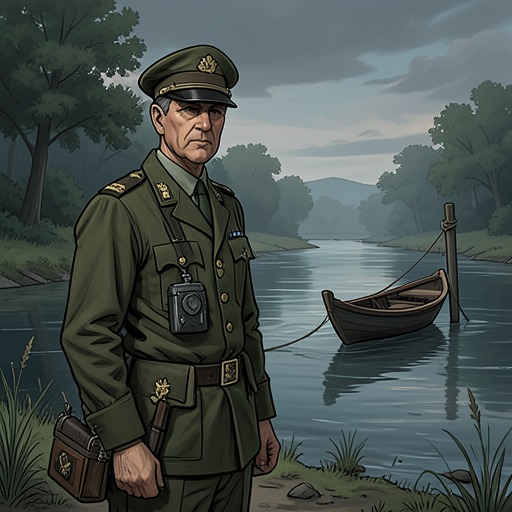
The village by the river lies only a few kilometres from the Swedish border, where the occupation is visible in the presence of a German patrol. The soldiers requisition a farmhouse near the church and shop, forcing its residents into an already crowded pensioner’s cottage. A guard is often posted at the gravel approach to the bridge. With a sub-machine gun over his shoulder, he smokes, scratches his flattened hair, or sits by the river while the rapids continue behind him. The narration stresses the disparity between the landscape’s unchanging flow and the guard’s enforced, watchful presence. To the soldiers, the war seems distant from this post; the Eastern Front is worse.
Occupation also depends on routine observation and the management of suspicion. The village’s residents know one another’s habits, and unusual behavior is noticed and entered into what the narration describes as a log book of each other’s lives. Trond’s father makes use of the same close-knit familiarity that makes concealment dangerous. He speaks German with the guards, learns where they come from and what they miss, and presents himself as an approachable handyman. Rather than acting as if the soldiers do not exist, he makes ordinary conversation part of his cover.
Resistance Beneath Everyday Cover
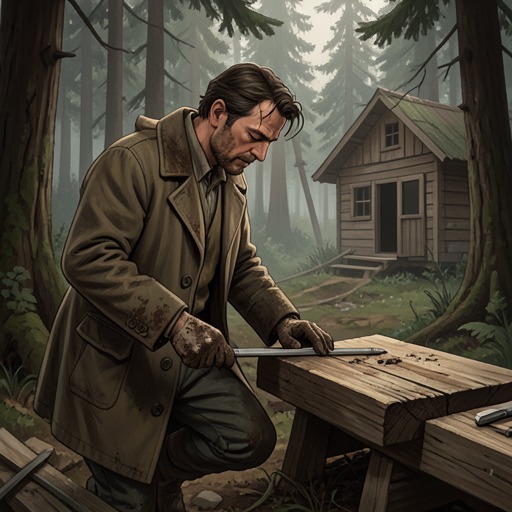
Franz tells Trond that in 1942 Trond’s father came through the forest seeking a place near the border from which he could travel to Sweden with papers, letters, and sometimes films for the Norwegian Resistance. He needed a place he could use repeatedly, and explained his presence as a search for somewhere to think. Only Franz knew the real purpose. Trond’s father established himself at Barkald’s farm, a neglected small farmstead, and gradually made himself look like a familiar local repairman.
The cover was made credible through work. He cleared and burned the remains of the byre, repaired the roof and chimney, replaced broken windowpanes, cleaned the riverbank, and made two chairs. After each journey to Sweden, he found another task to complete before returning to Oslo. The practical labor did more than improve the property: it built an alternative life in the village, one that Trond and the rest of his family in Oslo were not meant to know about. For more than five years, Trond’s father spent substantial time there while his family understood only that he went away and eventually came home.
The route depended on disguising the boundary crossing as ordinary local activity. Trond’s father crossed the bridge, spoke with the guard, and carried a bag that could be explained by his repair work. German soldiers searched the cabin, found tools and two books by Hamsun, and discovered nothing suspicious. At other times he avoided the bridge, walked along the road, then crossed the river by boat. The river and the Swedish border were not simply lines on a map: they were passages whose safety changed with patrols, darkness, weather, and the people available to help.
Trond’s father kept the route operating for two years, in summer and winter. When he was away from the cabin, people from the village sometimes completed the last leg across the border. Franz did so once or twice, and Jon’s mother carried out the work when she could get away. She also collected the concealed mail at the shop or from the bus, while food deliveries to the supposed handyman helped make her visits appear unremarkable. Jon’s father refused to participate, but did not openly oppose the work; when people or packages moved through his yard and barn, he looked away. The network therefore relied not on universal commitment but on carefully maintained silences, cover stories, and selective knowledge.
Exposure, Flight, and Retrospective Meaning
The occupation’s danger becomes immediate when a man in a suit is being moved near the river and German soldiers pursue the party. Franz, who has kept a detonator hidden beneath lifted floorboards, sees the motorcycle approaching and acts without hesitation. He slams down the device; the house shakes, and the bridge breaks apart, its planks falling toward the bank and into the current. The guard survives the blast but is left unable to hear. The bridge’s destruction is a direct material interruption of the patrol’s route, not merely a symbolic gesture: the soldiers and their motorcycle have to turn away from the crossing.
At the river, Jon’s mother struggles to get the suited man out of the boat as the soldiers close in. Trond’s father runs for cover among the trees and shouts for them to run. Warning shots strike the trunks before the soldiers fire directly; the suited man is hit and falls into the snow. The account presents resistance as perilous, improvised action rather than a clean passage to safety. The railway, road, bridge, river, and forest are all routes, but each can become a point of exposure.
Only years later does Trond understand what Franz’s account means. The father who had never spoken to his family about the war had built a second life in the village and served as the final link in a courier line to Sweden. The occupation thus reshapes Trond’s understanding of both his father’s absences and the apparently ordinary landscape of his childhood. In a later crossing toward Sweden, Trond and his father ride east from the ridge; the boundary looks much like the country they have left, yet Trond expects it to feel different. That movement echoes the wartime traffic while remaining a distinct journey. The border, like the occupation itself, is experienced not only as geography but as a change in what movement, silence, and belonging mean.