Horse
Out Stealing HorsesHorses are woven into the novel’s rural life as animals to ride, work with, and depend upon, but never as inert scenery: their speed, weight, habits, and reactions repeatedly alter what people can do. In the summer of 1948, Barkald’s horses give Trond and Jon an adventure that becomes a test of bodily courage; elsewhere, horses carry the demands of farm life and help turn the river’s timber work into a physical contest. Their recurring presence joins youthful exhilaration to labor, danger, and the memory of loss.
Rural Animals and Working Life
The horses belong to a landscape in which human work depends on close attention to animals and terrain. Barkald keeps horses in a paddock in the forest behind his farm, while other horses are used for transport and heavy work. Their bodies are described concretely: they breathe, sweat, stamp, toss their heads, and respond to pressure. The narrative gives those physical details weight in their own right, rather than treating a horse as a convenient means of carrying a human character from one scene to another.
That working relationship is especially visible beside the river, where Brona helps move logs. As the timber pile grows, the horse is brought down from the upper woods and positioned beside the water. Chains clank as the work proceeds, and Brona, dark and hot with sweat, makes circuit after circuit. She learns the route after a lap or two, so the reins can hang slack while Jon’s father accompanies her. The contrast between her practiced movement and the men’s strenuous labor gives the work its rhythm: the horse knows the circuit, while the people struggle to raise the logs higher.
The work also makes the horse’s physical presence intimate. Trond rests his forehead against Brona’s flank and breathes near her, registering the stiff coat against his skin and the strong smell of a sweating horse. In the city, he had encountered nothing like it. This is not an abstract pastoral image but a moment of bodily contact within a demanding job, in which the animal’s warmth and steadiness offer a brief pause before the labor continues.
Barkald’s Horses and the First Ride
Barkald’s horses stand at the center of the first adventure of the summer. Jon arrives at the cabin and proposes that he and Trond go stealing horses; the phrase names a private undertaking for the two boys, not a group expedition. The horses are in a forest paddock behind Barkald’s farm. To reach them, the boys pass through the barbed wire without tearing their clothes, then approach the grazing animals through the grass.
Jon assigns Trond a part in the plan: he climbs a birch tree whose lowest strong branch is three metres from the ground. From his perch, he watches Jon crouch near the horses and speak quietly to them. When Jon suddenly shouts and spreads his arms, the animals wheel around and run. Two break left; two charge toward Trond’s tree. The boys’ staged maneuver turns the horses’ ordinary movement into the dangerous center of the escapade.
Trond waits until the nearest horse comes beneath him, then drops from the branch onto its back. The landing is clumsy and painful: the horse’s shoulder bones strike him in the crotch, nausea rises, and he vomits while trying to keep hold of the mane. The horse accelerates into a gallop, with another following. Trond’s experience shifts from the discomfort and fear of controlling his body to a sudden exhilaration: he shouts as the horse carries him through the trees, and the hoofbeats seem to merge with a silence in which he can hear birdsong.
That exhilaration ends at the fence. The two horses turn sharply before reaching the barbed wire, but Trond’s momentum carries him onward and off the horse. He flies over the fence, catches his sweater on the wire, and lands in the heather hard enough to lose his breath. For a few seconds, he comes to without recognizing his own body or even knowing his name. The ride’s emotional swing—from nausea, to a moment of happiness, to a frightening fall—depends on the horse’s speed and the suddenness of its turn. The animal does not simply carry out the boys’ plan; its movement determines the outcome.
Bramina, Family Duty, and Danger
Bramina, the Haug family’s horse, is described with the practical specificity of an animal known through daily use. She is a fifteen-year-old bay, sturdy, with a white blaze and white socks. Jon thinks she may have hay fever because of her unusually heavy breathing. The journey to Innbygda and back takes most of a day, making her part of the family’s transport and routine rather than a figure reserved for dramatic scenes.
That routine is interrupted after Lars shoots his twin brother Odd. Their father has to leave to collect their mother, who had been given a lift to Innbygda the previous morning in the shop’s delivery van. With Odd’s body laid on the marriage bed and Lars standing stiff and silent in the hall, the father changes his blood-soaked clothes and harnesses Bramina. Jon walks slowly toward the stable and is there by the time the horse is between the shafts. His father seizes him by the shoulders, then recognizes that he has handled him too roughly; Jon says nothing. Bramina’s ordinary role as a horse for a day-long journey is thus bound to a scene in which the family must continue acting amid shock and grief.
In the account of the wartime escape, Bramina reacts to a stranger hidden in the barn. The man, brought to the farm in winter and made to wait through the daylight hours, eventually loses control, yelling and striking the barn with an iron bar. The animals in the adjoining byre grow restless: Bramina whinnies and kicks at the walls of her stall, while the cows call out. Her agitation becomes part of the practical urgency of the scene. The man cannot remain in the barn; he has to be moved upriver before his cries and the animals’ commotion draw further attention.
Return, Riding, and River Work
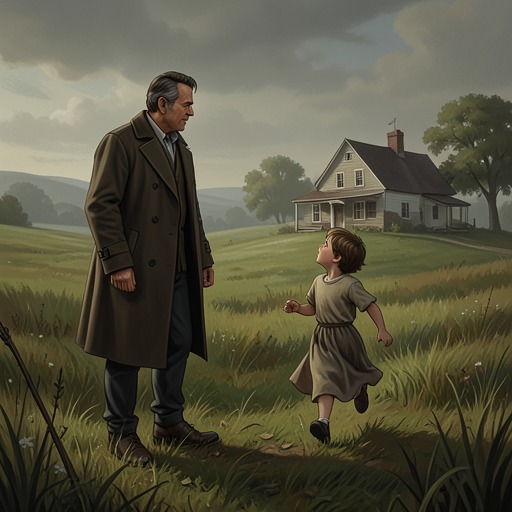
After Trond’s fall, his injured knee improves within a couple of days. One morning he hears horses snorting and stamping in the meadow behind the cabin and sees two animals grazing there: one bay and one black. He recognizes them as the same two he and Jon had ridden, though he cannot decide whether their reappearance is a good sign or a bad one. His father comes from the shed carrying a saddle and hangs it over a saw-horse. The scene returns the horses to view after the failed adventure, but now they are present in a quieter setting, alongside the possibility of riding with his father.
The return to riding forms part of the family’s effort to make the most of the remaining summer before going back to Oslo. Trond and his father set out on horseback toward Furufjellet, with breakfast behind them and saddle-bags, rugs, and anoraks packed for sleeping outdoors. The horses have been groomed and their manes shine. Their warmth against Trond’s thighs and the south wind against his face mark a different kind of ride from the frantic flight through the paddock: this journey is prepared, shared with his father, and directed into the landscape rather than away from danger.
Horses also provide the force needed to solve a problem in the river. When a jam of logs will not shift by hand, Trond identifies a log that can be loosened with a rope and insists that the horses can haul what the men cannot. He ties the ropes together, goes into the current, and secures a loop around the submerged trunk. Once he returns to shore, his father attaches the rope to the harness using a makeshift arrangement and urges the horse to pull. The first effort achieves nothing; on the next, a scraping sound comes from the rapids and the timber pile breaks forward, with log after log caught by the current. The horse’s pull turns Trond’s risky work in the water into a practical success, and his father’s nearly happy look confirms their shared satisfaction.
Narrative Significance
Across these episodes, horses connect different kinds of dependence. The boys’ confidence in their daring cannot control the speed or turn of a galloping animal; farm journeys rely on Bramina’s strength; and river work succeeds only when human ingenuity is joined to a horse’s pulling power. The animals’ reactions also register pressure that people may struggle to express, as when Bramina and the other livestock grow restless around the agitated stranger.
Their recurrence gives the novel a material sense of rural life: movement has weight, work has a pace, and danger may arrive through a sudden shift in an animal’s body. The same species can be a source of exhilaration, a means of carrying a family through its duties, and the force that frees trapped timber. Horses therefore bind together the summer’s physical adventures and its harder memories without becoming mere symbols; their specific actions remain consequential in the world the characters inhabit.