Jon’s gun
Out Stealing HorsesJon’s gun is a cherished hunting weapon whose accidental discharge kills his younger brother Odd. Its importance lies in the collision between care and neglect: Jon has treated the gun as a treasured possession and followed a strict routine for making it safe, but one moment of distraction leaves it available to Lars, who fires it without understanding the danger. In Trond Sander’s recollection, the weapon changes from a familiar instrument of skill into the material center of an irreversible family tragedy.
A prized possession and a practiced routine
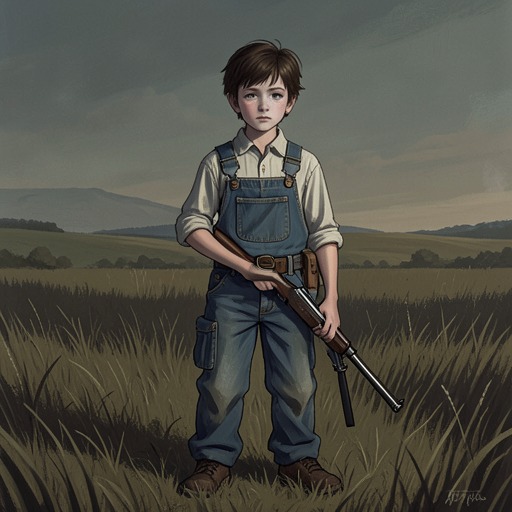
The gun is the only thing of value Jon owns. His father gave it to him for his twelfth birthday, with strict instructions about what it should and should not be used for. Jon has since polished it and kept it in good order as though it were a baby. Its place in his life is not simply practical: it represents a responsibility taught by his father and a skill that gives him a particular kind of pride.
That skill is evident in Jon’s hunting. The day before the shooting, he goes out as usual to hunt hares, a small and swift quarry at which he has become notably good. His usual success is one hare for every two shots; on this outing he brings home two hares after firing twice, a rare triumph that leaves him smiling. He hangs them by an ear on a cord, eager to show his parents. But his mother is visiting friends in Innbygda and his father is in the forest. In his hurry to find them, Jon overlooks who is home and remembers instead that he is responsible for the ten-year-old twins.
Jon’s ordinary safety procedure makes the lapse stark. When he comes home, he normally puts the gun at half-cock, removes the cartridges, and hangs it on a hook high inside the closet. This time he sets it down in the hall without taking out the last cartridge. The routine is precise, familiar, and usually protective; its failure is a single omission, not a general indifference to the weapon.
From admired object to fatal accident
The twins have spent the morning playing in the basement with cast-off clothes and worn-out shoes. When they come upstairs, they see the hares on the peg and Jon’s gun leaning against the wall. They know it belongs to their older brother, whom they admire and imitate. To them, the gun is bound up with being Jon: a powerful object that can turn play into a performance of his example.
Lars reaches it first. He swings it around, calls for attention, and pulls the trigger. The report and the recoil send him to the floor with a shriek. He has not aimed at anything; the shot could have struck the woodbox, the small window over the steps, a framed photograph of their grandfather, or the uncovered light bulb left burning so that someone outside in the dark could see the house. Instead, at close range, the bullet hits Odd in the heart. The gun’s familiar presence in the hall has become lethal before Jon can return to the house.
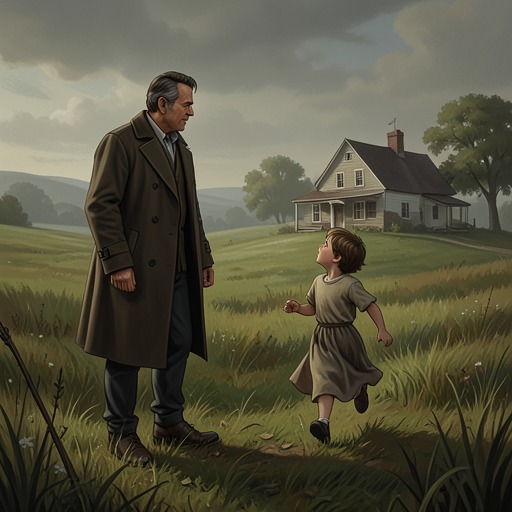
Jon is still near the river when he hears the shot. He splashes out and runs toward home, his wet trouser legs and shoes weighing him down. Halfway there, he sees his father running from the forest—something Jon has never seen him do. The sight tells him that something terrible has happened; he stops and sinks onto the grass, convinced it is already too late and unable to make himself go in. His father emerges from the house carrying Odd.
Responsibility, memory, and consequence
The account of the gunshot weighs against the idea that Odd’s death was written in the stars or determined by some power beyond human control. Trond Sander’s narration imagines the fatal instant as the kind of scene a Western might assign to destiny, then rejects that explanation: Jon knows that this is not how it happened. The gun was left loaded; Lars picked it up and fired; the shot struck his brother. The church registry book, where Odd’s name is entered and cannot be crossed out, records the consequence, but it does not make the accident inevitable.
Trond Sander also distinguishes the fixed event from the way its details live in memory. His father could not have told him everything in the full, vivid form in which he recalls it; he is unsure whether he began filling in the scene at once or did so over the years. He nevertheless insists that the basic facts cannot be disputed. The recalled details—the hares, the hall, the gun, and the run from the river—give the tragedy a sequence of ordinary actions rather than the shape of a fable about fate.
The gun’s meaning therefore changes without its physical nature changing: it remains the weapon Jon treasured, maintained, and used to hunt, but after the shot it can no longer be separated from the death of Odd or from the moment Jon failed to make it safe. Its ordinary place in the house is part of the horror. There is no distant battlefield or deliberate attack, only an unattended firearm, a younger brother’s imitation, and a family’s sudden loss.