Lars Haug
Out Stealing HorsesLars Haug is Trond Sander’s neighbor and, in the remembered tragedy at the center of his childhood, the boy who accidentally shoots his twin brother Odd with Jon’s gun. The novel brings the adult Lars back into Trond’s life decades later, making recognition itself an encounter with the past: Lars knows who Trond is, and Trond answers that he knows Lars too. Between those quiet words lies a death neither man can undo and a memory the narration can only partly reconstruct.
Identity and First Encounter
Trond and Lars have not properly introduced themselves when they meet outside in the dark. Trond raises his hand into the torchlight and gives his full name; Lars shifts his torch to his other hand and takes it. He identifies himself as “Lars. Lars Haug. With a g.” The exchange is conventionally polite, but its formality feels strange in the night. Trond compares his own greeting to the solemnly misplaced word his father once used at a funeral, while Lars appears not to register the awkwardness. Their first contact is therefore both ordinary—a handshake between grown men—and unsettled by the darkness and the histories that will surface around their names.
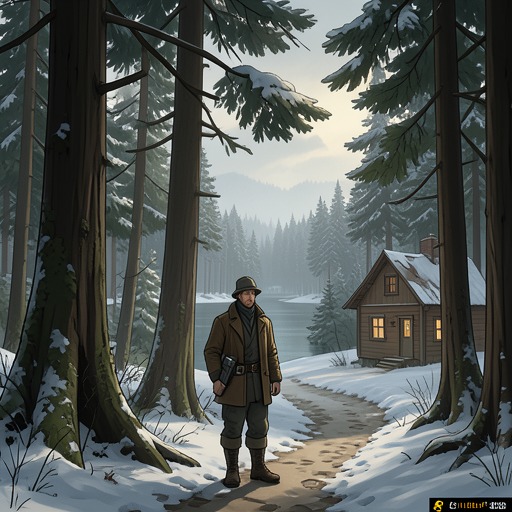
The weather has been rough, with days and nights of rain and wind among the pines and spruce, but the forest is now completely still. Trond feels a sudden cold down his back; Lars seems to feel it too, and points his torch beyond him. Poker stands rigidly on guard. Trond reads the dog’s posture as an expression of guilt, a feeling animals can show but dislike, and notices the contrast between the dog’s unease and Lars’s weather-beaten, lined face. The scene introduces Lars not through explanation but through a shared, wordless alertness in the forest.
The Childhood Accident
Lars’s defining childhood action takes place in a household where Jon’s gun has a strict safety routine. Jon has owned it since receiving it from his father for his twelfth birthday, along with emphatic instructions about what it should and should not be used for. He normally puts it at half-cock, removes the cartridges, and hangs it high in the closet. On this occasion, distracted by the responsibility of looking after his ten-year-old twin brothers, he leaves the gun in the hall without removing the last cartridge.
Lars and Odd have been playing in the basement with cast-off clothes and worn-out shoes. When they come upstairs, they see the hares hanging on a peg and the gun leaning against the wall. Jon is their older brother and their hero; his actions can become games for them to imitate. Lars grabs the gun, swings it around, and calls for attention. The recoil knocks him to the floor with a shriek. He has not aimed at anything in particular: the shot might have struck the woodbox, a small window, a framed photograph of their grandfather, or the bare light bulb left on so that people outside could find the house. Instead, it hits Odd in the heart at close range.
The narration explicitly resists turning the accident into destiny. It evokes the kind of story in which a victim’s name seems written on a cartridge or in the stars, then rejects that explanation: the shot was not directed by some power beyond human control. The distinction matters. The household’s ordinary objects and familiar safety habits frame the disaster, but no mystical account can make the responsibility disappear. Jon had forgotten the cartridge; Lars had pulled the trigger while playing at being his brother. The account gives the event its terrible contingency without making its consequence any less final.
Aftermath and the Limits of Memory
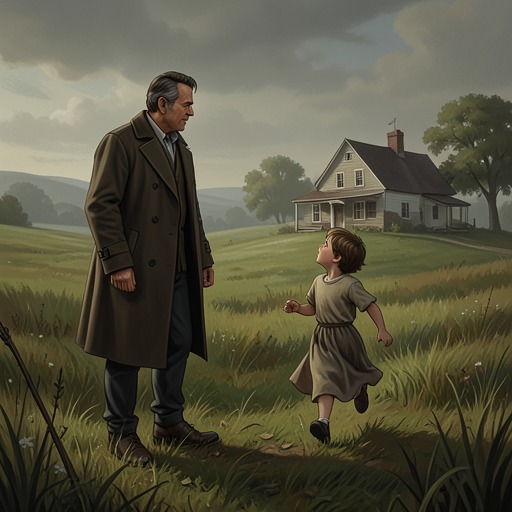
Jon hears the shot while searching for his brothers and runs from the river toward the house. Halfway there, he sees his father charge out of the forest. The sight is so frightening that Jon stops and sinks onto the grass, convinced that whatever has happened is already too late and that he does not want to see it. His father reaches the house first and comes out carrying Odd. The narrative gives no comparable account of Lars’s immediate response, and does not claim access to everything he experienced in the aftermath.
Instead, Trond’s account makes the uncertainty of recollection part of the story. He acknowledges that his father could not have told him every detail and that the remembered scene may have been filled in over the years, like a picture gradually completed. He distinguishes that imaginative reconstruction from the facts he regards as indisputable: the shot was fired, and Odd died. In the scene as Trond remembers it, Jon lies on the meadow grass watching the rain fall on the river. The church registry, rather than any imagined book of fate, is where Odd’s name becomes irrevocably recorded.
More than fifty years later, the narration speculates that Lars may have lain awake alone, unable to keep hold of his world, with the sound of the shot overwhelming other voices in the small house. The passage marks this as conjecture, not a witnessed certainty. Its careful qualification leaves Lars’s inner life partly inaccessible while conveying how the gunshot may have persisted beyond the instant in which it was fired. The novel does not reduce him to a single known reaction; it shows how the surviving evidence and the narrator’s memory can approach, but not fully occupy, another person’s experience.
Recognition Across Decades
At a later supper, Lars tells Trond that he knows who he is. Trond’s thoughts turn to the widely printed photograph taken after his wife’s fatal road accident: he remembers himself standing in icy rain, with the wrecked blue Audi and the stretcher carrying his wife behind him. He cannot tell whether Lars recognizes him from that image or from some other knowledge, and Lars does not explain. Trond replies that he knows Lars too. Lars nods, appears pleased, and returns to his meal; the exchange has given him the confirmation he wanted, without requiring a further account.
Their conversation leaves Trond ill at ease. The recognition is not explicitly an accusation, yet it feels close to one, and the men spend much of the meal in silence, glancing toward the yard as darkness falls. Lars nevertheless seems content and finishes his plate. Set against the childhood scene, this restrained meeting gives Lars a life beyond the moment of the shooting: he is now the neighbor at Trond’s table, capable of seeking acknowledgment in a few plain words. At the same time, the unelaborated recognition cannot settle what happened inside either man across the intervening years. The past returns not as a complete explanation but as a name, a shared knowledge, and a silence they can inhabit together.