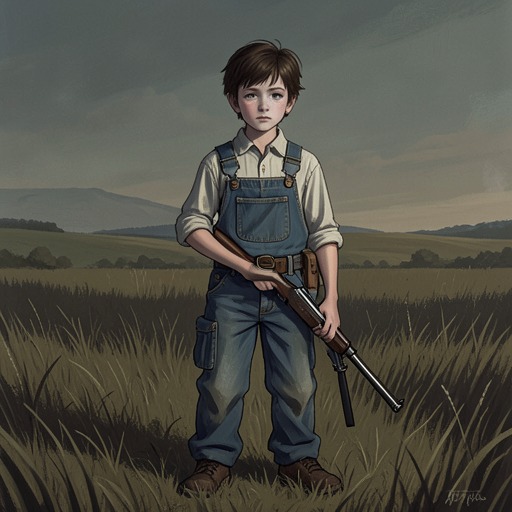
Lars accidentally shoots his twin brother Odd
Out Stealing HorsesLars Haug’s accidental shooting of his twin brother Odd is a death remembered through its irreversible consequences: an ordinary childhood bond is broken in an instant, and Jon loses one brother to the other’s gun. The novel does not stage the shooting itself. Trond Sander recalls it while working beside the older Lars, and later hears Lars name the act directly, confirming both the killing and its accidental nature.
Background and Circumstances
The recollection places the brothers’ last shared childhood scene in late autumn 1944. While their mother rowed upriver for her life, Lars rolled about on the kitchen floor, merrily mock-fighting with his twin. He did not know what was happening around him or what events might lead to. The juxtaposition makes the memory painful precisely because the children’s play is so ordinary: nothing in that moment suggests the later violence, and no one could know what was coming.
Three years later, Lars shot Odd with Jon’s gun. Trond’s account identifies the central circumstance that turns the death into an accident: Jon had forgotten to unload the weapon, and Lars did not know it was loaded. The text gives no further scene-by-scene account of the shooting, so its force lies in the brief, stark fact of the act and in the knowledge that its consequences cannot be undone.
The Event in Trond’s Memory
The shooting surfaces as Trond and Lars work together on a birch tree. Trond watches Lars handle a chainsaw systematically and with practiced balance, while thinking about how suddenly a body can be exposed to danger. The saw’s chain must remain an extension of the worker’s will, not the other way around; one instant of control can be followed by a crash that ruins everything. This present-day labor prompts Trond to imagine Lars’s mother in the earlier crisis and then to remember the killing of Odd.
The association does not equate the chainsaw with the gun. Instead, it makes Trond attentive to the terrible gap between ordinary action and irreversible injury. The people using dangerous tools may take care, but they cannot see every consequence in advance. Lars’s childhood ignorance of the circumstances around him returns, in altered form, in his ignorance that Jon’s gun was loaded. In Trond’s recollection, the later death casts a shadow backward over the twins’ play, while the play makes the death harder to reduce to a bare fact.
Consequences for Jon and the Brothers
The shooting changes Jon’s life as well as Lars’s and Odd’s. Trond recalls that he himself went to the river with Jon four years after the events of the wartime summer, and that Jon then disappeared from his life because one brother had shot the other with a gun Jon had forgotten to unload. The phrase that Jon was his brothers’ keeper gives the loss a further weight: Jon is linked to the weapon and to the brothers’ fate, though the account does not say that he intended or foresaw what happened.
The event therefore reaches beyond the death of Odd. A family relation is broken, and Jon’s friendship with Trond ends in the wake of a catastrophe Trond describes as having changed and destroyed everything in an instant. The narrative does not supply the brothers’ private responses or the details of what followed immediately after the shooting. Its emphasis is on the suddenness of the rupture and on how completely a single accident can reorganize the lives connected to it.
Confession and Retrospective Meaning
Years later, when Lars is with Trond, he says that he shot his brother. Trond turns back toward him and answers that he knows, that Lars did not know the gun was loaded, and that it was an accident. Lars agrees that he did not know and that the shooting was accidental. The exchange is brief, but it brings the event out of Trond’s inward recollection and into an acknowledgment shared between the two men.
Trond’s reassurance does not reverse the death or erase its consequences. It distinguishes the act from an intended killing: Lars fired the weapon, but he had not known it was loaded. Lars’s own admission confirms that distinction without diminishing the fact of what he did. Read together, the memory and the later conversation hold two truths in view—the fatal act belongs to Lars, and the circumstances made it an accident. That tension gives the event its lasting significance in the novel: it is at once an irreversible loss and an act that cannot be understood as deliberate murder.