Lars’s promise never to shoot a dog again
Out Stealing HorsesLars’s promise never to shoot a dog again originates in a farm incident in which he killed an Alsatian to stop it from pursuing two young roe deer. The vow returns when Poker growls at him in the dark: Lars recognizes the danger of another confrontation, but says he does not know whether he can keep the promise. The recollection links a past act of protection to a present moment in which the dog before him is no longer an abstract threat.
The Promise and Its Return
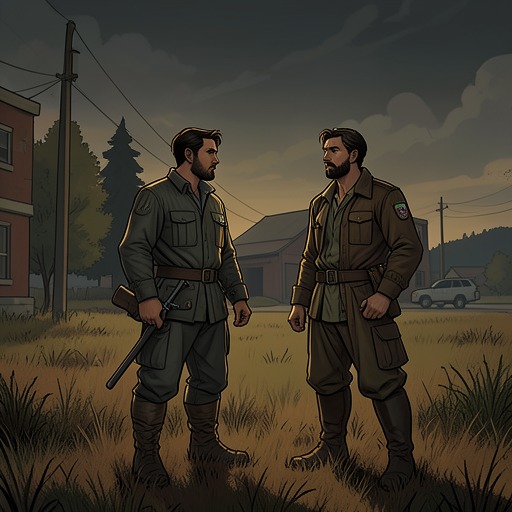
Lars tells Trond Sander that he has shot a dog once before and promised himself he would never do it again. The promise is personal rather than imposed by someone else; it expresses the limit Lars hoped to set after an experience that left him uncertain and distressed. In the present encounter, Poker’s growl makes that limit immediate. Lars stops advancing, lowers his torch toward the ground, and falters over what to do next. His admission that he does not know whether he can refrain from shooting shows that the vow has not resolved the danger confronting him.
The Farm Incident
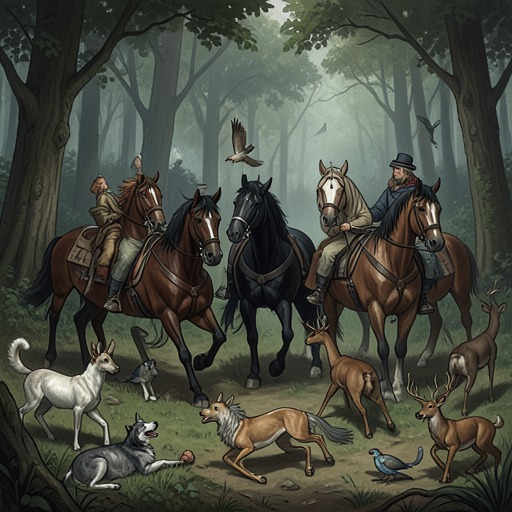
The earlier killing took place on the farm where Lars grew up. His mother first saw the Alsatian chasing two young roe deer that the family had often watched grazing near the north meadow. The dog circled them and bit at their hocks; exhausted and unable to escape, they were still being pursued when Lars’s mother could no longer bear to watch. She telephoned the bailiff, who told her the dog would have to be shot, then asked Lars to do it.
Lars did not want the task and says he hardly ever handled the gun. He nevertheless felt sorry for the roe deer and could not ask his mother to shoot the dog. No one else was at home: his older brother was away at sea, while his stepfather was in the forest felling timber for a neighboring farmer. Lars took the gun across the meadow. At the forest edge he could not see the Alsatian, and the quiet autumn day sharpened the isolation of the task. Looking back, he knew his mother was watching him from the house window and would not let him avoid it.
The Shooting
The two young roe deer suddenly ran toward Lars, too frightened or exhausted to change course. He knelt and raised the gun as they rushed past within a hand’s breadth of his shoulder. The Alsatian followed about thirty metres behind them. Lars fired immediately, but the dog kept running. A second shot brought it down on its knees; it rose and continued. Lars fired a third time when it was only a few metres away, and the dog somersaulted, fell with its legs in the air, and slid to his boots.
The dog was still alive, though paralyzed. Lars felt sorry for it and bent to pat its head, but it growled and snapped at his hand. He jumped back, became furious, and fired two more rounds into its head. The sequence explains why a promise followed: the first shots did not end the pursuit cleanly, and the attempted gesture of pity turned abruptly into a threat. The account does not present the killing as a simple, settled act of rescue; it ends with Lars’s anger and the dog’s death after it has already been disabled.
An Unsettled Vow
When Lars recounts the episode, Poker remains just behind Trond Sander, growling. Lars pauses and raises the torch toward the dog before continuing; his uncertain movement and bitten lip accompany the memory. Trond Sander feels sudden pity for him, a reaction he cannot locate in a particular source, and asks about the dog Lars had shot partly to calm his own trembling. The present danger thus brings the earlier scene back through both men’s responses: Lars cannot confidently say what he will do, and Trond Sander is affected by the vulnerability and uncertainty he sees in him.
The vow’s force lies in its incompletion. Lars remembers having made it, but Poker’s growl leaves open whether he can honor it now. The account establishes no further shot or resolution in this encounter; instead, the promise stands between remembered violence and a decision still pending.