Norway
Out Stealing HorsesNorway is presented through two connected landscapes: the far-eastern forest where Trond Sander lives alone in old age, and the river valley near the Swedish border where he spent the summer of 1948 with his father. The country is not simply a national backdrop. Its woods, waterways, roads, farms, and border crossings determine how people meet, work, hide, and leave.
Eastern Norway and the River Valley
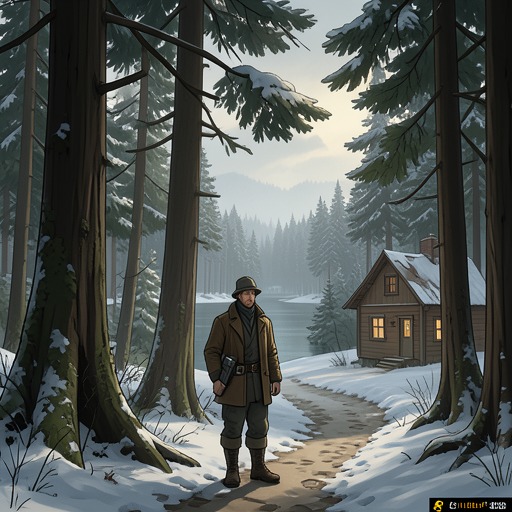
In the present-day frame, Trond lives in a small house in the far east of Norway. A modest river runs into a lake nearby, shallow in summer but brisk in spring and autumn, with trout in its waters. Its mouth lies about a hundred metres from his house; after the birch leaves fall, he can see it from the kitchen window. A cottage stands farther down by the river, occupied by an older man with a border collie. This close-set geography gives solitude a precise shape: Trond is alone in his house, but another life is visible across the wooded landscape.
The 1948 setting is also defined by water and forest. Trond and his father’s cottage stands among spruce, pine, and birch, with trees running down to the riverbank. A narrow, root-crossed track follows the river toward a wooden bridge and the village centre, where the shop and church are located. The river is also a working route: timber still moves downstream after the clearing is finished, while Jon and Trond dare each other to balance on the shining logs, sometimes scrambling ashore soaked and shivering nearly a kilometre from where they began.
Farms, Work, and Local Divisions
The river valley lies only a few kilometres from the Swedish border. Most residents are smallholders who rely on their farms, milk delivered to the dairy, and seasonal work as lumberjacks. Barkald, by contrast, is the district’s largest landowner. His farm has fields of oats and barley, a barn, and a large fenced forest where he keeps four horses. The contrast between his extensive property and Jon’s family’s smallholding is part of the local social landscape; Jon and Trond dislike Barkald, though the narrator cannot identify a particular offence behind their hostility.
The forest is both an economic resource and a sheltering terrain. Trond’s father owns land with pasture and trees, and Trond later understands that cutting the trees for timber is tied to his father’s need for money. He also suspects that his father has come to the river for time and quiet in which to plan a different life. The same wooded ground that can be sold as timber provides cover when violence reaches the riverbank.
Occupation and the Border as a Route
During the German occupation, the village’s bridge and roads are subject to military surveillance. A German patrol occupies a requisitioned farm near the church and shop, forcing its family into already crowded pensioners’ accommodation. Guards watch the gravel approach to the bridge, carrying sub-machine guns. The river remains audible behind them, but the bridge turns an everyday crossing into a controlled passage.
Franz’s house is part of the resistance landscape. When a motorcycle approaches, Franz retrieves a detonator hidden beneath floorboards and blows up the wooden bridge. The explosion destroys the crossing; the guard survives, but is deafened and disoriented. The blast transforms the bridge from a route of routine passage into an obstruction, briefly dividing the soldiers from those fleeing across the river. Its destruction also makes clear how the valley’s limited roads and crossings can become instruments of both occupation and resistance.
Leaving Norway
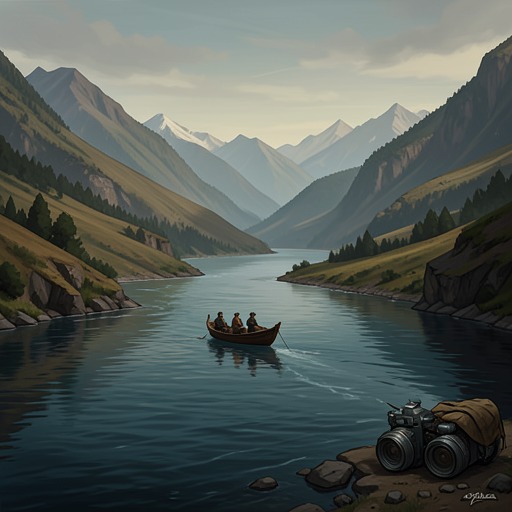
The borderland’s paths lead beyond Norway as well as through it. After the pursuit, Trond and his father ride horses toward the east. From the ridge, they look back across the river and valley before continuing down a steep, stony pass. Trond assumes they are heading for Sweden, and his father’s turn east confirms the direction. The crossing is not presented as arrival in a wholly different landscape: Trond expects the other side to look much the same, though he believes it will feel different because he has never been there.
Across these scenes, Norway is rendered as a place where geography carries changing meanings. The river sustains work and play, but can also impede flight; the bridge connects village life, then becomes a military checkpoint and a target; the forest is livelihood, concealment, and the ground from which a border crossing begins. The landscape’s continuity makes the changes imposed by occupation and departure all the more visible.