Norwegian Resistance
Out Stealing HorsesThe Norwegian Resistance is presented through the practical, perilous work of a courier line to Sweden, not through a detailed account of its hierarchy or wider operations. Its local route depends on a convincing civilian cover: Trond Sander’s father establishes himself at a neglected riverside farmstead, makes repeated crossings with papers, letters, and sometimes films, and relies on people who can move the final link without revealing the traffic. The secrecy is as much a matter of ordinary appearances as of border crossing; the same cabin work, shopping trips, and boat journeys that make the network possible also conceal it.
Purpose and local base
In 1942, Trond Sander’s father came through the forest looking for a place near the Swedish border where he could take cover, think, and return after trips across the frontier. His stated need for somewhere to think supplied a plausible explanation to local people. Only Franz knew the purpose behind it: the father needed a reusable base for the Resistance’s courier work.
Franz showed him a vacant summer cabin on the east bank of the river. The smallholding had been empty for four years after a foreclosure before the war; Barkald had bought it cheaply and owned the property, but had no use for it. Its position suited the work: the nearest bridge was a twenty-minute walk away, and beyond the farmsteads there were no other buildings until well past the Swedish side of the border.
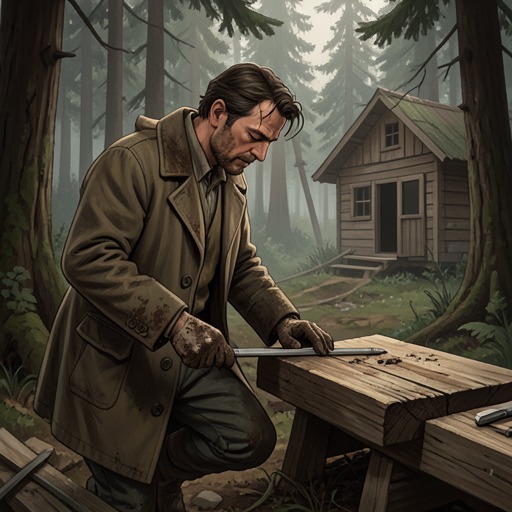
The father made the run-down place look like a legitimate undertaking by repairing it. He cut the grass, cleared and burned the remains of the collapsed byre, fixed roof tiles, cleaned the riverbank, renewed the gable boards, replaced broken windowpanes, mended the stove, swept the chimney, and made two chairs. Later he repaired cracked masonry around the chimney. These were necessary improvements to the property and a visible explanation for his presence: he was the handyman restoring Barkald’s cabin, not a courier using it as a base.
Cover and the appearance of routine
The cover extended beyond the repairs. The father stayed long enough for villagers to become accustomed to seeing him across the river, working on the roof or sitting by the water. He crossed Barkald’s meadow toward the shop with an empty bag and returned with supplies, sometimes around the arrival of the bus from Innbygda and Elverum. People saw a man restoring a property and making ordinary trips; the same routines helped disguise what the cabin was for.
The German patrol’s presence made that appearance consequential. A German patrol was stationed at a requisitioned farm near the church and shop, and a guard was often posted by the gravel approach to the bridge. The guard carried a sub-machine gun, but the father did not simply avoid him. He spoke German and chatted with the guards, learning where they came from and about their lives. The friendly exchanges helped make the father familiar rather than conspicuous, even as every passage near the bridge carried the possibility of being stopped or shot.
German soldiers searched the cabin three times. They found tools and two books by Hamsun, Pan and Hunger, but nothing suspicious. Barkald confirmed that the father had been assigned to restore the property, and the father’s border-residency certificate and other papers were in order. The cover therefore rested on several mutually reinforcing details: an owner’s account of the work, visible repairs, legitimate documents, and a presence that seemed unremarkable.
Couriers and concealment
The father kept the line going for two years, in summer and winter. When he was away from the cabin, someone from the village sometimes carried the final leg across the border. Franz did so once or twice, and Jon’s mother also helped when she could get away. The route was not the work of the father alone, but the evidence does not describe a formal local organization or a fixed roster of couriers; it shows a small, concealed chain of people taking turns with a dangerous task.
The transfer of the mail could be arranged around ordinary errands. Sometimes the father collected it directly from a bus or from the shop, before or after closing. At other times, Jon’s mother picked it up and carried it with food as she rowed upriver. Barkald often asked her to cook for the handyman, making her visit appear to be domestic assistance for a man supposedly unable to manage his own stove. The excuse worked precisely because it drew on familiar expectations and a plausible relationship to the cabin’s restoration.
The family in Oslo was not told about the father’s second life. Trond and the rest of the family knew that the father went away and came home, but not that he spent so much time in the village by the river or that the cabin served as a base for the courier line. Years later, Franz’s account gives Trond the information his father had withheld. The network’s secrecy thus shaped not only its dealings with the occupying force but also the family’s understanding of the father’s absences.
Surveillance, danger, and the border
The village itself acted as an informal system of observation. People knew one another’s routines, and anything out of the ordinary was noticed and recorded in what the narrator describes as a shared logbook of one another’s lives. That watchfulness could help conceal the traffic when a journey had an ordinary explanation, but it also made unusual behavior dangerous. The same close knowledge that made local assistance possible narrowed the space in which anyone could move unnoticed.
The river, bridge, and forest were working parts of the route rather than distant scenery. The bridge offered the most visible passage and was watched by armed guards; the river could be crossed by boat, while the forest provided cover. The father sometimes took the main road and then turned through the meadows along Barkald’s fence to row across. His movements depended on reading the terrain and the habits of those watching it, while the border remained both a geographic line and a guarded political barrier.
The danger becomes immediate when Franz uses a concealed detonator to destroy the wooden bridge. He had hidden the device beneath floorboards and acted when a motorcycle approached; after the explosion, the bridge lay shattered and a German guard was thrown into the snow, alive but unable to hear. Soon afterward, Jon’s mother and a suited man were pursued to the water’s edge by German soldiers. Trond’s father shouted for them to run and fled toward the river through the trees as shots struck the suited man. The scene shows how quickly a route sustained by patient cover could become a direct confrontation with armed patrols; it does not, by itself, establish the precise operational purpose of the bridge demolition.
Significance
The Norwegian Resistance’s local presence is defined by the double use of ordinary life. Repairing a roof, carrying food, collecting a parcel, or talking with a guard could all serve as cover for clandestine movement. The network’s effectiveness depended not on invisibility but on making its activity legible as something else, while the ever-present possibility of observation made each routine fragile.
The later movement toward Sweden echoes the route’s geography without fully explaining its purpose. Trond and his father ride east from the ridge, and Trond assumes they are going to Sweden; his father confirms the direction by turning his horse toward it. That crossing places the border again between familiar ground and an unknown other side, but the episode does not specify that this journey is a Resistance mission. Together, the cabin, river, bridge, and forest make the frontier a lived passage whose meaning changes with the people moving across it and the risks they carry.