Odd
Out Stealing HorsesOdd is one of ten-year-old twins whose death, caused by a gun fired by his brother Lars, leaves a lasting mark on their family and on Jon. He is introduced in the intimacy of ordinary childhood play, then remembered through the irreversible instant that ends it. The novel’s account makes his death neither an act of intention nor a destiny written in advance: it is an accident with a real weapon, a real victim, and consequences that remain long after the shot.
Identity and Family
Odd is Lars’s twin and the younger brother of Jon, whom the twins admire. Their hero worship gives Jon’s possessions a special force: the gun is not simply an object left in the hall but something associated with the older brother they imitate. The twins have spent the morning in the basement playing with cast-off clothes and worn-out shoes. Laughing, they stumble upstairs together into the corridor, where the hares hang from a peg and Jon’s gun leans against the wall.
The account gives little separate description of Odd’s temperament or appearance. Instead, it locates him within a close family arrangement: a child at home with his twin, looking up to his big brother, in a house where adults expect the children to be safe. That limited portrait matters. Odd is not presented as a character whose death follows from some concealed flaw or chosen danger; the scene begins in play, and the catastrophe intrudes upon it.
The Accident
Lars reaches the gun first. Wanting to hold it and imitate Jon, he swings it around and calls, “Look at me now!” He pulls the trigger without aiming at anything. The recoil and report knock him to the floor with a shriek, but the bullet strikes Odd in the heart at close range. The shot is unintended; its result is not reversible.
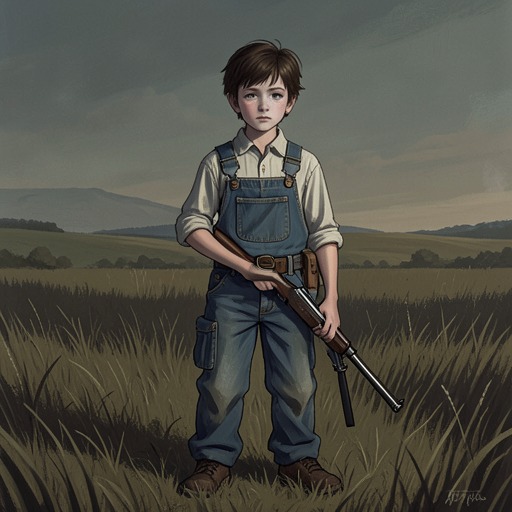
The gun’s condition is part of the accident’s concrete cause. It had not been made safe: a cartridge remained in it, although removing the cartridges and putting the weapon at half cock was the established practice. The gun was valuable to Jon, carefully maintained, and given to him by his father for his twelfth birthday with strict instructions about its use and, especially, its limits. The gap between that routine and the weapon left within reach turns a familiar household object into a lethal one. The twins know it as Jon’s gun, but their play does not include an understanding of what a loaded firearm can do.
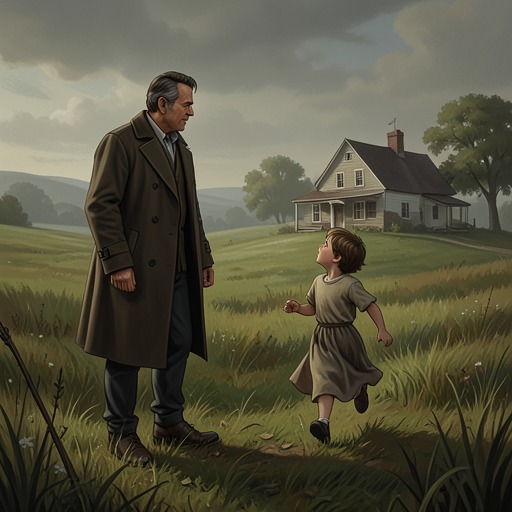
Jon runs from the river toward the house after realizing that the twins are alone. He sees his father race out of the forest and understands from the sight that something has gone terribly wrong; he stops and sinks onto the grass, unwilling to see what has happened. His father emerges from the house carrying Odd’s body. In the narrator’s reconstruction, Jon lies huddled in the meadow as rain falls on the river. The sequence joins discovery and helplessness: Jon knows the tragedy has happened, but arrives too late to prevent it.
The Family’s Immediate Aftermath
When the twins’ mother returns, she arrives smiling and greets the family as though she has come home to an ordinary welcome. Then she asks, “Where is Odd?” Jon looks toward his father, who stares at the barn wall and says nothing. He has not told her during their long journey through the forest. The silence does not undo the loss; it postpones the moment when it must be spoken aloud.
Odd’s funeral takes place three days later. The narrator, then a boy, attends his first funeral. He remembers not only the service but the strained encounter between his father and Jon’s father: they shake hands, yet do not look each other in the eye. The narrator’s father says, “Condolences,” a word that sounds foreign and that no one else uses that day. These spare details register grief through what the adults cannot comfortably say or meet directly. Odd’s death has become a shared fact, but not an easy basis for closeness.
Memory and the Meaning of the Death
The older narrator distinguishes the event’s certain facts from the way he pictures them. His father could not have supplied every detail, he acknowledges; the scene is “printed” in his memory, and he cannot tell whether he began filling in that picture at once or over the years. The uncertainty belongs to the reconstruction, not to the central fact: Odd was shot, and what happened cannot be contested. By making that distinction, the narration shows how a remembered death can acquire images and shape without becoming less real.
The account briefly evokes the language of westerns and destiny, imagining how a story might claim that Odd’s name was written on the cartridge or in the stars. It then rejects that consoling fatalism. Nothing supernatural directed the gun; the narrator insists that the event was not a line of fate that no one could have altered. The only book in which Odd’s name is finally written and cannot be crossed out is the church registry. That contrast preserves both the accident’s human cause and the permanence of its outcome.
Years later, Lars tells the narrator, “I shot my brother, I did.” The narrator replies that Lars did not know the gun was loaded and says, “It was an accident.” Lars confirms that he did not know. The exchange does not make Odd’s death smaller, nor does it erase the fact that Lars fired the shot. Instead, it brings the defining distinction into the open: Lars caused his brother’s death without intending it. Odd remains the absent center of that distinction, the child whose ordinary game ended in a loss his family could neither prevent in time nor simply put behind them.