Odd's funeral
Out Stealing HorsesOdd’s funeral, held three days after his death, is remembered by Trond Sander less as a formal rite than as a day of strained silences and grief that could not be contained. At the open grave, Lars runs in circles while the coffin is lowered; in that spectacle, Trond understands that the boys’ life of stealing horses together with Jon has ended.
Background and remembrance
Trond remembers the funeral as his first. His mother’s brother had been shot by the Germans while trying to escape from a police station somewhere in Sørlandet in 1943, but Trond had not witnessed that death and did not even know whether there had been a funeral. The contrast matters: Odd’s burial is not an indistinct report of wartime loss but an event Trond sees directly, with gestures and silences that remain vivid in memory.
His father asked whether they should attend, and Trond said yes. The funeral took place three days after Odd’s death. Trond later introduces his recollection as two remembered things, then corrects himself when the scene with Lars and Jon adds a third. The slight self-correction gives the memory its shape: the service is recalled not as a complete account of the day but through a few charged details that continue to matter to him.
The fathers’ silence
One of those details is the meeting between Trond’s father and Jon’s father. They did not look one another in the eye. Trond’s father shook the other man’s hand and offered condolences, using a word that sounded foreign and that no one else used that day; still, the two men avoided each other’s gaze.
The handshake therefore does not resolve the distance between them. The formal act of sympathy and the refusal of eye contact coexist, leaving Trond with an image of condolence constrained by an unspoken strain. The memory records what the men do, and what they will not do, without explaining the cause of their estrangement.
Lars at the open grave
The most public moment comes outside the church, beside the open grave. As the priest continues the ceremony and the little coffin is prepared to be lowered on ropes attached to its handles, Lars grows increasingly restless. He tears himself free from his mother and runs among the headstones, then circles near the churchyard’s stone wall with his head bowed and his eyes on the ground.
The ceremony and Lars’s flight unfold against each other. The longer he runs, the more slowly the priest speaks. A few people in the black-clad gathering turn to look; gradually the whole group turns from the coffin to Lars. The funeral’s attention shifts from the dead boy to his living twin, whose distress has become impossible for the mourners to overlook.
A neighbour quietly crosses the grass and catches Lars as he runs past, lifting him up. Lars’s legs continue running, but he makes no sound. Trond’s memory preserves both the physical motion and the silence: the attempt to flee persists even after the neighbour has stopped him, while grief finds no spoken expression in the scene.
The end of the boys’ pact
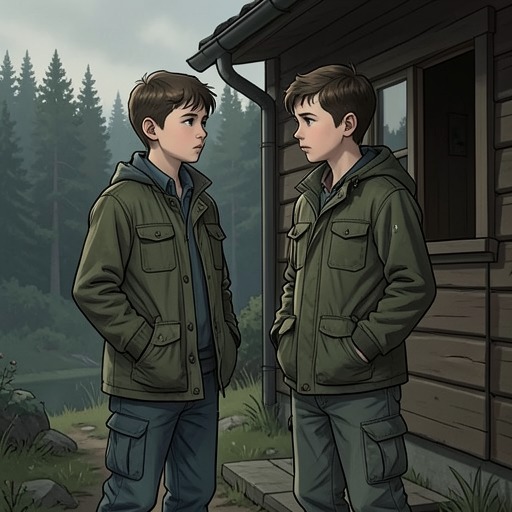
Trond looks at Jon, and Jon looks back. Trond gives a slight shake of his head; Jon makes no answering sign and stares straight into his eyes without blinking. In that exchange, Trond thinks they will never go stealing horses together again. The end of their shared adventure arrives not through a spoken agreement but through the funeral, the sight of Lars running, and the look between the two boys.
Trond says this realization made him sadder than anything else that happened in the churchyard. The funeral thus marks more than the burial of Odd: it fixes, in Trond’s recollection, the loss of a childhood partnership and the change brought by death into the boys’ lives. His final count of three remembered things holds together the fathers’ averted eyes, Lars’s desperate circling, and the silent recognition between Trond and Jon that their old world has ended.