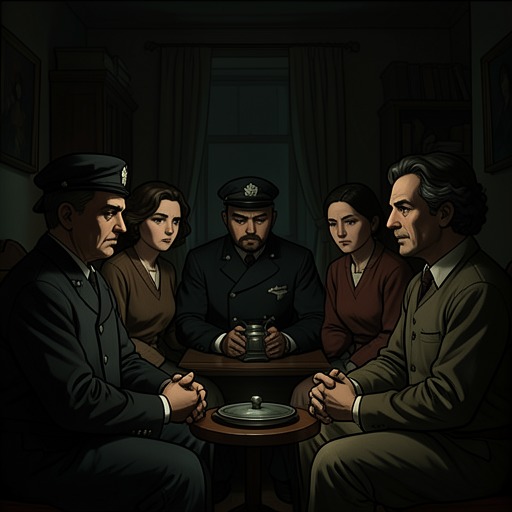
Secrecy and cover practices on the resistance route
Out Stealing HorsesSecrecy and cover practices on the resistance route made Trond’s father’s work between Norway and Sweden possible by giving it the appearance of ordinary rural labor and keeping its purpose from even his own family. The system relied on a neglected farmstead, predictable routines, credible paperwork, and help from people who could complete the final leg of a delivery without making the hidden traffic visible to the village at large.
A farmstead made into cover
In 1942, while searching for a place to think and to use as a hiding place and base for trips into Sweden, Trond’s father was shown a vacant summer cabin by Franz. The smallholding had been empty for four years after foreclosure. Barkald had bought the property cheaply, but it was of little use to him: the cow byre had collapsed and there was no herd. Its situation made it useful for the courier line. It stood on the east bank of the river, a twenty-minute walk from the nearest bridge, with no other building beyond the farmsteads until well past the Swedish border.
The cabin’s condition gave Trond’s father a convincing reason to stay and work. He cut the grass, cleared and burned the byre’s remains, repaired roof tiles and the roof itself, replaced broken windowpanes, renewed the gable boards, cleaned scrub from the riverbank, mended the stove, swept the chimney, made two chairs, and repaired cracked masonry around the chimney. These were real jobs, not a fabricated occupation: the repairs improved the property while making his presence there look legitimate. Work that he lacked time and freedom to do in Oslo supplied a practical cover for repeated stays in the village.
The cover developed gradually. Trond’s father had initially intended to stay only long enough for people to grow accustomed to seeing him across the river, working on the roof, in the yard, or sitting beside the water. After each trip to Sweden, he found further repairs to make and stayed longer. Over a couple of years, the handyman’s recurring tasks helped him establish an alternative life at Barkald’s smallholding—one that his family in Oslo did not know existed.
Routine, papers, and inspection
The appearance of ordinary work was reinforced by ordinary movement. Villagers might see Trond’s father cross Barkald’s meadow with an empty bag on his way to the shop around the time the bus came from Innbygda and Elverum, then return with supplies. At other times he walked along the main road carrying a somewhat fuller bag, turned into the meadows by Barkald’s fence, and rowed across the river. He waved to Germans and Norwegians he passed, and no one stopped him.
The explanation for his presence was available for others to check. Barkald confirmed that Trond’s father had been assigned to restore the cabin. German inspectors had visited the property three times. They found tools and two books by Hamsun, Pan and Hunger, but nothing they considered suspicious. Trond’s father’s border-residency certificate and other papers were in order, and his trips away could be explained by his work on several similar projects. A plausible identity, visible labor, and valid documents supported one another: none alone made the hidden purpose apparent.
The method did not depend on every journey being invisible. On the contrary, familiarity helped make movement seem unremarkable. People knew the man as Barkald’s handyman, saw him traveling at intervals, and could understand his absences as work-related. The routine made the bag, the river crossing, and the trips away part of an established pattern rather than isolated anomalies.
The courier line and its helpers
Trond’s father kept the line operating for two years, in summer and winter. When he was not at the cabin, someone from the village could carry the final leg across the border. Franz did so once or twice; Jon’s mother helped when she could get away. This local participation extended the route beyond Trond’s father’s own movements, but it also carried considerable risk. In the district, people knew one another and one another’s habits. Anything out of the ordinary was noticed and could be recorded in the community’s informal logbook of each other’s lives.
The mail itself moved through more than one arrangement. Sometimes Trond’s father collected it directly from a bus or at the shop, before or after closing time. At other times Jon’s mother collected it and took it with her when she rowed upriver with food. Barkald often asked her to cook for the handyman, making her visits appear to be domestic assistance rather than part of the courier system. She came once or twice a week, with food or without it, and with mail or without it. The variability helped preserve the ordinary explanation: a visit to feed a man living alone did not announce whether a delivery was also being made.
The food cover drew on a recognizable local expectation. Barkald presented Jon’s mother’s help as necessary because the handyman needed proper meals to stay strong enough for his work. That explanation disguised her role in transporting mail by attaching it to a plausible domestic task. Trond knew his father could cook well, but he did not know the larger purpose of the visits or the traffic they sometimes concealed.
Secrecy and its cost
The most consequential concealment was within Trond’s family. Trond’s father had spent as much time in the village by the river as beside the Bunnefjord, yet Trond, his mother, and his sister were not supposed to know the base or the route. To them, their father went away and eventually came home, sometimes after a week, sometimes after a month. The family learned to live without him from one day to the next, without knowing where he had been. The secrecy that protected the operation therefore also shaped family life through unexplained absences.
Franz’s account reaches Trond only later, when Franz explains how the cover had worked. Trond hears that his father had been nearly a resident in the village, and wonders why Jon, Jon’s mother, Barkald, or others had never told him. He does not ask. The delayed revelation makes the route’s secrecy legible in retrospect: the concealment had succeeded not because the village saw nothing, but because its visible details could be read as repairs, errands, meals, and ordinary travel. In this system, routine was both the disguise and the discipline; the same close familiarity that exposed deviations also made a carefully maintained pattern credible.