The 1944 rescue, bridge bombing, and escape to Sweden
Out Stealing HorsesThe 1944 rescue, bridge bombing, and escape to Sweden brings together the covert river traffic of the German occupation of Norway and the choices made when concealment fails. Recounted by Trond Sander as a remembered episode, it follows Jon’s mother as she tries to move a distressed man past German patrols, Franz as he destroys a bridge to obstruct their pursuit, and Trond’s father as he helps Jon’s mother flee across the border. The rescue succeeds only in part: the man is shot, while the two people who reach him leave their home and documents behind for Sweden.
The route and the man in hiding
The operation takes place within a clandestine traffic route that carries people as well as mail toward Sweden. Jon’s father refuses to take part, but he does not openly oppose the work. Instead, he repeatedly looks the other way: when Jon’s mother rows upriver in the red-painted canoe, and when a strange man with a tightly lashed suitcase is brought into the barn at twilight to wait for darkness. His silence provides a form of cover without making him an active participant.
The rescue begins on a snowy day in late autumn, when the river remains free of ice and can still be rowed. Before dawn, a man in a suit walks from the main road to Jon’s family’s farm. His summer shoes and thin soles are unsuitable for the cold; he is shaking when Jon’s mother meets him with a blanket and takes him into the barn. He has to remain hidden in the hay through the daylight hours, for about twelve hours, until evening makes movement less visible.
The wait becomes impossible. At two o’clock, the man breaks down, shouting and striking about him with an iron bar. The noise carries across the still air; Bramina kicks in her stall, the cows grow restless, and German patrols pass along the road several times a day. The danger is no longer only that the stranger might be discovered: his distress threatens to draw attention to the farm and the people sheltering him. Jon has not yet returned from school, and the twins are playing in the kitchen when their mother decides he has to be moved immediately.
The choice to move him
Jon’s mother dresses warmly and goes to the barn while her husband wakes and watches from the house. She brings the man out wearing his suit and summer shoes, now with a jumper beneath his jacket and the gray bag on his back. His earlier outburst has passed, leaving him exhausted and unsteady. Their footprints in the snow expose the route from the house and lane to the barn; the stranger’s shoes, conspicuous in winter, make the tracks especially difficult to mistake.
When he urges her to hurry, she looks back at her husband and tells him that he must walk in another person’s footprints and has no choice. He stiffens at her words, but she does not see his reaction. She and the stranger continue to the jetty and take the boat upriver. Jon’s father remains in the house, listening as they board and the oars begin to move. He understands that his wife is again going to visit the man from Oslo at the cabin, and that the immediate danger is now unfolding in daylight. He chooses to close the door rather than join her. The episode presents that decision as a consequential silence: he lets the rescue proceed without sharing its risks.
The bridge is destroyed
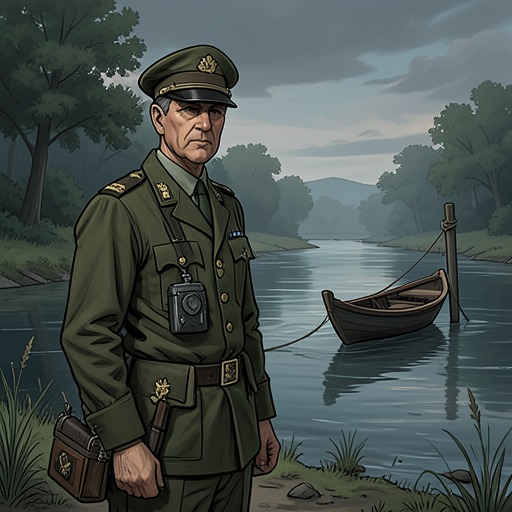
At the cabin, Trond’s father is working in an outhouse, unaware that Jon’s mother is approaching with the stranger. Meanwhile, Franz stands at home by an open window, thinking over his solitary life as the room, heated by his fire, grows too hot. Across the river, a guard waits near the bridge; the bridge is about fifty metres from Franz’s house, with the guard roughly twenty metres beyond it on the opposite bank. A motorcycle appears on the road, and the changing light allows Franz to recognize what is coming.
Franz has prepared for this moment. He runs inside, lifts a section of floorboards beneath a rag rug, and takes out the detonator hidden there. After checking the leads, he activates it. The blast shakes his house and breaks the wooden bridge apart. Planks tumble toward the bank and river, while the guard is thrown down in the snow. He survives, but cannot hear; the motorcyclist helps him back to the motorcycle and sidecar. Instead of returning to the farm where the patrol is billeted, they ride toward the river, force their way through a gate, and cross a snow-covered field.
The pursuit and escape
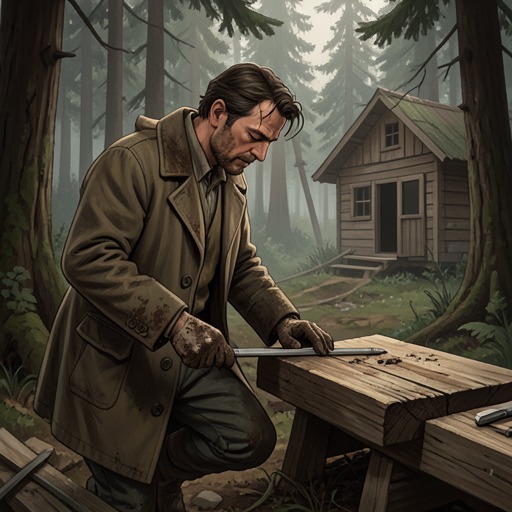
Jon’s mother reaches the cabin’s landing and hauls the boat far enough ashore to keep the current from taking it. The stranger tries to climb out too soon, falls, and hits his head against a thwart. As she pulls him from the boat, the motorcycle arrives across the field. Trond’s father rushes out of the shed, sees the soldiers approaching, and recognizes the danger. The soldiers order them to stop at the riverbank; crossing the cold, deep water would leave them exposed and could carry them downstream.
Trond’s father tells them to run and moves through the trees for cover. The soldiers first fire warning shots, then shoot at the man in the suit, whose dark jacket stands out against the snow. He drops the bag and falls; after being hit again, he slides down the slope until one summer shoe reaches the water. Jon’s mother is told to retrieve the bag. She runs bent over toward Trond’s father and reaches the cabin unharmed. The soldiers’ fire slackens, but the danger continues: more vehicles arrive across the field, and troops run toward the river.
Inside the cabin, Trond’s father and Jon’s mother gather their most important belongings and the documents he has hidden. He packs what they need into the stranger’s bag and wraps it in a sheet. Rather than leave by the obvious route, they climb out through a rear window and flee together toward Sweden, more or less hand in hand. The rescue has not saved the stranger, but it has helped the two remaining participants escape with the documents. Its ending is a flight from the cabin and the life they had there, not a return to safety at home.
Recollection and significance
The scene is narrated as a memory rather than a detached account of military action. Trond Sander reconstructs the episode through particular images—the strange shoes in the snow, the boat moving against the current, Franz’s hidden detonator, and the broken bridge—while acknowledging uncertainty about what was said during the pursuit. The shift from the earlier quiet movement of people along the river to open pursuit and gunfire makes the precariousness of the traffic visible: secrecy can delay discovery, but a single breakdown or approaching patrol can overturn the plan.
The event also sets different forms of responsibility against one another. Jon’s father avoids participation by looking away; Jon’s mother acts despite the danger; Franz uses a device concealed beneath his own floor to destroy the bridge; and Trond’s father leaves the shelter of the cabin to help her. Their actions do not undo the man’s death, but they change what can happen next. The crossing to Sweden brings the rescue’s immediate story to a close, while the remembered details preserve the cost of the choices that made escape possible.