The Top
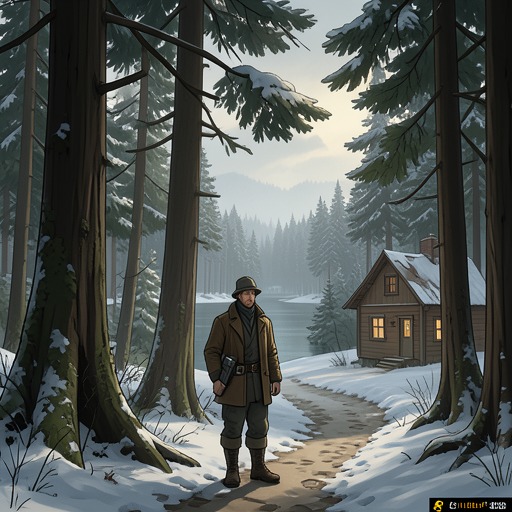
Out Stealing HorsesThe Top is Trond Sander’s small, secluded house in the far east of Norway, named for its view over a lake. He intends it to be his final home, and its surrounding woods and water make solitude feel both chosen and sustaining. Yet the nearest cottage belongs to Lars, a man Trond knew as a child. The house is therefore not simply a retreat: as the seasons shape its routines and Lars re-enters Trond’s life, its threshold becomes a boundary between a self-contained present and a past that has not stayed behind.
Setting and Approach
The house stands near the meeting of river and lake. The river is modest and becomes shallow in summer, but runs briskly in spring and autumn, with trout that Trond has caught himself. Its mouth lies about a hundred metres from the house. From the kitchen window, the river becomes visible once the birch leaves have fallen, making the view change with the season rather than remain fixed. A cottage sits lower down by the river; when its lights are on, Trond can see them from his doorstep. Lars lives there with a border collie.
The surrounding land is not an abstract wilderness but a working, inhabitable landscape. Trond has a yard with a bird table on a pole, and watches birds arrive there over morning coffee. He has seen eight species, though only the titmice strike the window. The lake, forest edge, yard, shed and river each enter his ordinary awareness at a different distance. In November, he watches the light over the trees and the shape of wind on the water; in the evening, the blue-hour light seems to draw the shed, woods and lake together. The landscape offers a sense of connection, although Trond remains unsure whether that impression is true or merely consoling.
A Home Made Through Routine and Labor
The Top is defined as much by maintenance as by its view. Trond’s plan is to make it his last home, but he takes the future one day at a time. Winter makes the practical limits of the place plain. The road down to Lars’s cottage is two hundred metres long, followed by another fifty metres to the main road. Trond’s bad back would make clearing that stretch with a shovel impossible, even if his back were as strong as it had ever been. The district Co-op is six kilometres away, so a reliable car battery matters in severe cold, as does keeping enough wood for the stove.
There are two old panel heaters in the house, but Trond suspects they consume more electricity than the heat they provide. He could buy modern oil-filled radiators, but prefers to do without heat he cannot produce himself. The old birchwood in the outhouse is insufficient and so dry that it will burn quickly. He has already begun using it, and cuts down a dead spruce with a chainsaw so he can saw it into pieces, split it into logs and stack them before it is too late. At midday he lays out the saw, file, ear protectors, petrol and two-stroke oil on the flagstone, makes coffee in a Thermos, changes into warm work clothes and sharpens the chain tooth by tooth. The deliberate preparation turns self-sufficiency into a daily practice rather than a declaration.
That work also places the present house beside an earlier landscape of labor. Trond reflects that he did not learn to sharpen a chainsaw from his father: in the Norwegian forests of 1948, one-man saws had not arrived. Timber was felled with a cross-cut saw and hatchet, by several men, with a trained horse and a chain tow to the river. The contrast makes the modern tool at The Top a point of contact with, and difference from, the labor remembered from his father’s time.
Access, Neighbors, and the House’s Threshold
The road’s vulnerability is partly resolved through a practical connection to the surrounding community. At the shop, the mechanic gives Trond the name and number of a nearby farmer with a tractor who clears his own road and can clear Trond’s as well. The suggested payment is fifty kroner each time. Trond accepts the arrangement as reasonable. A small yellow note with the contact details makes the immediate future feel much less complicated, and he feels at ease on the drive home. The Top may be remote, but living there depends on workable relations with people beyond its yard.
The house is also a place from which Trond watches the life around him without initially recognizing its importance. He first passes Lars while walking Lyra and merely nods. Even when Lars tells him his name, it does not register. Only later, after recalling a face seen wavering in torchlight, does Trond realize that this neighbor is the boy he last saw at ten, now more than sixty. The recognition unsettles his sense of having chosen a location freely: of all the places he could have moved, he has landed precisely here. He rejects the idea that fate governs people’s lives and insists on taking responsibility for the life he has shaped, yet the coincidence makes no difference to his plan while still making some difference to how the place feels.
That difference becomes physical when Lars comes to the door. Trond has begun supper alone, following rules he considers important: potatoes, sauce and green vegetables, a napkin and clean glass, candles on the table, and no sitting down in work clothes. He has changed into a clean white shirt and is eating fish caught in the lake when he hears a knock. No car has announced the visitor, and no one has called at the door since Trond moved in. Lars stands outside, with Poker sitting unusually still in the yard. In the blue light both man and dog seem stiff; neither looks Trond in the eye at first. After Lars leaves, Trond clears a table that has held two plates for the first time in the house and recognizes his response as feeling invaded—not by just anyone. The interruption gives the home’s solitude a precise limit: it is private, but not untouched by the neighbor and the history he carries.
Narrative Significance
The Top gathers the book’s contrasts into one lived setting. It is a chosen refuge, yet it cannot fully separate Trond from other people; its practical demands encourage independence, yet snow clearing requires help from a farmer; its surrounding landscape offers moments of consolation, yet the returning Lars makes the past present at the front door. Seasonal visibility reinforces that tension: the river can be seen from the kitchen only after the birch leaves fall, while a light in Lars’s cottage is visible from the doorstep after dark.
The house’s meaning is consequently built through repeated acts of looking, preparing and maintaining. Trond watches birds, follows the weather, tends the stove and works to secure fuel, while the view across the lake gives the property its name. But the knock at supper changes the emotional charge of those routines. The Top remains the home Trond means to keep, not a refuge that erases history. Its location makes room for both: a daily life ordered around work and solitude, and the unexpected presence of a neighbor who connects that life to Trond’s childhood.