The goldcrest’s nest and eggs
Out Stealing HorsesThe goldcrest’s nest and eggs are a delicate natural object whose discovery turns into an unsettling rupture between Trond and Jon. Found high in a spruce, the tiny nest first offers Trond a concentrated image of life poised to begin: an egg held in the hand, soon to become a bird able to fly. Jon’s sudden destruction of both egg and nest reverses that promise. Trond cannot explain what provokes the change, and the scene remains with him as both an unresolved memory and a pattern through which he later imagines death.
Finding and Form
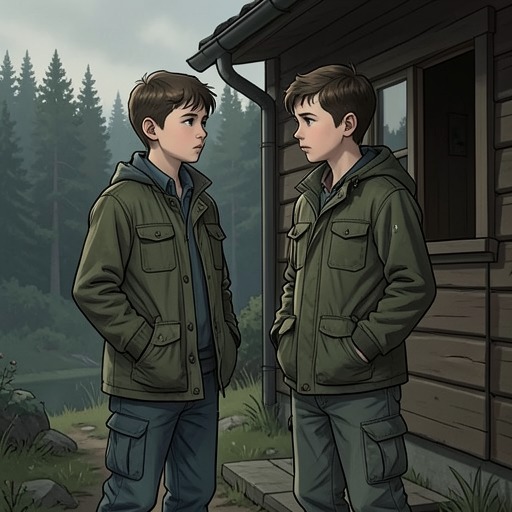
Jon points out a large spruce beside the path, but the tree itself is not what he wants to show Trond. He climbs first, moving several metres up before stopping at about ten metres to wait until Trond has reached the same height. The pause lets them sit side by side on a broad branch; from there, Jon indicates a fork farther along his branch. A tiny nest hangs in it, shaped like a deep bowl or cone and made of moss and feathers. Its suspended position makes it seem almost to hover rather than rest on the branch.
The nest’s smallness is central to Trond’s attention. He has seen nests before, but not one so minute and carefully formed. Jon identifies it as a goldcrest’s nest from a second brood. He reaches into the feather-lined opening with three fingers and lifts out one egg, balancing it at his fingertips so Trond can examine it. The scale of the object gives the encounter its force: what Jon holds is barely larger than a small oval, yet Trond imagines it becoming, within a few weeks, a bird capable of rising from the high branches and flying away.
The Encounter in the Spruce
For Trond, the egg makes the transformation from inert object to living creature difficult to comprehend. He voices his astonishment at the possibility that something so small can come alive and fly. The thought is less expansive than the feeling it expresses, but it marks the moment when the egg becomes more than an example of wildlife: Trond sees it as a life about to begin, and his sense of wonder is immediate.
Jon’s response is a startling reversal. His face becomes strained and pale; he looks directly at Trond with an intensity Trond has not seen from him before. Trond cannot tell whether his words or the egg in Jon’s hand has brought about the change. That uncertainty matters: the scene supplies no explanation that would settle the cause. The object is present in Jon’s hand at the turning point, but Trond is left unable to connect the action to a motive.
Jon opens his hand and lets the egg fall. It strikes a lower branch and breaks. The nest follows: Jon tears it from the fork and crushes it in his hand, then presses his palm against the trunk and rubs away what remains. In a few gestures, the object’s fine construction and its promise of a future are undone. Trond watches without being able to speak. The same nest that had seemed to hover is reduced to fragments and residue on the tree.
Destruction and Immediate Aftermath
After destroying the nest, Jon descends quickly without looking up at Trond. Near the ground he lets himself drop the remaining distance, lands, and sinks to his knees. He stays folded there for a long time before standing stiffly and walking down the path. The sequence leaves Trond above him, still in the tree and unable to understand what has happened. He feels that he is somehow at fault, although he cannot identify why.
Trond’s descent is slower and more deliberate. Rather than following Jon rapidly, he treats each branch as a point to hold on to, concerned with not missing anything important. By the time he reaches the path, Jon has disappeared. A storm begins soon afterward, but the account does not establish it as an explanation for Jon’s conduct or as a consequence of the nest’s destruction. The two occurrences instead remain close together in Trond’s recollection: the abrupt devastation in the spruce, Jon’s departure, and the weather changing around him.
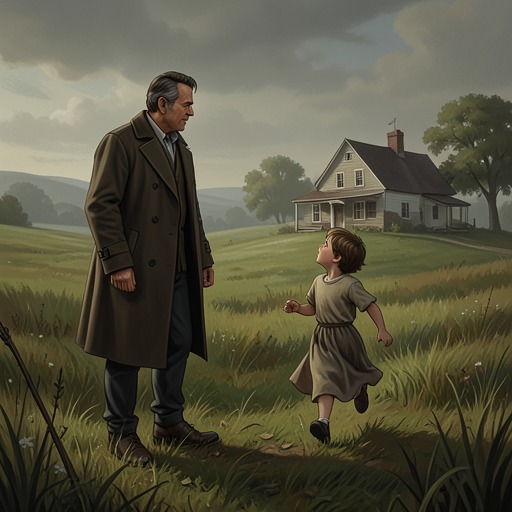
Later, when Trond’s father asks about Jon, Trond recounts the discovery and describes the crushing motion with his own hand. He says that Jon had been as usual until the end, then explains that Jon destroyed the goldcrest’s nest. This retelling makes the incident an early, concrete sign that something in Jon’s behavior has become inaccessible to Trond, rather than a fully understood event. In the days that follow, Trond does not see Jon by the river or on the water. Trond’s father does not ask whether they have been together, and Trond does not ask whether his father has seen Jon.
Memory and the Image of Death
The egg returns in Trond’s later thoughts while he and his father row across the water. With Jon absent, Trond considers what it might mean to lose a life early. His mind reaches for the egg held in a hand and then dropped and broken: an image that makes death seem final, while leaving him wondering about the instant before life ends. The object is no longer merely the focus of a frightening encounter in a tree. It has become the form through which Trond approaches a question he cannot answer.
The remembered egg joins two opposite possibilities without reconciling them. In the spruce, Trond had imagined a few weeks carrying the egg toward flight and life; after its destruction, he carries the broken egg forward as an image of a life that cannot continue. The scene does not make the bird’s fate a direct equivalent of a human death. Instead, it shows how a concrete object can give shape to a thought Trond can scarcely enter: the fragile passage between being alive and being gone.
Trond later describes that thought as an opening he tries to enter, a brief experience that leaves him sad and astonished by its quietness rather than frightened. The nest and egg therefore persist not because Trond discovers why Jon destroyed them, but because the event remains unexplained. Their physical fragility, Jon’s sudden change, and Trond’s later reflection are bound together in memory; the small egg becomes an enduring measure of how quickly a future can seem present, and how abruptly it can be lost.