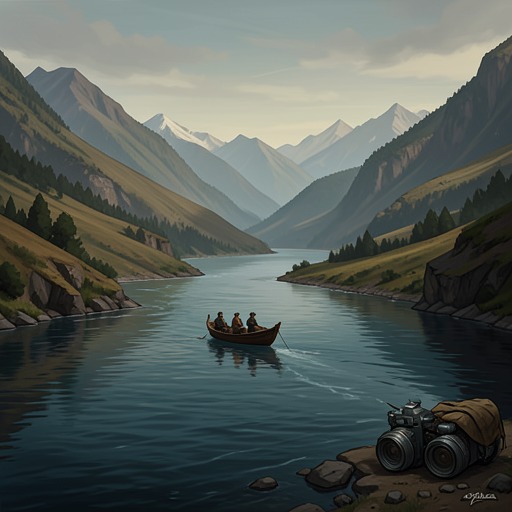
The river as boundary and anchor
Out Stealing HorsesThe river as boundary and anchor gives the novel a physical landscape in which separations are crossed, imagined, and sometimes made painfully visible. Flowing between Sweden and Norway, past the village and through the remembered summer landscape, it is at once a familiar presence and a measure of distance. For Trond, its changing currents accompany the movement from childhood expectation toward knowledge of death, his father’s absence, and adult intimacy; in a night of solitude, the river becomes the force that lets him feel himself still intact.
A familiar river and an imagined border
In the summer of his childhood, the river is already known to Trond before he returns to it. Standing on the doorstep in his underpants, he watches mist drift above the water and recognizes its flow from around the bend. He has dreamed about it all winter and knows it by heart. The scene binds the river to anticipation: the cold on his bare skin belongs to the moment before the day warms, while the water carries the promise of the summer he has been waiting to enter.
The river’s course gives that familiarity a geographical complication. It crosses from Sweden, passes through the valley and the village, then returns to Sweden farther south. To the younger Trond, this route raises the fanciful possibility that the water might remain Swedish while temporarily on loan to Norway, or even taste Swedish. The thought does not establish a literal difference in the water; it shows how a national boundary can be projected onto something that flows without pausing at it. The river makes the border perceptible, but its continuous movement also makes the border seem provisional.
On the bridge, Trond and his father look down at the rushing, nearly green water with their bamboo fishing rods in hand. His father calls every fish Jacob, whether he is fishing in the Oslo fjord or here, and makes the same playful challenge to the water. The repeated joke carries their shared anticipation across different landscapes. Trond remembers having wondered the previous year whether the river’s Swedishness could be seen, felt, or tasted; now he stands with his father and feels expectation spreading through his stomach. The bridge is both a crossing and a place to stop together and look down.
Water at the threshold of life and death
The river also becomes the setting for Trond’s private attempt to imagine dying. During a boat crossing with his father, he thinks of a life ending like an egg dropped from a hand and broken on the ground. He wonders whether, in the fraction of a second before death, the person knows what is happening. As he closes his eyes against the sun, he imagines pushing through a narrow opening, like a barely ajar door, into a quiet illuminated space. The experience lasts only a flash, but leaves him sad and astonished rather than frightened.
When Trond opens his eyes, the feeling remains as he looks across the water and at his father’s face. He gives his father a brief assurance that he is all right, yet carries away a small, bright yellow remnant of the experience, something he suspects may never leave him. The river does not answer his question about death; instead, the crossing gives the thought a form and leaves it attached to a remembered passage through the landscape. Water here is less a symbol with a single meaning than a threshold beside which an inaccessible boundary becomes momentarily imaginable.
The river as anchor in the night
Later, after a day that has overturned his confidence that he has never truly been alone, Trond wakes to find his father absent from the cabin. In the summer night, rain-swollen water runs higher over the boulders and shines faintly beneath rapidly moving clouds. Trond goes to the river and discovers that the boat is missing. He wades out a few paces, listens for oars, and sees nothing upstream or downstream. The missing boat makes his father’s absence concrete, while the familiar landscape remains in place: timber piles, fields, and the crooked pine bearing a cross.
In the water, however, Trond does not feel abandoned. The current surges against his boots, and the night’s scale and quiet make him feel singled out and calm. He understands the river’s force as something against which he can remain himself: even if immersed to the chin, he imagines, he could sit motionless while the current pulled at him and still be the anchor. The image reverses the river’s usual implication of movement. Its current does not carry him away; by pressing against him, it gives him a point from which to feel his own continuity.
The cabin offers no comparable shelter. Its windows are dark, the rooms empty, the duvets damp, and the stove gone out. Trond wades ashore rather than return inside and walks south, away from the route usually taken north. On the path, pale night light seems almost touchable, though his outstretched hands meet only air. He senses that life has shifted its weight and that he is no longer quite the person who began the day. The river’s anchoring effect therefore does not restore the earlier self or reverse what has happened. It steadies him at the very moment he recognizes change.
A boundary crossed by what Trond sees
The river also separates Trond from an intimacy he cannot avoid witnessing. At dawn he sits concealed by reeds on a jetty on the east bank, looking across toward the farm where Jon lives, or may have lived. Three boats are moored on the far side, including the blue boat associated with Jon, the red one Trond has seen Jon’s mother use, and a green boat that usually belongs by Trond’s cabin. Its presence on the wrong bank recalls that Trond himself had left it there.
On a bench at the other jetty, Trond sees his father sitting close beside Jon’s mother. She wears his jacket, and his arm is around her shoulders; then he kisses her while she cries. Trond initially reaches for other possible explanations, but the river is not wide enough at this point to make what he sees uncertain. The scene across the water exposes a relationship that had been hidden from him and makes the river a barrier that cannot protect him from knowledge. He watches despite wanting not to, then sees the pair rise and walk hand in hand toward the farmhouse.
Trond leaves without looking back. The distance between the banks has allowed him to observe the scene from concealment, but it cannot preserve his former understanding of his father or of the summer. In the novel’s recurring use of the river, continuity and division coexist: water carries the same familiar flow past childhood routines, imagined borders, the missing boat, and an intimacy revealed across its surface. It remains an anchor not because it holds events still, but because Trond repeatedly returns to it as a place from which to register how far life has moved.