The river in the childhood stories
Out Stealing HorsesThe river in the childhood stories is more than a feature of the Norwegian landscape: it is a route for work and play, a border crossing watched and contested during wartime, and a recurring measure of what changes and what endures in Trond Sander’s life. Its current carries logs toward Sweden and boys into risky adventures; years later, the river’s sound and course return to him with the force of bodily memory.
Setting and Seasonal Character
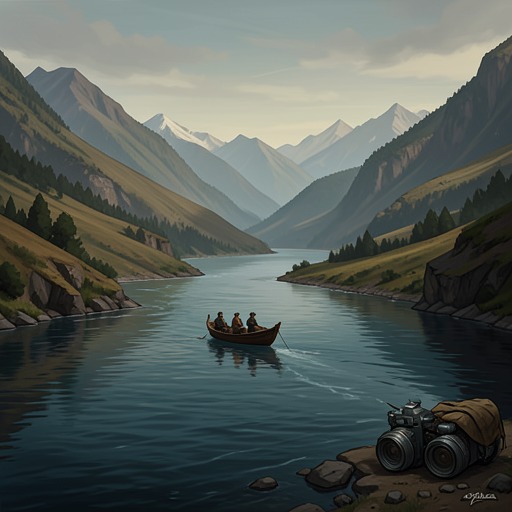
The river runs through the wooded valley in the far east of Norway, crossing the national border in a broad curve: it comes from Sweden, passes through the village, and returns to Sweden a few kilometres farther south. Near Trond Sander’s later home it flows into a lake. Its mouth is about a hundred metres away, visible from the kitchen window after the birch leaves fall. The river is shallow in summer, but runs briskly in spring and autumn, and holds trout.
The water is never merely scenery. Its level and pace shape what can be done there: a summer’s low flow can make timber rafting precarious, while rain swells the current around the bank’s boulders. At night, the river can be heard before it is seen. In Trond Sander’s recollection, its familiarity does not make it static; its appearance and force shift with weather, season, and the work underway beside it.
A Landscape of Boyhood
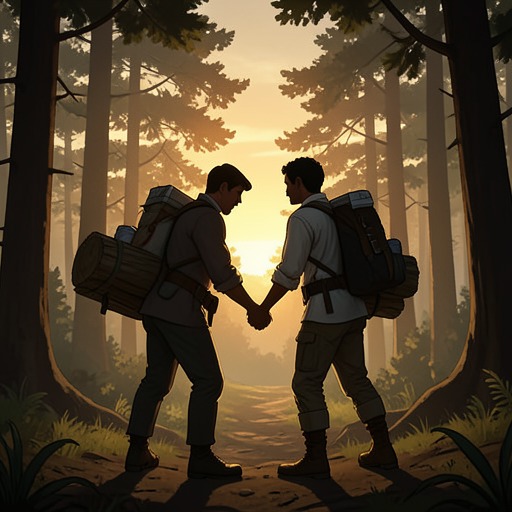
In the summer of 1948, when Trond Sander is fifteen, the river is a meeting place shared with Jon. Jon arrives at the cabin without knocking, often at unusual hours, and the boys go fishing for trout, shooting hares, or walking through the forest. They also balance on the shining logs still moving in the current after the river’s clearing. They begin nearly a kilometre downstream from the cabin; sometimes they travel so far that they have to walk back through the forest, wet and shivering, after scrambling onto the bank.
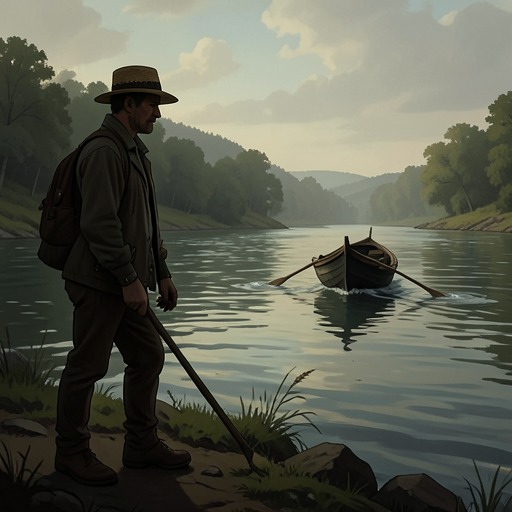
The river is also a boundary the boys know how to use. On one early morning, Trond Sander and Jon row across in Jon’s small boat and land about fifty metres downstream, far enough that the boat cannot be seen from the cabin. They climb the opposite slope and follow a barbed-wire fence beside Barkald’s field. The secret crossing belongs to the ordinary, improvised freedom of their summer: the boys pass between riverbank, fields, and forest without telling Trond Sander’s father what they are doing.
The logs offer another kind of precarious passage. Their movement through the water turns play into a test of balance and nerve, while the route between the cabin and the far bank makes the river a place where the boys can slip beyond adult attention. For Trond Sander, friendship with Jon takes shape in these repeated departures and returns, in the shared risks that make the river crossing feel like an adventure rather than a simple journey.
Work, Timber, and a Changing Valley
The river is also part of the valley’s economy. Barkald, the district’s largest landowner, keeps four horses in a fenced area of forest and owns substantial woodland. Most local families are smallholders, relying on farm produce and dairy income, and many men work as lumberjacks during logging season. Timber felled in the forest is hauled to the bank and sent downstream toward a sawmill in Sweden. The river therefore connects local labour to a destination across the border.
In the summer of 1948, Trond Sander’s father decides to fell timber at midsummer and float it down the river. Franz warns that the logs are full of sap and roughly twice as heavy as they would be at another time of year; the low water makes the plan riskier still. The logs accumulate beside the bank, hauled into position by horse and men. Trond Sander remembers the hot, sweating animal at work and his father and Jon’s father straining together to stack the timber higher. When the carefully piled trunks are finally released, they crash and slide toward the water; the remaining logs are prised loose or rolled out with pike poles, then drift calmly downstream toward Sweden.
The river’s work depends on knowledge of a particular landscape and on techniques that later disappear. In the older Trond’s account, timber is felled with a cross-cut saw and hatchet, stripped of bark, and drawn by horse to the water; men use pike poles to guide it into the current. The same retrospective attention marks the valley’s haymaking: a rack filled by hand stands harmoniously in the field, but later gives way to tractor work, mechanical turning, and wrapped silage. These changes do not belong to the river alone, but they make its remembered working world part of a landscape whose older rhythms have passed.
Border, Occupation, and Danger
The river valley’s border is both an everyday fact and a wartime obstacle. During the German occupation, a patrol is stationed on a requisitioned farm near the church and shop, and a guard is often posted by the gravel approach to the wooden bridge over the river. The crossing is watched, and people who need to pass cannot treat it as an ordinary route. Trond Sander later learns from Franz that his father had moved through the village during the occupation, information his father himself had never disclosed.
The bridge’s destruction gives this controlled passage a sudden, violent turn. When a motorcycle rider comes into view, Franz retrieves the hidden detonator from beneath the floorboards of his house and activates it. The bridge is shattered; its planks fall toward the bank and into the current. The guard survives the blast but is stunned and unable to hear. The river, which had connected the two sides, is now beside a broken crossing and a disrupted patrol.
In a later pursuit at the riverbank, Jon’s mother and a wounded stranger are caught between the water and German soldiers. The soldiers stop short of entering the river: it is cold and deep, and the current could carry swimmers downstream while leaving them exposed to gunfire. Trond Sander’s father urges them to run for cover among the trees. Here the river is not an open escape route but a dangerous limit on movement, made more perilous by the soldiers’ weapons and the exposed bank. Its role changes with circumstance: it can conceal a crossing, carry timber, or leave people with nowhere safe to go.
Memory and Meaning
For the older Trond, the river’s significance gathers around remembered sensation as much as geography. On a summer night, he finds Jon’s boat missing from its place and stands alone in the swollen stream, the water surging around his boots. The cabin behind him is dark, and he does not want to return to its empty rooms and extinguished stove. In the river he feels calm, not abandoned; its current presses against him, yet he experiences himself as the world’s anchor. The water’s force and his sense of steadiness coexist.
The river also carries memory across national borders. Near the end of the journey with his father, Trond Sander rides east toward Sweden, expecting the country beyond the ridge to look much like the one he is leaving but to feel different. In Sweden, he hears the river before seeing it. When it appears through the trees, he recognizes it as their own river, now farther south and well inside Sweden. The recognition is immediate, even though he acknowledges that water cannot literally be identified by its flow. The river has crossed the border without ceasing to be itself.
That recognition connects the boy’s journey to the older man’s act of remembering. The river is a physical thread through the landscape, but it is also a thread through the narrative: its crossings, changing levels, and recurring sounds allow childhood, wartime stories, labour, and later solitude to meet in the same place. It anchors Trond Sander not by holding the past still, but by giving him a route back into it.