The traffic
Out Stealing HorsesThe traffic is the clandestine route from the village by the river across the border to Sweden, kept running by Trond’s father under the cover of restoring Barkald’s neglected farmstead. It moves both mail and people, and its secrecy reaches beyond the border: the father’s own family in Oslo does not know where he goes or what he is doing. The route’s defining feature is the ordinary life built around it—repairs, shopping, meals, and familiar routines that make dangerous work look unremarkable.
A cover built from ordinary work
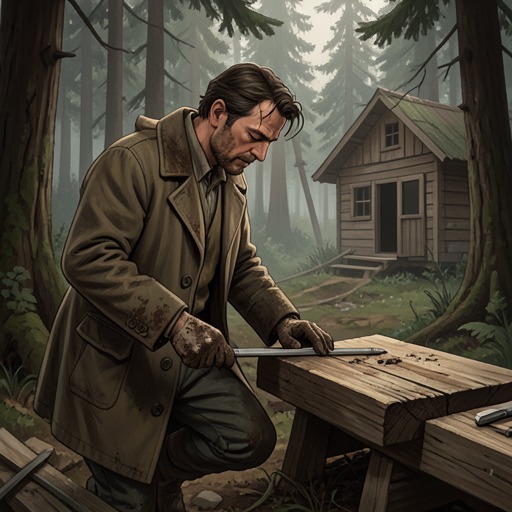
In the second year of the war in Norway, Trond’s father established himself at Barkald’s farm to provide cover for the final link of a courier line to Sweden. The farmstead gave him visible, plausible work. He cleared and burned the remains of the byre, repaired roofs and gable boards, replaced broken windowpanes, mended the stove, swept the chimney, and made chairs. The work was not merely a pretext invented for occasional visits: it gradually made the neglected place more habitable while explaining why he was there.
His stays were initially meant to be short, long enough for people to get used to seeing him across the river, working on the roof or sitting by the water. He crossed Barkald’s meadow to the shop around the time the bus came from Innbygda and Elverum, carrying an empty bag on the way there and supplies on the way back. After delivering what he had to deliver in Sweden and returning over the border at night, he would find another repair to make. A cracked chimney needed its masonry restored before it could collapse and send tiles down onto someone. Each task extended a visit; over a couple of years, the work established a second, unrecognized life for him at Barkald’s farm.
The route and its routines
Trond’s father kept the line going for two years, in summer and winter. When he was away from the cabin, someone from the village took the last stretch across the border. Mail could be collected straight from a bus or at the shop, sometimes before closing and sometimes after it. The handoffs varied, but the routine was designed to fit the village’s ordinary movements rather than announce itself as a separate operation.
The father’s own movements were made to look legitimate. He walked the main road with a fuller bag, turned through the meadows by Barkald’s fence, and rowed across the river. People saw him and waved; he was known as the man repairing Barkald’s cabin. When German and Norwegian authorities had searched the place, they found tools and two books by Hamsun, Pan and Hunger, but nothing they considered suspicious. His border-residency certificate and other papers were in order, and his periodic absences could be explained by other repair projects.
The cover also depended on small domestic performances. Jon’s mother rowed upriver once or twice a week, sometimes with food and sometimes with mail, ostensibly to cook for the handyman. Barkald presented this as practical help: a man living alone might otherwise eat badly and become too weak for his work. Trond knew his father could cook as well as his mother, but also knew he could be lazy about it; when father and son were alone, they often ate simple food such as fried eggs. The story of the woman bringing proper meals thus made the father’s isolation look ordinary and gave Jon’s mother a credible reason to travel to him.
A village that watched and looked away
The route relied on local assistance in a district where people knew one another’s habits closely. Anything out of the ordinary could be observed and entered into the village’s informal record of each other’s lives. Familiarity therefore created danger as well as cover: a changed routine might attract attention, while repeated, explainable movements could pass without comment.
Franz sometimes carried the final leg, and Jon’s mother did so when she could get away. Jon’s father did not join the operation. He had not openly opposed it, but he wanted no part in it; when his wife went to the river with her basket and boarded the red-painted boat, he looked away. He did the same when a city-dressed stranger, holding a tightly lashed suitcase, was quietly brought into the family barn at twilight to wait for darkness. The stranger was later taken upriver by boat at night, without lights or conversation. Jon’s father’s silence did not make him an active courier, but it allowed the household’s ordinary space to shelter the passage of strangers.
The danger could be starkly physical. In late autumn, when snow lay on the ground but the river had not frozen, a man in a suit arrived before dawn in thin-soled summer shoes. Shivering in the cold, he was given a blanket by Jon’s mother and directed to the barn, where he had to remain hidden in the hay through the white hours of the day. He had arrived around five in the morning and could not move on until evening. The route’s work was not only the transfer itself: it also required sheltering a person through a long, exposed wait until darkness made travel possible.
Mail, fugitives, and family secrecy
At first, mail was the traffic’s principal cargo, but the operation widened to include people escaping across the border. The strangers passing through the village were not all treated as parcels to be moved quickly; they had to be concealed, fed or sheltered when necessary, and conveyed without disturbing the routines that protected the line. The combination of repair work, shopping, cooking, barn space, and river transport made the village into a chain of cover rather than a single secret hiding place.
The secrecy extended to Trond’s family. While his father was spending as much time in the village by the river as beside the Bunnefjord in Oslo, his wife and children did not know that this second life existed. At home, he went away and returned after a week or a month; the family grew accustomed to living without him, without knowing where he had been. Trond later hears the history from Franz and recognizes it as news, not confirmation of something he had been told. The traffic is therefore revealed not only as a wartime route but as the hidden structure behind his father’s repeated absences: a sustained undertaking carried out in plain sight, while those closest to him remained outside its knowledge.