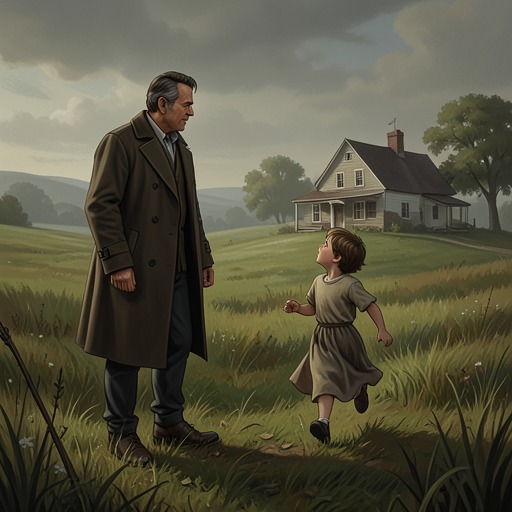
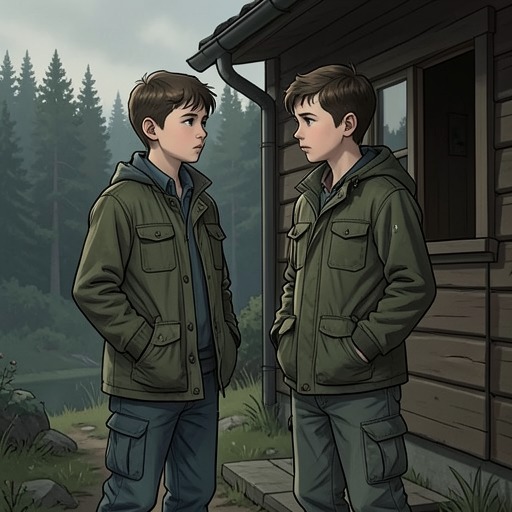
Trond Sander and Jon
Out Stealing HorsesTrond Sander and Jon are fifteen-year-old companions whose intense summer friendship is built through shared risks, physical adventure, and a closeness that neither boy explains. In 1948, as Trond stays with his father in a cabin by the river, Jon repeatedly arrives to draw him into the forest and onto the water. The friendship feels effortless until Jon’s sudden destruction of a goldcrest’s nest exposes a distress Trond cannot understand; the later funeral of Jon’s brother Odd gives their shared adventures an ending Trond feels before either boy names it.
Identity and the Summer of 1948
Trond is spending the summer with his father in the first days of July 1948. He is fifteen, and the German occupation has ended, though his father never speaks about the war. Jon, also fifteen, appears at the cabin at all hours, often with an invitation to go out stealing horses. The phrase gives their excursions a private, adventurous character: it is the language of boys making a world together beyond the cabin door, not a description of a settled or openly discussed friendship.
Jon wants no company but Trond’s. He has two younger brothers, the twins Lars Haug and Odd, while Trond spends the rest of the year in Oslo. Neither boy fills in the other’s life beyond the summer: Jon does not talk about whom he sees when Trond is away, and Trond does not tell him what he does in the city. Their intimacy is therefore both exclusive and bounded. They share the present intensely without exchanging much about the lives that surround it.
Shared Risks and Physical Trust
Their companionship is enacted in repeated excursions: shooting hares, walking through the forest by moonlight, fishing for trout, and balancing on the shining logs still moving down the river after the clearing work has ended. The river becomes one of their tests of nerve. They begin nearly a kilometre downstream from the cabin, sometimes travelling so far on the logs that getting back through the forest takes an hour. They may emerge wet and shivering, but Trond never refuses Jon’s invitations and keeps their activities from his father.
Horse riding turns their shared daring into a bodily ordeal. As the horses approach, Trond waits in a tree and drops onto one’s back, landing too near its neck. The impact makes him nauseated; he struggles to hold the mane and vomits as the horse gallops through the trees. For a moment the ride seems to suspend ordinary sensation: the hoofbeats fade, birdsong becomes distinct, and Trond experiences a sudden happiness. The horses turn before a barbed-wire fence, throwing him over it. The episode makes plain that their adventures are not simply games of control: Trond trusts the moment and the animal, but the outcome exceeds what he can manage. Jon’s presence makes the risk shared, even when each boy must meet its consequences alone.
The Nest and the Unspoken Rupture
A later encounter in a tree changes the emotional weather between them. Jon shows Trond a goldcrest’s nest, suspended in a fork of the branches, and takes out one of its tiny eggs. Trond marvels that something so small can become a living bird and fly away. He cannot tell whether his words or the egg itself prompts Jon’s response. Jon’s face turns white; he drops the egg, tears the nest from the branch, crushes it, and rubs the remains against the tree. His animal-like sounds and abrupt collapse on the ground leave Trond unable to speak. Trond feels that he has caused the outburst, but does not know why.
The scene breaks the ordinary terms of their closeness. Until then, their friendship has largely been expressed through movement and shared undertakings; now Trond sees an anguish in Jon that their adventures have not prepared him to interpret. Jon walks away without looking back. Trond remains in the tree, breath whistling in his chest, listening to it like the asthma of a man he knows in Oslo. The physical aftermath gives the moment an unanswered echo: Trond can register what has changed in his body and in Jon’s face, but cannot make the change intelligible.
Separation and Retrospective Meaning
In the rain that follows, Trond finds Jon waiting in a boat at the riverbank. Jon says nothing as Trond climbs in, and rows him against the current all the way home, although Jon lives downstream and the crossing alone would have been enough. Trond wants to tell him that he need not make the longer journey, but cannot bring himself to speak. The care is practical rather than explanatory: Jon rows, Trond accepts the ride, and silence carries what neither can put into words.
At Odd’s funeral, that silence meets a different and irreversible loss. As the small coffin is lowered, Lars Haug tears himself away from his mother and runs in circles by the churchyard wall until a neighbour catches him. Trond looks toward Jon; Jon looks back at him without blinking. Trond understands, in that moment, that they will never go out stealing horses together again. The thought makes him sadder than anything else at the churchyard. His recollection gives the friendship no spoken farewell or later reconciliation. Instead, it fixes its ending in a look exchanged beside a grave, after the boys’ shared summer world has been altered by grief and by the distress they never learned to discuss.