Trond Sander's aging and physical vulnerability
Out Stealing HorsesTrond Sander's aging and physical vulnerability emerge through the gap between the independence he chooses and the limits his body imposes. At sixty-seven he considers himself fit and still feels spry, but winter work, a bad back, and an episode of sudden illness make self-sufficiency precarious. His age is neither a diagnosis nor a single turning point: it is lived in repeated acts of getting up, working, tending the house, and testing what his body can still do.
Age and daily routine
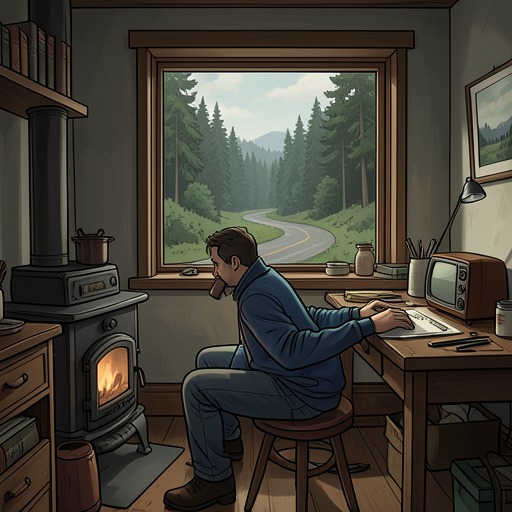
Trond lives alone in a small house in the far east of Norway, where the river meets the lake. His early mornings are already shaped by age and habit: he has often been awake for hours by the time daylight arrives, having stoked the fire, walked around, read the previous day's paper, washed a few dishes, and listened to the British Broadcasting Corporation. He says that sixty-seven is supposedly no age nowadays and that he feels spry. The claim is not simply disproved by what follows. He remains active, but the effort and preparation that activity requires become increasingly visible.
The house and its surroundings give that independence a practical form. Trond walks Lyra several times a day, and the dog is part of the daily rhythm that keeps him moving. In the morning after a night of hard work, however, he is stiff and sore enough to push himself carefully from bed, first lowering his knees to the floor before attempting to stand. The sequence makes getting upright a task to be managed rather than an automatic gesture. He can do it, but his body registers the previous day's exertion before the day has properly begun.
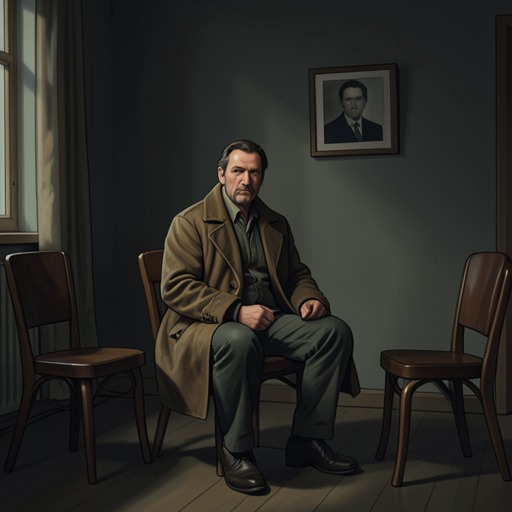
His face in the bathroom mirror offers another quiet measure of age. After installing a boiler and gaining a proper dishwashing sink, he sees the face he had expected to have at sixty-seven. He recognises himself and accepts that recognition, while acknowledging that liking what he sees is a separate matter. The mirror does not prompt a dramatic rejection of age; instead, his response is restrained and practical. There are few people to whom he expects to show himself, and he can ask no more than to recognise the person there.
Winter work and physical limits
Preparing the house for winter is where independence meets its clearest material constraints. The road from Trond's home to Lars's cabin is two hundred metres, followed by another fifty metres to the main road. With his back as it is, he says he cannot clear that stretch with a shovel; even with the strongest back he ever had, the work would leave no time for anything else. His concern is not abstract frailty but access: heavy snow could make the short road an obstacle between the house and the outside world.
He therefore attends closely to the means of keeping the house functioning. Snow clearing matters, as does a reliable car battery in severe cold; the district Co-op is six kilometres away. The stove needs more wood than the dry birch already piled in the outhouse can provide, so Trond cuts down a dead spruce with a chainsaw and sets about turning it into logs. His plan is to rely on the heat he can produce himself rather than buy portable oil-filled radiators. That choice preserves his sense of self-reliance, but it also commits his aging body to strenuous labor.
The work proceeds in stages that make its physical cost concrete. Trond trims and cuts the spruce into lengths, carries three chunks at a time in a wheelbarrow, and stacks them in a pyramid almost two metres high against the woodshed wall. By the end of the day his back has had enough. He cleans the saw, removes his damp boots and the wood chips lodged in them, and refuses Lyra's invitation to play because he lacks the energy to keep throwing her pine cone. The small domestic aftermath—the sawdust, the boots, the dog waiting with a cone—records fatigue as part of the work rather than as an exceptional collapse.
Exposure, illness, and isolation
The gale that brings down the large birch in Trond's yard turns physical vulnerability into a problem of confinement. The tree lies between the shed and his car; its branches reach toward the kitchen window, damage the shed's gutter, and obstruct the woodshed door. He immediately begins planning how to free the car and clear access to his firewood. The chainsaw will need its chain filed, and he may need petrol and two-stroke oil, but the car may be trapped. The practical questions accumulate until he feels panic and claustrophobia, despite knowing that he has food, running water, and the ability to walk. The fallen tree is not merely a large job: it threatens the transport and heat on which his chosen life depends.
His body then gives him a more immediate reason to doubt his security. After sleeping for half an hour, Trond sits up, becomes dizzy, and falls forward to the floor, striking one shoulder. He is in pain and cannot tell whether he can safely move. He has no telephone, a decision he had postponed because he did not want to be accessible; at this moment, he recognises the other consequence of that choice, that other people are not accessible to him either. The episode links his preference for solitude to a practical vulnerability without turning that preference into a simple mistake.
Trond manages to get upright by rolling onto his knees and using the doorframe for support. His knees shake. He keeps his eyes closed until the dizziness passes, then checks himself as best he can: a faint nausea and sore shoulder remain, along with more light-headedness than usual. Still, he dresses, puts on his boots, and takes Lyra out. He walks close to the house to avoid the fallen branches, reaches the path by the bridge, and continues to the river mouth. There he vomits onto the withered grass. When Lyra comes to sniff, he sharply tells her to back off, then resumes the walk more slowly and sits on the bench by the reeds. The scene moves from collapse to effort, but does not resolve the uncertainty about what has happened to him.
Self-reliance under pressure
Trond's response to bodily difficulty is to observe, adjust, and continue where he can. After the fall, he listens closely to his body, distinguishes the sore shoulder and nausea from sensations that seem normal, and proceeds cautiously rather than treating his apparent recovery as proof that nothing is wrong. His determination to walk Lyra is consistent with his habits, but the scene also shows how much judgment the routine now requires. He must weigh his symptoms, the obstructed yard, and the distance around the lake against his wish to go on.
That negotiation is visible even in small domestic tasks. On a cold morning, he lays a rug beside the bed so the floor will not shock his bare soles. He considers replacing the floor and adding insulation, but wonders whether he will have enough money in the spring, then catches himself in that worry. On another day, he notes that his sister could never get the stove to burn properly, while he eventually succeeds even if not on the first try. The contrast places competence within a family history of ordinary habits and limitations; Trond's own method is systematic, but not effortless.
His isolation also makes practical arrangements consequential. When the fallen birch blocks the car, he must consider whether he can obtain fuel and supplies; when he falls, the absence of a telephone sharpens his solitude into a possible barrier to help. Yet he does not abandon his plan to stay in the house. After waking from a dream of struggling toward the surface, he thinks through the day's work: replacing unsafe doorstep boards with impregnated timber and three-inch nails, splitting the spruce, and later hauling a large root with Lars using chains and a car. He lets go of his trousers and lies down again, not because the work has ceased to matter, but because he is not ready to rise. His plan to remain there is conditional on his ability to manage.
Meaning of bodily vulnerability
The account of Trond's age resists both easy reassurance and a story of inevitable helplessness. He is capable of cutting, hauling, stacking, walking, and making decisions about his home; he also knows that his back cannot clear the road, feels the consequences of labor the next morning, and can be brought to the floor by dizziness. His independence is real, but it is built from preparation and repeated physical effort, not from immunity to need.
The storm and the spell of illness expose different scales of risk. The birch makes the house feel claustrophobic by obstructing essential routes and resources; the fall reveals the private danger of being alone when the body suddenly fails. In both cases Trond responds by making plans, yet planning cannot restore certainty. At dawn he insists that he is not afraid of death, but the disturbing possibility is that one morning he might not rise from the depths of sleep. His vulnerability therefore reaches beyond strength or mobility: it touches his awareness that an ordinary routine can be interrupted without warning. The novel's portrait of aging rests in that tension—Trond remains the agent of his chosen life, even as the body and circumstances on which that agency depends become less predictable.