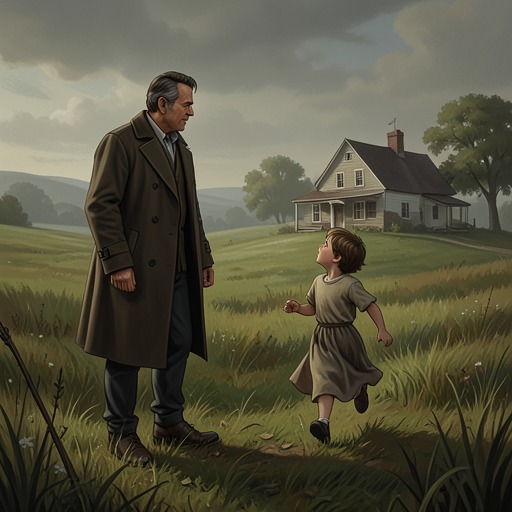
Trond Sander's unresolved loss of his father
Out Stealing HorsesTrond Sander’s unresolved loss of his father begins in a farewell that seems temporary to the boy and becomes final only in retrospect. His father tells him to go home and promises to follow, but Trond never sees him again. The gap between that assurance and what followed leaves Trond unable to determine whether his father’s absence resulted from events beyond his control or from a decision already made. In memory, the father persists both as a model for how to work and as the unanswered question at the end of a journey home.
A loss without a settled explanation
The father’s disappearance is inseparable from the last words he gives his son. He instructs the fifteen-year-old Trond to board a bus, change to the train at Elverum, and travel home to Oslo; once his own work is finished, he says, he will come after him. Trond answers, “Yes,” and “OK,” but recognizes even then that the arrangement does not feel all right. The promise sounds familiar, and the unease in his stomach makes the boy wonder whether this separation might not be like the others.
The uncertainty that remains is specific, not simply a general grief over an absent parent. Trond repeatedly asks himself whether something happened that his father could not control, or whether the father already knew that he would never follow. The account supplies no answer. It marks this departure as the last time they saw one another, while preserving the distinction between what Trond could feel at the moment and what he could only suspect afterward. The loss is unresolved because the promise of return and the fact of permanent separation cannot be reconciled by anything he knows.
The father preserved in practical knowledge
Long before this farewell is interpreted as final, Trond’s father has become an enduring guide to action. As an adult, Trond privately describes how he approaches practical tasks: he closes his eyes and pictures how his father would have done the work, or recalls watching him do it, then copies his movements until the task becomes intelligible and his body finds the right rhythm. This is more than recollection of a particular instruction. Trond experiences work as something whose order is already latent in the task, waiting to become visible through a practiced sequence of movements.
That method makes the father present in Trond’s everyday competence even as it emphasizes how little time they had together. The man Trond watches in memory is barely forty, the age his father was the last time Trond saw him, when Trond was fifteen. Trond understands that his remembered father will never grow older. His image is therefore both a source of practical knowledge and a fixed figure held at the point of separation.
When a friendly mechanic asks whether Trond might need help putting his house in order, Trond does not disclose the private ritual behind his practical work. He answers simply, “I had a practical father. I learned a lot from him.” The modest explanation turns a private, intimate dependence into a socially ordinary remark. It acknowledges inheritance without revealing the depth of the absence that gives that inheritance its force.
The farewell as remembered scene
The final departure unfolds through concrete details that Trond later revisits: the shop, the bridge over the river, his father standing beneath an oak, and the wide blue sky over the village in the summer of 1948. From the bus, Trond watches the scene recede. Dust rises outside and obscures his father; then the shop, tree, and figure disappear around a bend. The landscape does not explain what is happening. It records the last visible moment while leaving the meaning of the separation open.
Trond describes his response through the familiar staging of a farewell in a film: the decisive scene after which the protagonists’ lives change direction. But that pattern of dramatic hindsight is set against the boy’s actual ignorance. No one has told him how events will turn out, and he has no way to know what lies behind the scene he is living. He runs between his seat and the window, changes places, sits and stands again, unable to settle. The driver watches him in the mirror but says nothing. Trond’s restless movement gives physical form to an alarm for which he has no explanation.
A voice in the imagined cinema audience shouts, “You damn prick!” at the departing figure, speaking on behalf of both the spectator and Trond. The outburst lends the scene an accusation that the boy himself cannot yet formulate. Yet it does not resolve the question of the father’s intentions. Trond is grateful for the imagined support, while continuing to insist on the boundary between later interpretation and what he knew then.
Memory's continuing afterlife
The memory returns as a problem Trond has thought over “a thousand times since.” Its recurrence does not produce certainty; instead, it keeps the two possible readings of the farewell in view. The father may have been prevented from keeping his promise, or he may already have known that he would not return. Because the scene contains both a reassuring instruction and Trond’s immediate distrust of it, neither can erase the other.
The remembered lesson about not becoming bitter sits beside this unresolved departure. The father asks whether Trond understands, and Trond says yes, then recognizes that hearing the words did not mean he had grasped their meaning. The advice becomes part of the memory precisely because the boy cannot fully understand it at the time. In the farewell’s afterlife, remembering is not a route to a definitive explanation but a way of returning to what was said, what was felt, and what could not yet be known.
The loss thus shapes both Trond’s practical life and his account of the past. His father remains available in the movements Trond imitates, but not in the conversation that could clarify the final promise. The same memory that teaches him how to proceed with a task leaves him unable to determine what happened after the bus carried him away. His inheritance is tangible; the reason for his father’s absence is not.