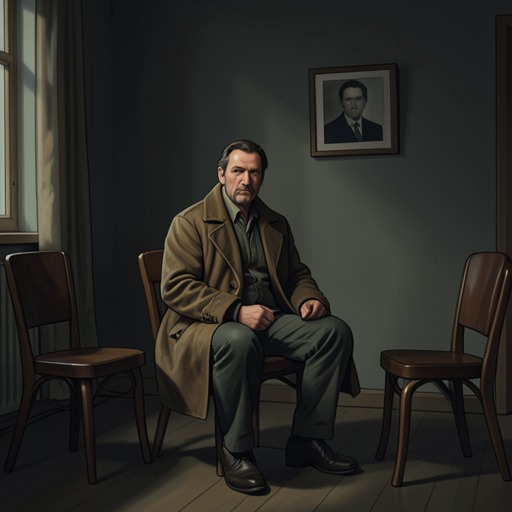
Trond Sander's bereavement and widowhood
Out Stealing HorsesTrond Sander's bereavement and widowhood are not confined to a single bereavement scene: the deaths of his wife and sister reorganize his work, his home, and his capacity for ordinary conversation. Three years later, grief still surfaces in small routines—in a sparse shopping basket, an unsteady morning fire, or the coffee he can no longer associate with a clearly remembered face.
The Two Losses
Trond's wife died in an accident three years before the present, an accident from which he himself only just survived. She was not his first wife; he has two grown-up children from an earlier marriage, and they have children of their own. After his wife's death, he no longer wanted to continue working. He pensioned himself off and began looking for a completely different place to live.
His sister died of cancer in the same month as his wife. The illness was diagnosed too late for anything to be done. The sister and Trond's wife had grown close, often talking on the telephone in the evenings about world affairs. Sometimes their conversations turned to Trond, whom they affectionately teased as The boy with the golden trousers. Their laughter carried no malice; it gently countered his own seriousness. The two women shared a private bond, and their deaths removed not only two loved ones but also the living connection between them.
A Changed Daily Life
The social facts of Trond's loss are known in his village. He has told people about his working life, his age, his wife's death, his earlier marriage, and his family. They respond warmly to the story of how happy he was to find his current house, though they point out that it had been in poor condition and that others had declined to take on the work it needed. Trond says that not knowing its state beforehand was fortunate: he might otherwise have passed it by. It can be made liveable one step at a time, and he has time.
That measured account does not make him feel understood. He believes the villagers know facts about him, not his feelings or the meaning of the decisions he has made; they fill what they do not know with their own assumptions. The distance is protective, allowing him to remain polite without making himself fully available. At the shop, his reduced needs become physically apparent: alone, he buys little more than bread and something to put on it. A sudden, meaningless melancholy rises as he searches for his money, and the checkout attendant's quiet kindness nearly brings him to tears. He leaves quickly, certain that the people around him do not understand.
Solitude, Work, and Memory
After his wife and sister were gone, Trond lost interest in talking to people and no longer knew what to say to them. This is one reason he lives where he does; another is his closeness to the forest, which had been important to him long ago and absent for a long time. When everything around him fell silent, he recognized how much he had missed it and felt he had to return. His move into a remote life is therefore both a response to bereavement and a recovery of an older attachment.
The losses return through domestic tasks rather than formal acts of remembrance. One morning Trond struggles to light the stove, something his father could always do, and remembers that his sister never managed it either, despite having dry wood, newspaper, and a stove with a good draw. The practical memory opens directly onto absence: he misses her. On another evening, a familiar coffee-making routine prompts him to reach for the memory of the woman with whom he shared coffee each morning for many years, but he cannot see her face. The habit remains, while the image it should summon eludes him.
Grief Without Closure
Trond's account makes bereavement recurrent rather than complete. The women remain present in the surviving details of their relationship—their evening phone calls, their teasing, the stove his sister could not light, and the morning coffee associated with his wife—yet those details also emphasize that neither can answer him now. The past is not simply a store of consoling recollections: it can be entered with concentration, but its scenes are altered by what came afterward. Grief shapes the present through absence, while memory gives that absence particular voices, habits, and domestic gestures.