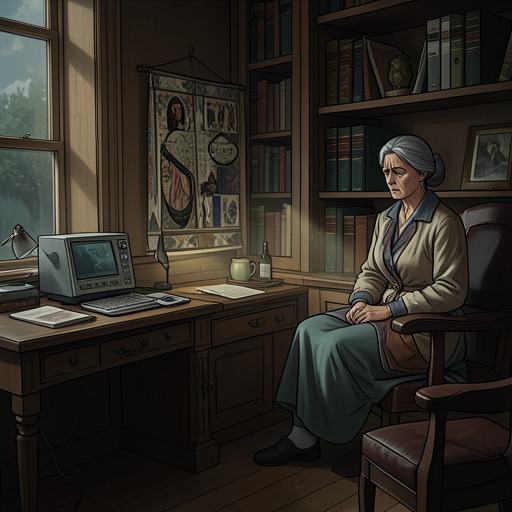
Trond and his mother
Out Stealing HorsesTrond and his mother are bound by love, but that bond is strained by Trond’s powerful attachment to Trond’s father and by the father’s departure. Their relationship unfolds through sharply contrasted gestures: the mother runs toward her returning husband while Trond hangs back, later sits opposite her on the train unable to bear the future her face seems to represent, and finally walks arm in arm with her through Karlstad. That last closeness is real, but it does not last.
Family reunion and divided attention
In 1945, Trond and his sister wait at a window overlooking the road for Trond’s father to return from Sweden. Their mother stands in the doorway, twisting a wet handkerchief and unable to keep still. When she can no longer restrain herself, she runs down the road and throws herself at him. Trond remembers her as young and light on her feet in that moment, while also recognizing that his later memory of her is dominated by the bitterness and heaviness she acquired afterward.
The reunion exposes different ways of welcoming the same person. Trond’s sister runs down the stairs and imitates their mother’s movements; Trond follows slowly, embarrassed by the display and reluctant to be carried away. He watches from beside the letter box as the two women cling to Trond’s father. When their father’s eyes find his, Trond gives a slight nod and receives a faint, private smile in return. He understands the exchange as a pact with his father. At twelve, he feels his life shift away from his mother and onto a new course. The moment describes Trond’s own sense of allegiance, not a declaration that he has ceased to love her.
Trond’s father had been gone for eight months, and the family had heard nothing until two days before his arrival. Trond’s mother’s exuberant greeting carries the force of that long absence; Trond’s quiet exchange with his father begins a separate intimacy. The difference matters throughout their relationship: the mother makes her feeling visible through movement, while Trond’s most consequential response is a restrained nod and a shared look.
Separation and what is left unsaid
After spending the summer with Trond’s father, Trond repeatedly cycles into Oslo in the rain, hoping to see him arrive from Elverum. Then he stops going. The change feels to him like a curtain falling and the world being experienced anew. In late autumn, a letter arrives addressed to his mother. Although the sheet inside bears all three family names, the message says that Trond’s father is not coming home again. It offers practical arrangements for money due in Karlstad for timber felled and sent downriver, but no special greeting to Trond. He had believed he had earned one.
Trond’s mother knows nothing of what he and his father did together that summer. Trond had told her only that his father would come home when he had finished what he needed to sort out. When she reads the letter, her single spoken response concerns the timber. Her reaction gives the practical news a different weight: the timber and the money are real, but they do not explain the shared summer or restore the absent relationship. Trond’s silence has kept that experience between father and son, leaving his mother outside a part of his life that has become central to him.
The letter’s announcement also changes the balance between mother and son. On a train journey toward Karlstad, Trond looks across at his mother and thinks that his father has disappeared and left him with her. He explicitly acknowledges that he loves her, yet he cannot imagine a future in the face before him without feeling pressed and short of breath. He gets up, crosses the carriage, and eventually sits alone in an empty compartment, looking at the river and perhaps crying against the window. His distress does not cancel his love; it shows how thoroughly the father’s departure has altered what he can bear to see in his mother.
The journey to Karlstad
The trip brings the two together through a shared practical task. Trond’s mother has never been abroad, while Trond has crossed a border only in the forest. At Karlstad station she looks lost and sleep-swollen; the town’s speech sounds foreign, and they have only one bag because they do not intend to stay overnight. They need to find the bank where the timber money is held and then find something to eat. Trond’s mother has also borrowed money from her brother, Uncle Amund, in the period after Trond’s father’s letter.
Their closeness on the journey is not immediate or uncomplicated. On the northbound train, Trond first watches his mother across the compartment, then withdraws from her and chooses an empty compartment of his own. The river draws his attention away from the family crisis, but it does not resolve it. His movement through the carriage gives physical form to the distance between them: he cannot remain beside her, though they are travelling together toward the same errand.
A brief shared lightness
After their time in Karlstad, Trond and his mother walk down the street with her arm in his. He carries his old clothes in a paper bag, and the new suit he is wearing moves lightly with him. She walks with a click in her heels; their heights match, and Trond experiences their steps as almost a dance. The scene offers a striking counter-image to the train compartment: instead of sitting opposite his mother under the pressure of an imagined future, he moves alongside her, joined to her by her arm.
The ease is temporary. Trond remembers that they never walked that way again. Back in Oslo, his mother returned to the heaviness he associated with her for the rest of her life. Yet the Karlstad walk is not erased by its brevity. Trond’s hand is swollen and sore from clenching it until his nails pierced the skin, but in that moment he finds the suit, the town, and their shared walk good. The memory preserves a relationship more varied than either the boy’s resentment or his mother’s later sadness alone: they love one another, fail to share important knowledge, and briefly find a way to move together.