Trond’s father
Out Stealing HorsesTrond’s father is a practical, resourceful man whose covert work for the Norwegian Resistance takes him repeatedly across the Swedish border during the German occupation of Norway. He makes an abandoned summer cabin look like an ordinary repair project, turns routine encounters with guards into part of his cover, and keeps the purpose of his absences from his family. His skill at making a hiding place seem domestic and uneventful stands in sharp contrast to the departures that eventually define his relationship with Trond.
Identity and Background
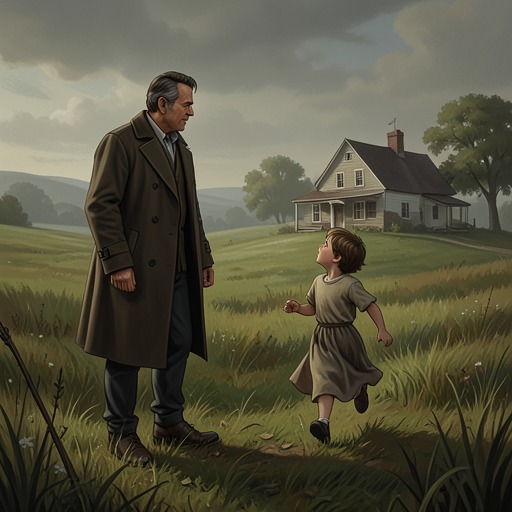
The novel presents Trond’s father through his son’s memory and, later, through Franz’s account of the resistance work Trond had never been told about. Before the war, the family rented rooms in Oslo. Trond’s father earned a living through changing kinds of work involving tools, small machines, journeys, and plans made with pencil in hand; he was no longer employed by another man. His income was uncertain, but he had saved enough to buy a cabin for the family’s summer stays. The narrator recalls him inspecting that place, patting its trees, and sitting by the river as though he were among old friends.
During the war, his prolonged absences repeatedly altered the family’s ordinary life. Months could pass without Trond seeing him. When he did come home, Trond felt that he had changed a little and had to concentrate to hold on to the familiar father. Yet the boy remained sure of his special place in his father’s heart, and imagined journeys they would take together after the Germans were defeated. That confidence coexisted with a crucial ignorance: Trond, his mother, and his sister were not told where his father went or what he did there.
The Cabin and the Resistance Route
In 1942, Trond’s father came through the forest looking for a place near the border where he could take cover, think, and repeatedly set out for Sweden carrying papers, letters, and sometimes films for the Norwegian Resistance. He was not then behaving like a fugitive. Open and friendly, he allowed people to understand his search as a desire for somewhere quiet to think; only Franz knew the real purpose. The father wanted a base he could return to after each mission and a place from which his tracks could be obscured.
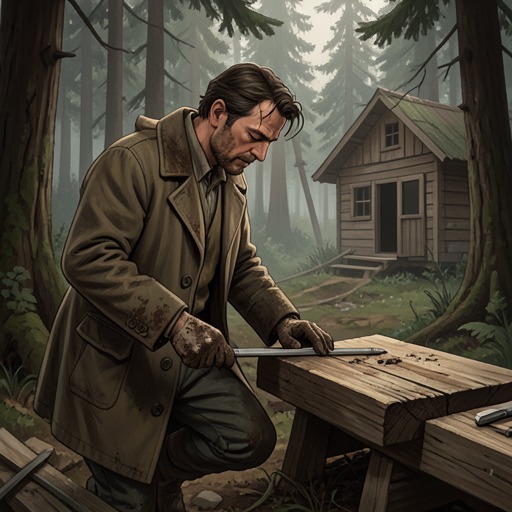
Franz showed him a summer cabin left vacant after a foreclosure and empty for four years. Barkald had acquired the smallholding and its property, which were of little use to him. The location suited the work: it stood on the river’s east bank, a twenty-minute walk from the nearest bridge, with no other buildings behind the farmsteads until well beyond the Swedish border. The decayed property also supplied a credible reason for sustained work. Trond’s father cut grass, cleared and burned the remains of a collapsed cow byre, repaired roof tiles and the roof, renewed the gable boards, replaced broken windowpanes, mended the stove, swept the chimney, and made two chairs. These were useful repairs, but their visible ordinariness also made him appear to be no more than a handyman restoring Barkald’s cabin.
He extended his stays each time he returned from Sweden, finding further work to do. Villagers could see him crossing Barkald’s meadow with an empty bag on his way to the shop, or returning with supplies. At other times he carried a fuller bag by the main road, then crossed the river by boat. German patrols had searched the cabin and found tools and two books by Hamsun, but nothing they considered suspicious. Barkald confirmed that the father had been assigned to put the cabin in order, and the father’s border-residency certificate and other papers were in order. The cover depended not on invisibility but on being readily understood as an ordinary local worker.
Deception, Danger, and Escape
A German patrol was stationed at a nearby farm, and a guard was often posted at the gravel approach to the bridge. Trond’s father made a point of speaking with the guards in German. He learned personal details about them and treated them with consideration, sometimes sharing a cigarette and talking until it was time to part. This friendliness made each crossing less conspicuous, though it did not make it safe: he knew that an abrupt attempt to run could bring gunfire. The scene reveals his method as a form of close attention, not a guarantee of control.
The route also relied on the village’s ordinary traffic and on people who could carry messages without exposing the network. Trond’s father kept the line going for two years, through summer and winter. When he was away, Franz or Jon’s mother sometimes completed the final crossing. Sometimes the father collected the mail from the bus or the shop; at other times Jon’s mother carried it while rowing upriver with food for the supposed handyman. The arrangement had to look natural, even as neighbors watched one another’s routines and unusual behavior could be recorded. Trond’s father nevertheless maintained the secret from his wife and children.
When the danger finally reached the cabin, Franz used the detonator he had hidden beneath a section of floorboards and destroyed the bridge. As the soldiers pursued a man arriving by motorcycle, Trond’s father called Jon’s mother to take the man’s bag and reach him. They gathered essential belongings and documents from the cabin, packed them into the bag, and escaped through a rear window. With a sheet and the father’s long underwear over their clothes, Trond’s father and Jon’s mother fled hand in hand to Sweden. The escape brings together the work concealed in years of repairs, the villagers’ participation, and the sudden necessity of abandoning the safe-looking base.
Father and Son: The Crossing and the Departure
In the summer Trond spends with him, his father is both an intimate companion and a man whose larger purposes remain largely unspoken. On the ride toward Sweden, the two stop at the top of Furufjellet and look back across the river and the valley. Trond is impatient to continue; his father turns east without having explained where they are going. The boy understands that they are crossing into Sweden only as they set out, and finds that the other side feels different even though the landscape looks the same.
After Trond tells him to let something go, his father reaches for his hand, then embraces him in a way the boy cannot remember him doing before. Trond is surprised and uncertain how to return the gesture, but does not push him away. His father releases him, brushes dirt from his shirt, gives him the reins, and resumes their journey. The brief embrace breaks their accustomed reserve without dissolving it: the father’s care becomes unmistakable, while the son is still left to interpret what has been withheld.
Late that autumn, a letter postmarked Elverum arrives addressed to Trond’s mother. It thanks the family for their time together, recalls it with happiness, and says that the father will not be coming home again. He authorizes Trond’s mother to collect money in a Karlstad bank for timber the family felled and sent downriver that summer. The practical instruction does not explain the separation, and the letter gives Trond no special greeting. The boy had believed he had earned one. His mother’s brief response, asking about the timber, registers how little the family had known about the work and how much the letter leaves unsaid.
Narrative Role
Trond’s father is defined by the tension between presence and concealment. He can repair a stove, make chairs, speak easily with a guard, and give his son a rare embrace; he can also sustain a dangerous secret without telling his wife or children where he is or what he is doing. The same practical intelligence serves both care and evasion: it keeps the cabin usable and the Resistance route functioning, but cannot preserve the family’s expectation that he will return.
The novel’s gradual disclosure of his wartime work revises Trond’s understanding of the past without supplying a simple explanation for the father’s final departure. His story links the river and border to both clandestine movement and family memory: the crossing to Sweden can be a mission, an escape, or a journey shared with his son. The cabin’s repaired surfaces and the letter’s account of timber leave tangible traces of a life whose central purpose remained hidden from the people closest to him.