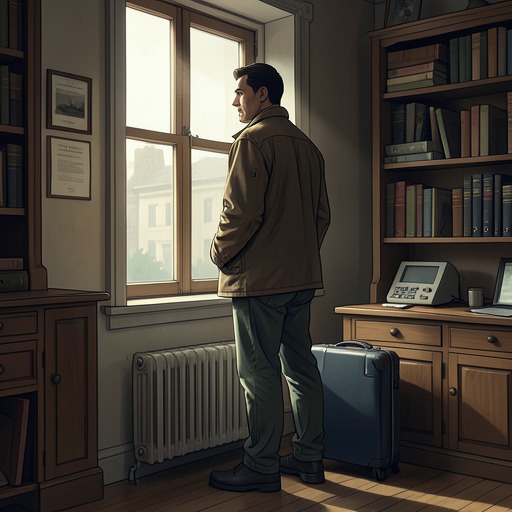
Trond’s father and Franz
Out Stealing HorsesTrond’s father and Franz are linked by a wartime partnership that turns an abandoned farmstead into both a practical refuge and a convincing cover for secret work. Franz is the one person who knows what the father is really doing there: helping sustain a courier line to Sweden for the Norwegian Resistance. Years later, he becomes the person entrusted to tell Trond about that concealed part of his father’s life.
A meeting shaped by secrecy
In 1942, Trond’s father came through the forest from the north looking for a place near the border. He needed somewhere he could use repeatedly: a base from which to carry papers, letters and sometimes films to Sweden, and a place to return to when each mission was complete. He did not act like a fugitive. He was unhurried, open and friendly to the people he met, presenting his search as a desire for somewhere to think. That explanation passed without much question, but Franz alone understood its real purpose.
The two men already knew of each other, though they had not met face to face. Their first meeting took place at Franz’s door, where Trond’s father knocked and used a prearranged phrase about going out to steal horses. The phrase connected the meeting to the men’s covert work without naming it openly. Their relationship begins, then, not with an account of their plans but with a shared code: Franz recognizes what the visitor is asking, and the conversation can proceed under cover.
The cabin as shared work and cover
Franz showed Trond’s father a vacant summer cabin on a smallholding that had been bought by Barkald after a foreclosure. The property had been empty for four years. Its cow byre had collapsed, and the place needed substantial repair; its position on the east bank of the river, a twenty-minute walk from the nearest bridge and with no buildings farther back before the Swedish side, made it useful for the father’s purpose.
The work on the cabin served two functions. Trond’s father cut grass, cleared and burned the remains of the byre, repaired the roof, replaced broken windowpanes, cleaned scrub from the riverbank, renewed the gable boards, mended the stove and swept the chimney. He even made two chairs. These repairs made the property usable, but they also gave his presence a legible everyday explanation. People could see him improving Barkald’s neglected place; Barkald confirmed that this was what he had been asked to do.
Franz believed that the father genuinely enjoyed the practical labor, not merely its usefulness as camouflage. The work was the kind of thing he had little time or freedom to do in Oslo, where he lived with his family in rented rooms. His stays in the village were initially meant to be brief, long enough for people to grow accustomed to seeing him across the river. But each return from Sweden gave him another repair to finish. A cracked chimney, for example, needed masonry work before it might collapse and send tiles down onto someone. The successive jobs lengthened his visits and, over a couple of years, helped create an alternative life there that his family did not know existed.
Keeping the route alive
Trond’s father maintained the line for two years, in both summer and winter. When he was away from the cabin, someone from the village sometimes carried the final leg across the border. Franz did so once or twice; Jon’s mother also helped when she could get away. Their participation placed the relationship within a small, exposed network rather than a partnership operating in isolation. In a district where people knew one another’s routines, unusual behavior was noticed and recorded for later use in the community’s informal accounting of each other’s lives.
The father’s public identity helped protect the work. He could be seen crossing Barkald’s meadow with an empty bag on his way to the shop, or returning with supplies. At other times, he walked along the main road with a fuller bag, turned into the meadows by Barkald’s fence and rowed across the river. Germans and Norwegians alike knew him as the man repairing the cabin. Officials had checked the property and found tools and books, but nothing suspicious; his border-residency certificate and other papers were in order. Franz’s role and the repairs thus belonged to a larger strategy of making the concealed activity appear ordinary.
The handling of the mail also depended on that ordinary appearance. Trond’s father sometimes collected it from the bus or the shop, before or after closing. At other times Jon’s mother picked it up and carried it upriver with food for the supposed handyman. The arrangement made her visit seem domestic and practical: Barkald could ask her to cook because the man restoring the cabin needed feeding. In fact, the appearance of assistance also gave her a reason to travel and a way to carry the mail.
The entrusted account
The secret remained hidden from Trond and the rest of his family. His father left for stretches of a week or a month and returned without explaining where he had been; the family learned to live with his absences, while Trond continued to think about him. Trond later understood from Franz that his father had spent nearly as much time in the village by the river as beside Bunnefjord. At the time of Franz’s account, this was startling news: Trond wondered why his father and the people in the village had never mentioned the father’s repeated presence, but did not ask.
When Trond finally asked Franz why he was telling him what his father himself would not discuss, Franz answered that the father had asked him to do so when an opportunity arose. The disclosure gives their relationship a further dimension. Franz had not only known the secret and helped sustain its practical arrangements; he had also been made responsible for passing the knowledge on. His testimony lets Trond see the repairs, absences and unremarkable errands as parts of one concealed life, while preserving the distinction between what the family was allowed to know then and what the father later wanted his son to learn.