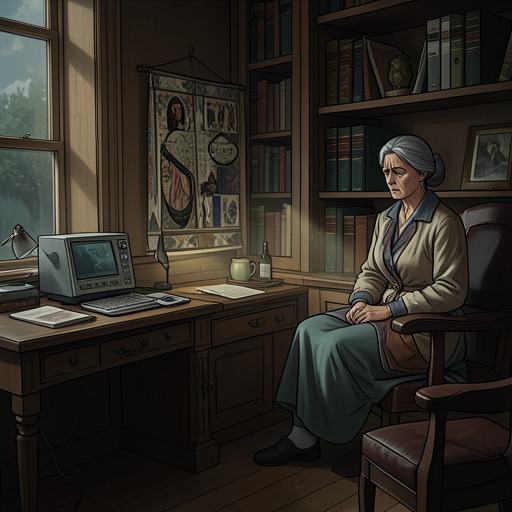
Trond’s mother
Out Stealing HorsesTrond’s mother stands at the center of two sharply different homecomings: she runs to embrace Trond’s father when he returns from Sweden after the war, then later receives his letter saying he will not come home again. Trond’s recollections show her enduring the consequences of his departure while remaining his mother in acts of practical care. Their journey to Karlstad briefly brings them together on unusually equal terms, a lightness neither can sustain once they return to Oslo.
Reunion and its aftermath
In June 1945, after eight months without seeing Trond’s father and with only two days’ notice that he was coming, Trond and his sister watch the road from a window. Their mother waits in the open doorway, twisting a wet handkerchief and unable to keep still. At last she runs down the road and throws herself at him. The scene presents her reunion as an immediate, unrestrained response, in contrast with Trond’s shyness: he hangs back by the letter box while his mother and sister cling to his father.
Trond remembers his father arriving in a worn grey suit with a grey sack on his back, walking slowly up Nielsenbakken from Ljan Station. His mother’s reception is what the moment seems to demand, but the narrator’s later knowledge alters its image. He remembers that she was young and light on her feet then; he also sees in retrospect the bitterness and heaviness that marked her in later years. The contrast makes the reunion more than a picture of happiness: it becomes a point from which Trond measures the change in her life.
The letter and the burden left behind
When Trond’s father does not return as expected, Trond repeatedly goes into Oslo to check the train from Elverum. Late that autumn, a letter arrives addressed to his mother. Though the sheet bears the names of all three family members, its message is decisive: Trond’s father thanks them for their time together, says that circumstances have changed, and states that he will not come home. He also explains that money for timber felled and sent downriver is held in a Karlstad bank, and authorizes Trond’s mother to withdraw it with proof of identity.
Her response is to ask about the timber, which reveals how little she has been told about what Trond and his father did together that summer. Trond had said only that his father would return once he had finished sorting things out. The money, and the undisclosed work behind it, therefore reach her together with the news of his departure. Trond recalls her as already growing physically heavier, a change he connects not only with the way she moves but with her voice and bearing. He describes her eyelids as heavy too, as if she were not fully awake. These are his retrospective impressions, not a neutral account of her inner life; they show how his grief and sense of abandonment shape the face he sees.
The journey to Karlstad
Trond’s mother borrows money from Uncle Amund to buy tickets for the Stockholm train, then asks Trond to accompany her while his sister remains at home. The trip is undertaken to withdraw the timber money, but for Trond it also makes the consequences of his father’s absence unavoidable. Sitting opposite his mother on the train, he sees her eyes closed and her face lit intermittently by the passing landscape. He thinks that his father has disappeared and left him with her. He immediately qualifies the severity of that thought: he loved his mother, but the future he imagined in her face feels oppressive to him.
In Karlstad, mother and son walk through town looking for the bank. When they reach the Klara River, she remarks on its beauty. Trond, cold and impatient, wants instead to settle the account and establish what has been received, given away, and left. The difference in their attention gives the errand two emotional registers: to her it can still be a day spent together in an unfamiliar town; to him it is a reckoning with what his father’s departure has cost and left behind.
After they finish at the bank, Trond’s mother changes the mood of the day. She smiles and points out that the two of them have had an outing together, something that does not happen every day, and laughs. Her response is modest rather than a denial of their difficulties. It makes room, briefly, for companionship beside the practical purpose of the journey.
A temporary ease
On the walk back toward the station and a café, Trond’s mother puts her arm through her son’s. They walk in step, their heights matched, and he compares the experience to dancing, though he has never danced. He is wearing the dark blue suit bought in Karlstad; its light fit and movement become part of the scene’s sense of ease. That ease is not presented as a cure for their estrangement. Trond’s clenched hand is sore, and the wind remains cold, yet at that moment he feels that things are fine.
The narrator makes the moment’s limit explicit: they will never walk arm in arm like that again. On returning to Oslo, his mother falls back into the heaviness he associates with her for the rest of her life. The contrast gives the day its special force. Their closeness is real, but it is temporary, held within one journey and one town rather than becoming a new pattern between them.
Relationship and narrative significance
Trond’s mother is seen largely through her son’s memory, and that perspective preserves a tension between affection and resistance. He insists that he loved her, while also describing the weight of looking at her and his difficulty accepting the future he imagines beside her. Her practical choices—borrowing money, travelling to collect it, and inviting him along—coexist with the emotional distance created by what he has not told her and what his father has left unsaid.
Her remembered movement also frames the larger change in the family: from the young woman running toward her returning husband to the woman Trond sees after that husband has withdrawn from their home. In Karlstad, mother and son briefly move together without the burden defining every gesture. Because the narrator insists that this ease does not recur, the arm-in-arm walk remains a small but decisive counter-image to the heaviness that otherwise governs his recollection of their life together.