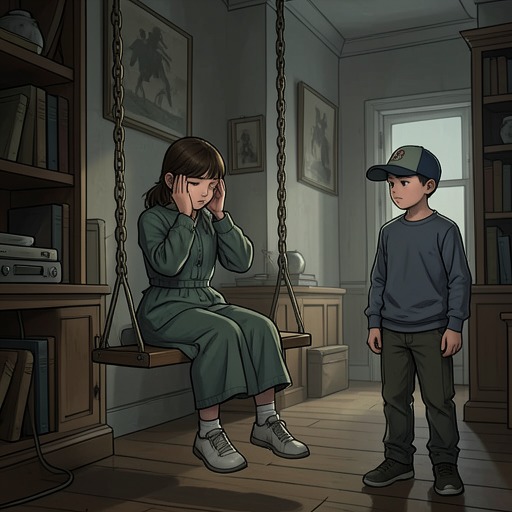
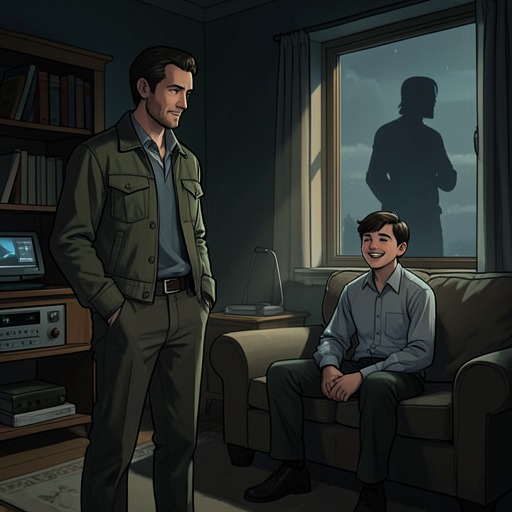
Lara Jean and Peter reconcile in the tree house
P.S. I Still Love YouLara Jean and Peter Kavinsky reconcile in the Tree House on the night before it is due to be demolished, making their renewed relationship inseparable from a place that is about to disappear. Their conversation brings hidden fears into the open, revises Lara Jean’s understanding of Peter’s ties to Genevieve, and replaces their promise to protect each other from heartbreak with a deliberate willingness to take that risk. The reunion is not a return to an untouched past: it is the moment they decide to begin again without a safety net.
The Farewell and the Meeting
The reconciliation follows Lara Jean’s recognition that Genevieve had once treasured the same object she had placed in the time capsule. At the party, Genevieve had taken the object out and hidden it rather than let Lara Jean see it. The discovery gives Lara Jean evidence that their friendship had once been real and important to Genevieve too. As tears come, she says goodbye in her thoughts to Genevieve, their middle-school years, and the Tree House and summer that had shaped those memories.
That sense of parting extends beyond one friendship. Lara Jean reflects that people can be central to someone’s life and then drift away: she had not expected Josh to cease being a constant, or imagined how difficult it would be to live without Margot nearby. The thought that people’s time in one another’s lives cannot be predicted gives the scene its emotional setting. The next day, the Tree House is to be bulldozed and replaced by a gazebo, so this meeting takes place at the edge of another goodbye.
Peter Kavinsky calls up to Lara Jean from outside in the dark, then climbs the ladder and sits opposite her. She tells him about the demolition, but he recognizes that the building is not the real reason she summoned him. Lara Jean tells him she knows Genevieve’s secret. The intimate, soon-to-be-lost setting creates room for a conversation neither has managed to have while their relationship was suspended between hurt and longing.
What Kept Them Apart
Peter Kavinsky explains that Genevieve’s family life had been troubled by her father’s infidelity, and that the situation had previously become difficult for her. During those periods, Genevieve had hurt herself, and Peter Kavinsky had felt responsible for protecting her. He admits that being needed mattered to him, even when the role frightened him. He also acknowledges that he had long known Genevieve could be manipulative, yet found it easier to fall back into the familiar position of caring for her. His confession presents their continued connection not as proof that he loved Lara Jean less, but as a pattern bound up with responsibility, fear, and what he already knew how to do.
He then identifies a different fear: disappointing Lara Jean. He understood that sexual intimacy mattered to her and worried about mishandling it, especially in light of his own past. Lara Jean initially wants to dismiss the importance of that past, but recognizes that this would not be entirely honest. Instead, she realizes that she has been the one unable to let Genevieve go. She had compared herself with Genevieve and treated the other relationship as a measure of what she and Peter Kavinsky could be. That comparison had prevented her from giving their own relationship a fair chance.
Peter Kavinsky asks what Lara Jean wants now that she has won. She describes a hope for them to be themselves together and to have a sweet first romance she can remember throughout her life. She does not mean that their relationship must already be doomed: the first romance need not be the last, but its place as a first makes it special. Peter Kavinsky answers that although he has had a first before, Lara Jean is the most special to him because he loves her. His declaration changes the conversation from speculation about the relationship’s limits to a plain statement of what it means to him.
Choosing Without a Safety Net
The confession does not instantly erase the possibility of hurt. Lara Jean recalls their contract’s promise that they would not break each other’s hearts and asks what would happen if they did. Peter Kavinsky rejects the idea that guarding themselves so carefully could lead to a real relationship. He asks her to go all in with him and proposes that they set aside the contract and its protection. His appeal turns the old agreement inside out: rather than making safety the condition of love, he invites them to accept that love cannot be made safe in advance.
Lara Jean reaches toward him and traces his eyebrow before asking about heartbreak; afterward, she places her hand over his heart. She lets it fall, but now believes his heart is hers to protect and care for, as well as something she could break. The gesture gives the abstract risk of the conversation a concrete shape. She is not claiming certainty that neither will ever be hurt; she is accepting responsibility for what they entrust to each other.
She also reflects on chance. If Kitty Covey had not sent the letters, or if Lara Jean had not gone out to the hot tub that night, the story might have unfolded with Peter Kavinsky and Genevieve together. Those alternatives matter because they make the present feel chosen without pretending it was inevitable. Lara Jean understands that their path could have been different, but this is the path they took. She concludes that she does not want either to love or to be loved by halves: having the whole relationship means accepting the risk that comes with it.
The Night They Become Real
Lara Jean takes Peter Kavinsky’s hand and places it over her heart, telling him to take care of it because it is his. He looks at her in a way that assures her he has never looked at another girl quite like that. They embrace and kiss, both shaking, with the shared understanding that this is the night their relationship becomes real. The physical closeness follows, rather than replaces, the difficult work of naming their fears and choosing each other.
The scene closes on the language of becoming real, echoed by the passage about the Skin Horse and the Rabbit. Its placement links the couple’s commitment to a broader idea: being real is not simply a condition one starts with, but something that happens. In the Tree House, on the last night before its destruction, Lara Jean and Peter Kavinsky stop treating their bond as a contract designed to prevent pain. Their reconciliation makes love a mutual act of trust, care, and exposure to uncertainty—even as the place associated with their earlier history is about to vanish.