Air-raid siren
Pamela's WarThe Air-raid siren is both a practical warning device and one of the most powerful recurring sounds in Pamela Wheeler Fellows's memory of the Second World War. Positioned directly opposite The Woodman Hotel and beside the police station, it marks the moment when distant danger becomes an immediate domestic reality. Its importance lies not only in announcing bombing, but in governing the family's movements, bodily reactions, and understanding of the landscape around them.
Location and Physical Presence
The siren is stored in a lean-to building directly opposite The Woodman Hotel, adjacent to the police station. Its placement makes it part of the hotel's everyday visual and spatial environment, alongside the lane leading toward the hills, the police station's windows, and the fields used by the local Home Guard. The object is therefore never remote from ordinary life: it stands within the same small cluster of buildings that contains work, law enforcement, military preparation, and family residence.
That proximity gives the siren a special narrative force. The hotel is already a place where people watch for signs of danger: from the elevated bar, Pamela Wheeler Fellows can see over the top sash window of the police station and observe when the Sergeant puts on his helmet. The siren belongs to this same system of observation and response. Its warning does not arrive in an abstract public space; it erupts from the familiar surroundings of the family's business and makes the local village part of the wider war.
Sound and Fear
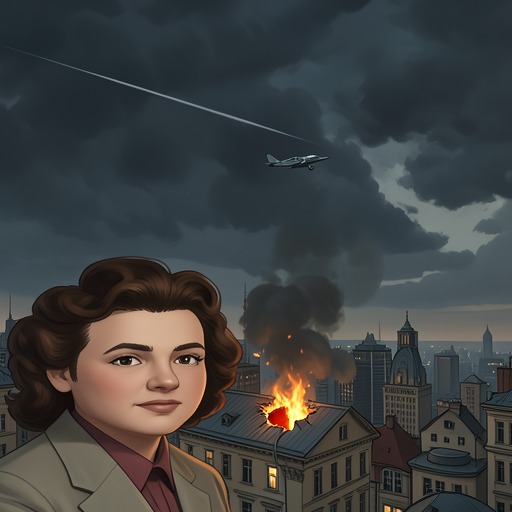
Pamela Wheeler Fellows remembers learning to fear the siren's sound long after the immediate scene has passed. It begins as a slow whine and rises into a high-pitched shriek, a progression that turns a mechanical operation into a carefully graded experience of terror. The noise is described as wrapping cold hands of fear around the heart, while the narrator's stomach muscles tighten at the expectation of another night in the cellar. The remembered sound remains frightening because it prolongs anticipation before the attack itself is visible.
The siren's warning is preceded by an earlier, quieter sign. Before the horrible wail begins, the lights in the hotel dip, apparently because the mechanism's demand places a strain on the local electricity supply. This electrical fluctuation is almost as frightening as the siren. It allows fear to begin before the formal warning, so that the family recognizes the coming raid through a change in the building's illumination as well as through sound. The hotel itself seems to register the approaching threat.
The Warning and the Surrounding War
The siren signals a danger produced by German bombers flying over the Midlands. The bombers target factories and weapons works in the cities, but they also dump unused bombs over the Clent Hills, Hagley Park, and surrounding areas to lighten their loads and improve their chances of returning safely. Several bombs are jettisoned close to the family's home, although none causes damage. The siren consequently stands between two forms of danger: the deliberate destruction aimed at industrial and urban targets, and the residual explosives cast down over the countryside during the bombers' return journey.
Its warning also connects the hotel to the wartime defensive network around it. Young soldiers stationed about half a mile away operate a searchlight intended to locate German bombers, while the local Home Guard patrols the hills at night against a possible parachute landing. The siren's sound therefore belongs to a larger chain of detection, warning, search, and response. Even the hotel kitchen participates in that defensive world when Pamela's Mother cooks meals for the searchlight team. Military preparedness and domestic routine occupy the same rural geography.
From Rural Alarm to Urban Survival
The meaning of the Air-raid siren changes when the family leaves The Woodman Hotel. Father secures a lease on a top-floor mansion flat about half a mile from Birmingham city centre, and the family leaves the relative safety of the countryside for a city already being bombed nightly. The move turns the siren from a terrifying feature of the hotel neighborhood into the prelude to a direct personal catastrophe. The first air raid in the new home is nearly Pamela Wheeler Fellows's last.
When bombing begins, the air-raid shelter is inaccessible, so the residents of the flats gather on the ground floor. Father's military experience governs the response: he orders everyone onto the floor with hands over their ears, and all comply without question. The instruction is not merely a verbal reaction to the warning; it becomes an action that protects the family and the other residents. After the raid, inspection reveals shrapnel holes mostly at waist or head height, showing that anyone standing would probably have been struck. The siren thus leads into a sequence in which warning, obedience, improvised protection, and physical evidence of survival are inseparable.