Alf Joseph
Pamela's WarAlf Joseph is one of the most important adult figures in Pamela Wheeler Fellows’s childhood: a childless family friend who treats her as a cherished companion, teaches her to ride, recruits her into his practical jokes, and eventually helps shelter her family when war destroys their home. His importance lies not in military or political authority but in the generous, playful competence with which he makes a difficult world more inhabitable. The warmth of his relationship with Pamela becomes a durable counterweight to the separations, shortages, deaths, and uncertainty that define the war years.
Identity and Place in Pamela’s Childhood
Alf Joseph is introduced as “Uncle” Alf Joseph, husband of “Auntie” Leah Joseph. The Josephs are childless, close family friends, and notably kind to Pamela and her family. Alf takes Pamela under his wing, giving their relationship a protective and affectionate character without reducing her to a passive child. His generosity is practical as well as emotional: he gives time, attention, instruction, and later a place of safety when the family has nowhere secure to go.
That adult friendship expands Pamela’s world beyond the immediate family. Alongside weekends spent with Gloria, her company includes grown-ups who welcome her participation rather than insisting that childhood must remain separate from adult life. Alf’s manner allows Pamela to act as an assistant, pupil, companion, and accomplice. The resulting bond is built through shared activity, and it gives the pre-war sections of the narrative their sense of motion and possibility.
Riding, Instruction, and Trust
Alf is the person who takes Pamela to the local riding school. He pays for her lessons, teaches her what he knows about horses, and later accompanies her on hacks through the lanes and bridle paths around Stakenbridge. His role is therefore more substantial than that of a benefactor who merely supplies an opportunity. He is a mentor whose knowledge is transmitted through repeated practice: Pamela learns to get her seat, rise to the trot, and control her mount until she becomes a confident rider.
The rides also dramatize the trust between them. Before reaching the roads, their route crosses a large grass meadow where they allow both horses to run freely. Alf rides a seventeen-hand horse, while Pamela’s smaller mare has much shorter legs, yet the pony is fast and feisty enough to keep pace at a gallop, and Pamela often wins the race. The scene reverses the expected hierarchy between adult and child and between large horse and small mare. Alf provides the knowledge and security that make the adventure possible, but he also permits Pamela genuine exhilaration and the satisfaction of succeeding on her own terms.
The Water Otter Hoax
Alf’s generosity is matched by a highly developed sense of humour. Pamela becomes his sidekick and assistant in practical jokes, most elaborately in a scheme designed to separate his friends among the hotel customers from half a crown each. The joke proceeds by stages: a rumour announces that a very rare creature has been seen locally; the creature is supposedly captured; posters advertise its exhibition; and a showman’s invitation brings a queue to the greenhouse where it is said to be held.
The “rare creature” is an otter, or, in Alf’s deliberately inflated formulation, a “water otter.” The exhibition’s real object is an enormous black kettle, presented as the biggest water hotter in the county. Pamela collects the entrance money while the audience is required to enter by one door and leave by another, preventing disappointed visitors from warning those still waiting outside. The trick depends on theatrical staging, controlled movement, and the comic gap between grand announcement and ordinary object.
The hoax is not presented as simple exploitation. The half-crowns go to charity, and the people who have been deceived generally regard the experience as clever and amusing and worth the money for the entertainment. Alf’s humour thus converts deception into communal play. He understands the appetite for spectacle, but the charitable destination of the proceeds and the good humour of the audience keep the prank within a social world of shared amusement rather than cruelty. Pamela’s role as collector also shows how fully he trusts her with the mechanics of his performance.
Refuge During Wartime Displacement
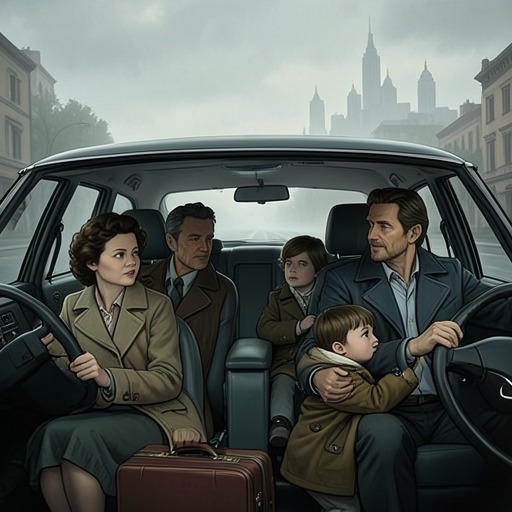
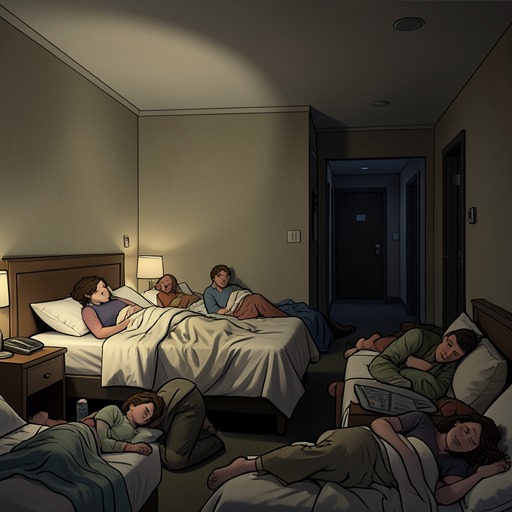
The Josephs’ importance becomes decisive after the war forces Pamela’s family from a home in which they have barely spent a night. Bombed out and suddenly homeless, the family first squeezes into the tiny accommodation above the café of Jim and Renee Parkes in Quinton. After that hospitality ends, the Josephs receive them in Hagley, where they spend several weeks as cherished guests. The earlier friendship and joking companionship therefore acquire a new weight: Alf’s kindness is not merely a pleasant feature of childhood but a material resource in a national emergency.
The Josephs’ refuge stands in sharp contrast to the wider wartime landscape. Coventry is destroyed in a sustained bombardment, families are divided by evacuation, and ordinary households are pressed by shortages and rationing. In that setting, shelter is more than a roof. It is an act of social attachment that prevents displacement from becoming complete isolation. Alf and Leah provide continuity when the family’s domestic arrangements have collapsed, and their welcome embodies the wartime pattern by which friendship becomes a form of practical survival.
Character and Narrative Significance
Alf is a rounded presence because his qualities work in several registers at once. He is a mentor who teaches discipline and control through riding, a showman who turns an enormous black kettle into a “rare creature,” and a friend whose hospitality becomes indispensable under bombardment and housing crisis. These aspects are not contradictory. His humour, competence, and generosity all arise from an ability to transform circumstances: a meadow becomes a racetrack, a kettle becomes an exhibition, and a temporary home becomes a refuge.
His scenes also establish a tonal contrast that makes the later narrative more painful. Pamela’s pre-war years pass happily, filled with animals, races, jokes, and trusted adults, while the coming war will remove loved ones, impose hunger, and replace certainty with telegrams and rumours. Alf does not prevent that historical rupture, but he helps define what is being lost and what can still be preserved. Against the bombing of cities, the thinning ranks of young men, and the grief surrounding David’s death, his relationship with Pamela records another wartime truth: community is sustained not only by official morale or public celebration, but by individuals who teach, amuse, open their homes, and make room for someone else.