Atomic bomb
Pamela's WarThe Atomic bomb is presented as the decisive instrument that finally ends the Second World War after victory has already been achieved in Europe. Its significance lies in the contradiction it embodies: it brings liberation to prisoners and families awaiting the return of loved ones, yet does so through destruction on a scale described as unbelievable. The object therefore closes the war not with uncomplicated triumph, but with a victory inseparable from mass death.
Development from Conventional War to Final Destruction
The memoir places the Atomic bomb at the end of a long escalation of violence. Earlier, the bombing of Coventry has shown how aerial warfare can transform a beautiful medieval city into a landscape of fire, while the bombardment of London and attacks on Bath, Canterbury, York, Norwich, and Exeter demonstrate the deliberate targeting of both civilians and cherished architectural heritage. Those raids are intended to break the population’s spirit, but shared danger instead strengthens communal bonds. By contrast, the later use of the Atomic bomb is not described merely as another raid in the continuing sequence; it becomes the final mechanism by which the war in the East is forced to stop.
The narrative connects this final stage to America’s entry into the war after the Japanese attack on Pearl Harbour in 1941. American nuclear bombs are said to bring the conflict to its halt in August, after the first bomb fails to make Japan surrender and a second is dropped. The sequence produces a stark value reversal: the continuing uncertainty of wartime becomes capitulation, but the means of achieving that change is annihilation rather than endurance, negotiation, or the gradual wearing down of an opponent.
Use and Immediate Consequences
The bombs destroy two cities, and the devastation is described as unbelievable. The Emperor, inspecting the damage and seeing the annihilation, finally concedes defeat. The Atomic bomb thus acts materially and politically at once: its physical effects produce the decision that conventional military pressure has not secured. The object’s power is not passive or merely symbolic within the account; it changes the course of history by making surrender unavoidable after the first strike has failed to do so.
On 15 August, Victory in Japan is declared, and the narrator can state that the war is truly over. The date gives the weapon’s consequence a public and calendrical form. Three days later, on 18 August, the narrator’s twenty-first birthday arrives, placing personal maturity beside the formal ending of global conflict. The juxtaposition does not erase the destruction. Instead, it makes the end of the war feel historically immense and personally immediate: an international announcement and an individual milestone occupy the same narrow space in time.
Liberation, Survival, and Moral Ambivalence
The end brought by the Atomic bomb has a direct consequence for Geoff, Gloria’s cousin, who has endured three and a half years in captivity. The defeat of Japan frees him and preserves the lives of other prisoners. The narrative explicitly recognizes the grim arithmetic involved: the sudden destruction of so many Japanese lives saves Geoff and those who have survived alongside him, while many of the prisoners captured with them have already died. The weapon is therefore linked to rescue, but the rescue cannot be separated from the deaths that make it possible.
Geoff returns alive but severely damaged. He is stick-thin and hollow-eyed, his health broken by ill treatment; the journey home takes more than two months and includes quarantine in America. It takes years of treatment to restore anything like normal health. These details prevent the Atomic bomb from functioning as a simple emblem of deliverance. Victory ends captivity, but it does not undo captivity’s bodily consequences, and the weapon’s arrival cannot restore the lives already lost.
From Private Grief to Public Victory
The memoir’s treatment of the Atomic bomb is shaped by an earlier pattern of intimate loss. In September 1941, at a wedding in Dudley, the narrator is overcome by a physical foreboding that David has died; the certainty proves correct, and the grief becomes so severe that the narrator thinks the heart will break. Shortly afterward, Max is also killed in his Sterling bomber over Germany. The original group of twenty young men who once gathered for a drink diminishes week by week as members disappear, are reported missing, or are presumed dead. Against this repeated experience of young lives abruptly removed, the Atomic bomb brings a final end that is public and unmistakable, but not emotionally clean.
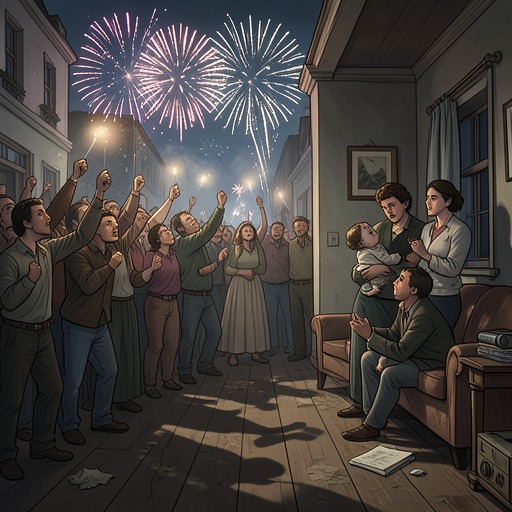
The contrast is sharpened by the celebrations held after victory in Europe. Street parties fill the country with trestle tables, bunting, Union Jacks, sandwiches, trifles, jelly, cake, fireworks, and bonfires; hoarded food is brought out to make a feast. Yet at John’s parents’ home there is no uncomplicated celebration because Rex remains missing. Even before the war in the East ends, victory is shown as unevenly distributed: some families can rejoice, while others wait for the telegram that may announce a son’s death. The Atomic bomb ends the wider conflict, but it cannot make uncertainty, bereavement, or wartime separation disappear.
Historical and Thematic Significance
The object’s importance lies in the way it gathers the memoir’s central oppositions into one final image: life and death, freedom and destruction, communal relief and private mourning. Earlier bombing fails to destroy the population’s spirit because suffering creates solidarity; radio, music, humour, and practical help allow strangers to act like friends. The Atomic bomb produces a different kind of collective transformation. It ends the threat and releases prisoners, but its success depends on devastation so immense that celebration must remain shadowed by what victory has required.
As the war’s final instrument, the Atomic bomb also changes the meaning of the phrase that the war is over. Europe’s fighting has stopped, but the East continues to burn until the two August bombings force surrender. The memoir therefore distinguishes between the emotional hope that conflict might soon end and the historical fact of its termination. The Atomic bomb supplies that fact, while leaving the reader with the uncomfortable recognition that the final peace is purchased through an unprecedented act of destruction.