British Home Front in World War II
Pamela's WarBritish Home Front in World War II is the civilian experience of total war as it unfolds through ordinary places and relationships. Its decisive significance lies in the way military danger reorganizes every part of social life: businesses lose customers and fuel, households surrender food and metal, young people assume defensive duties, public spaces become observation posts or refuges, and private joy is repeatedly interrupted by absence and death. The narrative presents endurance not as an abstract national virtue but as a daily practice, maintained through labour, vigilance, improvisation, humour, emotional restraint, and mutual aid.
A War That Reaches Civilian Space
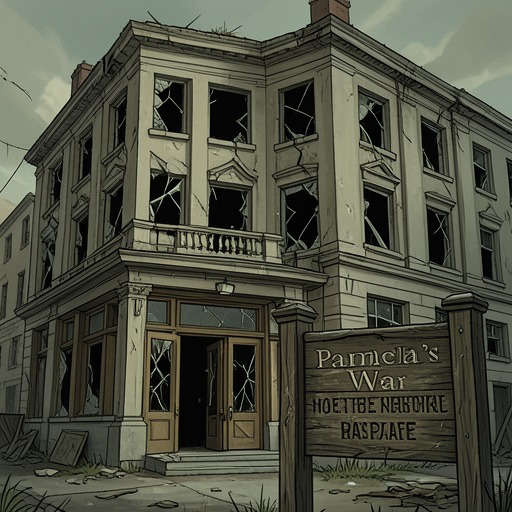
The home front is first defined by the war’s remaking of the landscape. The Woodman Hotel stands in a rural setting, opposite a lane leading towards properties, fields, and the wooded Clent Hills. That apparently sheltered geography becomes strategically charged. A group of men approaches the hotel each evening from the direction of the hills, orders drinks in English, and then speaks quietly in a foreign mother tongue. The father, listening from behind the bar, recognizes the guttural language from his service in France and his experience on the Somme. The hotel is therefore not merely a place of hospitality: wartime suspicion turns its bar into a listening post, while the nearby hills become a possible route of enemy access.
The same transformation affects the hotel’s relationship with authority. The police station stands directly opposite, making the strict licensing laws a constant threat to the family’s livelihood. Yet the elevated bar gives the narrator a view over the station’s top sash window. When the Sergeant puts on his helmet, the family receives advance warning of the licensing inspection. They call time, cover the beer pulls with towels, lower the shutters, and urge customers to finish drinking before the Sergeant crosses the road. The episode captures the improvised intelligence of civilian life: surveillance is answered by counter-surveillance, and a domestic business survives by reading small movements in an institutional space.
The hotel also becomes a place of protection. As bombing makes the city increasingly unbearable, people with cars and enough fuel leave Birmingham at night, carrying blankets and thermos flasks and sleeping in country lanes. Others face the damp, cold, noisy insecurity of an Anderson shelter, or later the cramped metal cage of a Morrison shelter. The family opens the hotel bar to these temporary refugees without charging for the overnight accommodation. Milk is heated for babies and tea and coffee are provided for adults, although a ham-and-egg breakfast is sold to those who want one before returning to work. Hospitality becomes an air-raid service, joining commercial practice to unremunerated care.
Mobilization, Shortage, and Improvisation
War shortages produce both organized contribution and inventive substitution. A village woman collects unwanted newspapers in piles so high above her Austin Seven that observers fear the little car will overturn as she rounds the corner. The papers are sold to raise money, and despite the newsprint shortage reducing ordinary newspapers to four pages, her campaign eventually funds a mobile canteen supplying tea, coffee, and meals to troops. At a canteen based on the cricket ground at Dudley, the narrator helps the WRVS women prepare and serve refreshments while wearing an old school overcoat. The scene joins civilian inconvenience, female volunteer labour, and public morale in one improvised workplace.
The contribution is also material and compulsory in its reach. Large bins are distributed for food scraps because the nation’s pigs are short of feed, and households are urged to donate fresh and dry leftovers. Scrap-metal collections gather pots, saucepans, bicycles, buckets, and prams for conversion into aircraft or bombs. The family’s dented brass plant pot is surrendered, while church gates, railings, and garden fences disappear from streets for recycling. The home front thus converts familiar domestic objects and civic fixtures into military resources; the visual environment itself records the pressure of the war.
Shortage also enters the performance of femininity. Unable to buy stockings, the narrator and Gloria stain their legs brown with liquid leg makeup and draw black-pencil seam lines up the backs of their legs. The wavering lines are an improvised imitation of scarce nylon stockings, while bare legs at the office remain socially scandalous and older lisle stockings are treated as the acceptable substitute. Such details reveal that civilian adaptation is not only about survival or production. Bodies, clothing, respectability, and the expectations placed upon women are also regulated by scarcity and wartime convention.
Food preparation becomes another form of service. A battalion of young soldiers stationed roughly half a mile from the hotel struggles to cook its rations with basic equipment and little experience, having only recently left homes where their mothers handled the cooking. The mother offers to prepare the meat joints if the soldiers deliver them to the hotel kitchen, after which they march across the field in single file and eat together around a large table. The meal is her contribution to the war effort, but the licensed premises also make drink an almost inevitable accompaniment. Care work, nourishment, morale, and the hotel’s commercial identity overlap without ever becoming fully separable.
Local Defence and the Discipline of Fear
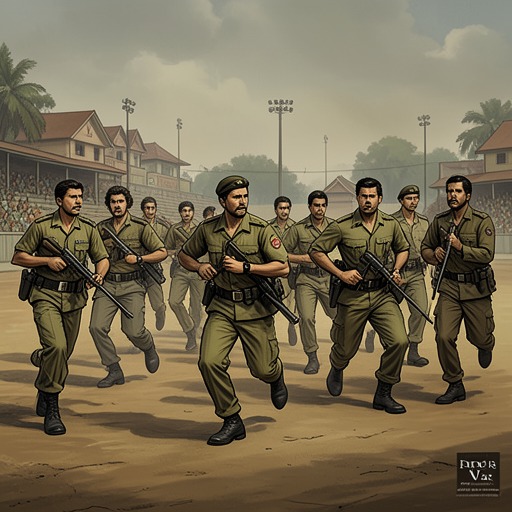
Civilian protection is organized through the local defence movement. Because of his previous war experience, the father is placed in charge of the local group, whose members are mostly young men too young to enlist. Initially identified by LDV armbands and mocked through the phrase Look, Duck & Vanish, they are later renamed the Home Guard and issued new armbands. Their lack of equipment is conspicuous: rifles are unavailable, so broom handles serve as substitutes during drill, while shotguns, pistols left from the previous war, pitchforks, and eventually weapons supplied by the British public and America are discussed as possible means of resisting an invasion.
The group nevertheless treats its responsibility seriously. It drills on the field behind the police station, the same field where the narrator once played cricket, and the father’s commands can be heard through the hotel’s open windows. His insistence on discipline changes the youths’ understanding of their role. They are not playing at soldiering; they are preparing for the possibility of confronting parachutists and protecting Clent and the surrounding area. Their frequent night patrols across the hills show how the home front turns darkness into a military condition and familiar countryside into defended territory.
The patrols also create a system of local observation. A young German maid working for an elderly woman high on the hill is seen opening and closing curtains as German aircraft approach, despite blackout rules. The action could provide the aircraft with a ground reference for locating targets. After being challenged and claiming ignorance, she repeats it and is arrested. This episode shows the emotional ambiguity of civilian security: vigilance is necessary, but it also makes neighbours, servants, foreigners, and ordinary gestures objects of suspicion.
Air Raids, Love, and Irreversible Loss
The escalating bombardment makes national events visible from the family’s immediate horizon. When Coventry is blitzed on 14 November 1940, the glow of the fires can be seen from forty miles away. The attack lasts for hours, and the medieval city is set ablaze. Other beautiful cities, including Bath, Canterbury, York, Norwich, and Exeter, are also damaged as bombing attacks both inhabitants and architectural heritage. Evacuation divides families by sending children into the countryside, and the separations are understood to have consequences that may continue into later family relationships.
Military presence brings exhilaration as well as danger. A Stirling bomber flies almost level with the hotel chimneys, close enough for the narrator to see the faces of the pilot and crew. The crew waves, and the narrator waves back, but the father identifies the pilot, Max, and demands an apology for the foolhardy manoeuvre. A later explanation suggests that the low flight may have been preparation for a raid intended to destroy a German dam, though the father remains unconvinced. The scene’s excitement is therefore shadowed by discipline and mortality: the dashing spectacle of airmen is inseparable from the risk that makes their recklessness intolerable.
For the seventeen-year-old narrator, the presence of young servicemen also produces a private conflict between paternal protection and romantic desire. The father forbids her to leave the hotel or enter the car park with them and insists that she must never be alone with a young man. She nevertheless falls in love with David, a twenty-four-year-old visitor who returns in Royal Air Force uniform. Because they know the father will disapprove, they plan to disguise their meeting as an outing with Gloria. After the narrator serves a meal to David and his friends in the upstairs dining room, the tables are pushed back and the pair dance together. At the end of the evening, she is allowed onto the car park to say goodnight; they kiss beneath a not-yet-dark sky while his friends wait in the car. They promise to take care of themselves, but wartime makes that promise fragile from the moment it is made.
On Friday 5 September 1941, the narrator attends a friends’ wedding in Dudley with Gloria. During the service, a sudden and overwhelming sense of doom makes her physically ill. She tells Gloria that David has just died, although she cannot explain how she could know. The conviction proves correct. His death becomes one of the war’s most intimate forms of violence: the event is not experienced first through an official announcement but through foreboding, followed by confirmation. The narrator remembers his laughing smile and carefree manner, and the loss is expressed as a wound that seems capable of breaking her heart.
David’s death is part of a wider attrition. Shortly afterwards, Max dies in his Stirling bomber during a raid over Germany. Of the original group of twenty young men who had visited the hotel for drinks, the number diminishes week by week. Men disappear one by one, and the family receives only the briefest details, supposedly to protect military information but also, the narrator suspects, to preserve morale. The prohibition against discussing whether the missing are dead makes the grief worse. Silence does not contain loss; it gives loss an unresolved and recurring presence.
Collective Feeling and the Meaning of Victory
The home front depends on emotional management as much as on material endurance. Radio broadcasts keep spirits high after local medium-wave transmissions are dropped for fear that their transmitters could assist enemy direction-finding. The Home and Forces Service carries Winston Churchill’s speeches and Charles Hill’s health advice, while comedy programmes, including ITMA, Hi Gang, Music While You Work, and Workers Playtime, supply catchphrases, singing, and laughter. Entertainment is not presented as an escape from the war so much as a resource that allows people to continue living inside it.
The resulting wartime spirit is described as a social change in behaviour. A common enemy lowers the usual British reserve; strangers speak like old friends and offer lifts to people they have never met. The same society that watches suspicious curtains, regulates alcohol, and disciplines young women also creates networks of practical kindness. Fear and solidarity are therefore not opposites on the home front. Surveillance, sacrifice, humour, hospitality, and grief arise from the same pressure, each helping civilians negotiate a world in which private safety depends upon collective action.
Victory in Europe Day finally converts endurance into public ritual. Street parties fill the aftermath with trestle tables covered in colourful cloths, bunting looped between houses, Union Jacks hanging from windows, and food released from carefully hoarded supplies. Sandwiches, trifles, jelly, and cake turn rationing into a temporary feast, while fireworks and bonfires symbolize freedom from the tyranny that had been feared. Yet celebration is not universal. At John’s parents’ home, the family knows that John is safe, Derek is safe, and Megan is at home, but Rex has been missing for months after fighting somewhere in Europe. When a telegram arrives addressed to W. B. Fellows, the arrival itself produces terror because such messages usually announce that a loved one is missing or dead. Victory therefore contains an unresolved remainder: national relief coexists with families still waiting for names, news, and the end of uncertainty.