British wartime blackout
Pamela's WarBritish wartime blackout transformed night into a regulated hazard. Introduced two days after war was declared, it required the extinguishing of street lights, the masking of vehicle headlights and reflectors, and the elimination of every visible chink of illumination. Intended to protect the country from German bombers, the measure also made roads, buildings, water, and familiar landmarks dangerously unreadable, turning civilian life into a continuous negotiation between military necessity and preventable risk.
Imposition and Rules
The blackout was immediate and comprehensive. Street lights disappeared across the country, while car headlights and reflectors were painted over so that vehicles could not provide an easily visible target from the air. Blackout curtains and blinds became obligatory, and all lights had to be switched off before an outside door was opened. Air-raid wardens enforced the rules, and the repeated command to put the light out became part of the national soundscape.
The regime was backed by prosecution rather than voluntary caution. The local newspaper was filled with cases against people who failed to comply. Lighting a match outdoors could lead to court and a fine of 10 shillings at the beginning of the war; later, the penalty rose to 1 pound 10 shillings for one match and 2 pounds for two. Chimney fires were treated as a possible aid to the enemy, so failure to have a chimney swept could also bring prosecution and a fine. The logic was uncompromising: even a small, momentary light might assist a foreign aircraft.
Darkness as a Civilian Danger
The blackout prevented visibility as effectively as it prevented illumination. People walked into ponds, canals, and ditches that could no longer be seen and drowned. Drivers struck other cars, cyclists, and pedestrians dressed in dark clothing. A close friend of the family caused someone’s death while driving, although no prosecution followed. The absence of punishment in that case sits uneasily beside the strict penalties imposed for a lit match, exposing the uneven boundary between deliberate non-compliance and accidents produced by the system itself.
Coal heating made the darkness worse. Thick smog, smoke from household chimneys, and unfavourable weather combined with the missing street lights, especially in the cities. Without lamps or landmarks, people became hopelessly lost in places that should have been familiar. The recommendation that carrots would improve eyesight offered a domestic wartime joke rather than a solution: better eyesight could not make anyone see through total darkness and smog.
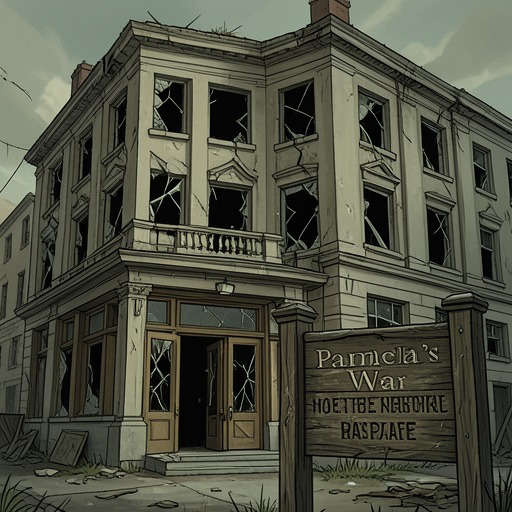
The Blackout at The Woodman Hotel
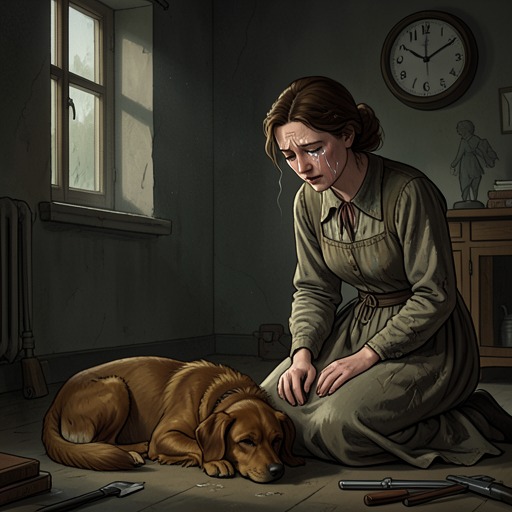
At The Woodman Hotel, the car-park lights were extinguished like everything else. In the countryside, when there was no moonlight, the area became completely black. This local condition gave the blackout a personal cost when Bonzo, Pamela Wheeler Fellows’s dog and beloved companion, was run over and killed in the car park. The car was one of the things Bonzo loved most, making the vehicle that ended his life an especially bitter instrument of wartime danger.
The driver could not reasonably be blamed. The permitted headlights produced only a tiny, dim opening of light, described as a two-inch-diameter hole through which the driver could see almost nothing. Bonzo’s death is therefore presented as an accident of war rather than an individual moral failure. He was buried somewhere in the garden, without Pamela Wheeler Fellows being told where, while for several days the family tried to say that he had run away. The blackout’s official abstraction thus becomes an intimate experience of bereavement, concealment, and a truth that the child already understands.
The hotel also shows how darkness reorganized social and commercial space. Its elevated bar allowed staff to see over the top sash window of the police station opposite. When the Sergeant stood up and put on his helmet, the hotel received advance warning that enforcement was approaching. Staff called time, covered the beer pulls with towels, pulled down the bar shutters, and hurried remaining customers to finish drinking. For months, the arrangement allowed the hotel to comply just in time, while leaving uncertain whether the Sergeant knowingly advertised his arrival or suspected the nightly preparations.
War, Suspicion, and Regulated Space
The blackout belonged to a wider wartime environment in which ordinary places were recoded as sites of observation and danger. A lane opposite the hotel led toward the Clent Hills, where a large house operated as a nursing home and cultivated vegetables for local sale. German-speaking men began arriving there in a group each evening, ordering drinks in English before speaking quietly in their mother tongue. Sidney Wheeler recognized the language from his service in France and the Somme, and the men’s presence became entangled with fears of the enemy within.
Suspicion intensified when a German maid was seen opening and closing curtains at night despite warnings, and when a large flat roof at the house appeared to have been painted white. Villagers wondered whether the roof was a signal for bombers or a marker for parachutists. Sidney Wheeler, by then leading the local Home Guard battalion, reported the group to the authorities. The Home Office responded quickly: police cars raced to the house and the Germans were taken away to imprisonment while villagers jeered and shook their fists.
The episode reveals the same emergency logic that governed the blackout. A tiny visual sign, an unfamiliar language, or a movement behind a curtain could be interpreted as evidence of an imminent attack. The narrator later recognizes that many of those detained may have been legitimate workers and that some may even have been Jews who hated Adolf Hitler. Yet the later discovery of radio transmitters in the nursing home’s chimneys confirmed that the community’s fear was not wholly irrational. The blackout’s demand for total concealment therefore coexisted with a culture of constant visual suspicion: light had to disappear, while every remaining sign had to be read.
Consequences and Significance
The blackout’s protective purpose remained inseparable from its destructive consequences. It saved concealment from the air, but it also caused drowning, collisions, disorientation, and Bonzo’s death. It converted the smallest household act into a possible offence and placed wardens, police, and neighbours inside private routines. At the same time, it altered the meaning of familiar buildings: the hotel became an observation point, the police station a visible warning system, the countryside a field of absolute darkness, and the city a landscape stripped of landmarks.
Its psychological force lies in this collision between necessity and damage. The measure was not merely an absence of light; it was an active social discipline that made safety depend on obedience while making ordinary movement hazardous. Later wartime scenes underscore the same instability. When Pamela Wheeler Fellows’s family moved from the relative safety of the countryside to a top-floor flat near Birmingham’s centre, they entered a city already marked by bombing, and the inaccessible shelter left residents exposed when an air raid began. The blackout had prepared civilians to live without sight, but it could not guarantee protection. Its legacy in the narrative is consequently double: a collective defensive practice and a machinery of accidental loss, fear, and enforced silence.