Broome
Pamela's WarBroome is a small village near Clent whose farm becomes the setting for Pamela Wheeler Fellows's most direct encounter with wartime labour. Reached from Halesowen by bus and a long walk, it brings her close to the landscape she had known before leaving the hotel, but the work there replaces sheltered hospitality with physical endurance, collective female service, and a new understanding of what the war demands from civilians.
Setting and Approach
Broome lies near Clent, and the farm is close enough to the former hotel that Pamela Wheeler Fellows observes it would have been little more than five minutes from home had the family not left. The journey nevertheless marks a change in social and physical world: she takes a bus from Halesowen, walks up the farm's long drive, and arrives at a large farmhouse kitchen for an interview. Broome is therefore both geographically familiar and narratively transitional, a rural threshold between the life that wartime economic collapse has taken from the family and the strenuous work that follows.
The interview exposes the practical standards of the place. Pamela arrives in a smart suit and high court shoes, dressed as though applying for an office position. Mr Pheysey, the farmer, assesses her against the demands of agricultural work and asks whether she has flat brogue shoes, since such shoes are necessary on the land. Her father supplies the required footwear, allowing her to begin the following Monday in brogues, dungarees, a cotton shirt, and a headscarf used to keep hair and corn out of her eyes.
Wartime Agricultural Work
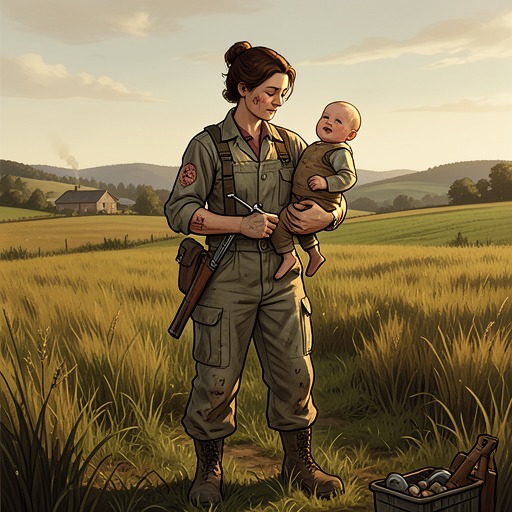
The farm is staffed largely by women drafted into the Women's Land Army to replace men called up to fight. They wear khaki dungarees, use an outside privy, and wash at a cold-water pump in the yard. The only men remaining are the farmer and men too old for military service, yet their accumulated experience allows them to teach the women the skills needed to keep the farm operating. Broome thus presents wartime substitution not as an abstract national policy but as a daily transfer of knowledge between generations and between men who remain and women newly recruited to the land.
The farm also reflects the material economy of wartime Britain. Two working horses pull tractors and carts, eliminating the need for petrol-consuming machinery at a time when fuel shortages restrict movement and commerce. The women plant, hoe, and harvest in all weather and work long hours. On her first day Pamela eats her sandwich lunch by eleven o'clock because she is so famished, a small but concrete lesson in the bodily cost of agricultural labour; she does not repeat the mistake. Broome makes hunger an index of exertion rather than merely of rationing, while the horses represent a rural adaptation to the scarcity that has damaged the family hotel.
Pamela's Transformation
Pamela loves the work despite its hardship. By the end of the summer she is tanned, supple, and exceptionally fit, a physical change that contrasts sharply with her initial appearance as an overdressed town worker in high court shoes. The farm does not merely provide employment: it alters her body, routine, and sense of capability. The movement from hotel rooms, bars, and formal clothes to fields, dungarees, cold water, and weather produces a practical coming-of-age grounded in labour.
This transformation also carries a new vulnerability. By the end of that summer Pamela is expecting her first baby. Advancing pregnancy forces her to retire from the Women's Land Army, and her sister-in-law Megan takes over her position on the farm. Her departure is therefore not caused by failure or reluctance; it is the consequence of a new stage of life that interrupts a role she has embraced. Broome remains the place where national mobilisation and private maternity meet, with the work passed on to another woman when Pamela can no longer continue.
Broome in the Wider Wartime Landscape
Broome belongs to a network of rural locations that becomes increasingly important as the war reshapes movement, food, and work. Elsewhere, a hotel that once had six letting bedrooms, a bar, a lounge, a dining room, fourteen staff, and a floodlit car park loses its customers under fuel rationing; eventually Pamela's father relinquishes the tenancy to the brewery. At the farm, by contrast, the absence of petrol is met by horses and carts, and the land remains productive through labour that the Women's Land Army has been created to supply. The contrast gives Broome a structural role in the book: it is the rural counterpart to the failing service economy.
The village also sits within a countryside marked by surveillance and suspicion. Near Clent, a large house understood to be operating as a nursing home is surrounded by fields and backs onto the wooded Clent Hills; groups of men speaking German there attract attention, and Pamela's father, by then leading the local Home Guard battalion, reports them. Police raid the property, and the Germans are driven away for imprisonment after villagers gather outside the hotel. Years later Pamela hears that a policeman from Lye sent to inspect the nursing home found radio transmitters up the chimneys. Broome's apparently pastoral setting is thus connected to the wartime fear of the enemy within, showing how farms, hills, nursing homes, roads, and businesses acquire new meanings under military pressure.
The farm's productive purpose also resonates with the wider national demand for food. Households are asked to collect scraps to fatten pigs, while shortages remove familiar foods and leave Pamela's family permanently hungry after the hotel is gone. Her later baby's pram is commandeered by her grandmother to carry food for the family, and rationing continues to govern ordinary domestic life. Against that background, the work at Broome is not picturesque rural interlude but part of the effort to sustain a population deprived of supplies and separated from the abundance once available through hotel catering.
Narrative Significance
Broome is remembered as a place of separation and renewal. Pamela arrives carrying the outward signs of an office-bound town life, learns the physical grammar of farming, and leaves with a changed body and a pregnancy that redirects her future. The location gathers several wartime oppositions into one compact setting: city and countryside, petrol and horsepower, male absence and female replacement, comfort and exertion, public duty and private motherhood.
Its importance also lies in the way the memoir connects intimate memory to national structures. A bus ride from Halesowen, unsuitable shoes, a cold-water pump, headscarves, two working horses, an early-eaten sandwich, and a summer tan make the Women's Land Army tangible. Broome becomes the point at which the war is experienced not through battle alone but through the body, the soil, and the exhaustion of work that must continue in every kind of weather.