David
Pamela's WarDavid is remembered as the young Royal Air Force pilot who becomes Pamela Wheeler Fellows’s first great love and then one of the war’s innumerable lost young men. His relationship with Pamela is brief but decisive: their attraction grows through the hotel where she works, culminates in a single kiss and a promise to keep safe, and ends when David sacrifices his chance of survival to keep a disabled aircraft from crashing onto houses. His death gives a personal shape to the wider wartime catastrophe, in which handsome visitors disappear from one week to the next and are reported only as missing or dead.
Identity and Introduction
David belongs to the group of servicemen who visit the hotel for drinks and meals between sorties. The young men bring with them an atmosphere of movement and danger: despite the shortage of petrol, they continue to find their way to the hotel, and some promise to fly over it to say hello. Their presence makes the hotel a temporary meeting place between civilian life and the air war, while their youth and vulnerability remain increasingly apparent as the casualty rate rises. Only a quarter of bomber crews survive, and Pamela’s future dreams are repeatedly altered when men she has begun to like are first declared missing and then dead.
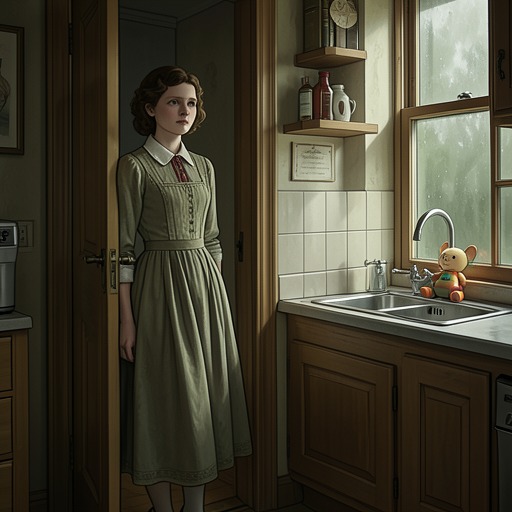
David initially appears as a regular visitor to Pamela’s cocktail bar. He has recently arrived in his Royal Air Force uniform, and Pamela is immediately struck by how handsome he looks. Her attraction is reciprocated: he invites her out, and they arrange to attend a dance when he next comes home on leave. The relationship therefore begins not as a distant fantasy but as a mutual, practical courtship conducted under wartime restrictions and the watchful authority of Pamela’s father.
Courtship Under Restriction
Pamela’s father imposes strict rules because the hotel is surrounded by young servicemen. She is forbidden to walk out of the hotel or onto the car park with any of them and is never to be alone with a young man. These rules turn an ordinary courtship into a small act of concealment. Pamela and David decide to tell her father that she is going out with Gloria, making no mention of the Royal Air Force men. Their plan shows both the force of the paternal barrier and Pamela’s determination to create a private emotional life within it.
Their most important evening takes place after Pamela prepares and serves a meal for David and his friends in the upstairs dining room. Once the meal is cleared, the tables are pushed back and David sweeps Pamela into his arms; they dance together in the room that has just served as a dining space. The transition from service and social formality to intimacy gives the scene its emotional force. Pamela decides that David is the person with whom she wants to spend the rest of her life, and David tells her that he feels the same.
David is twenty-four and Pamela is seventeen. At the end of the short evening, she is permitted, despite her father’s careful policing, to walk onto the car park to say goodnight. His friends wait in the car while the couple kiss once beneath a late-summer sky, with dance music faintly audible in the still air. Pamela treats that single kiss as confirmation of a future marriage. The intensity of her certainty is matched by the fragility of the circumstances: David must return to service, and the war has already made promises of safety unreliable.
Flying and the Premonition of Loss
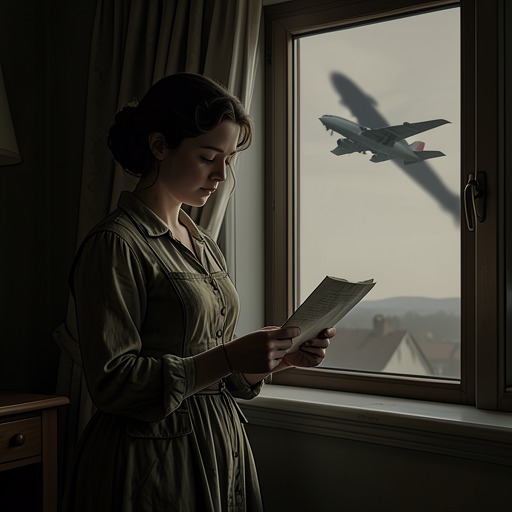
Before the final separation, David sends Pamela a message from the air. On the following Sunday she recognizes the unmistakable engine noise of a Spitfire. The single-seat fighter is smaller and higher than the Stirling bomber that had previously flown dangerously close to the hotel, and Pamela understands at once that David is at the controls. He loops the loop above her, and she answers discreetly from an upstairs window by waving a tea towel. The improvised signal preserves the playfulness of their courtship while placing it inside the lethal machinery of aerial combat.
Pamela does not know that this will be the last time she sees him. Days pass while she thinks about David constantly. On Friday, 5 September 1941, she travels with Gloria to Dudley for a friends’ wedding. During the service, although the occasion is otherwise happy, Pamela is overwhelmed by an unprecedented feeling of doom so powerful that it makes her physically ill. She tells Gloria that David has just died, even though she cannot explain how she could know this. Reassurances from the wedding party prove false: when they return home, confirmation of the news has arrived.
Death and Final Tribute
David has been training in Scotland shortly after their precious evening together. He has held his pilot’s licence for only six weeks when his aircraft collides with another. His disabled plane threatens nearby houses, and David remains at the controls rather than attempting to save himself immediately. By the time he escapes, the aircraft is too close to the ground; his parachute fails to open fully, and he dies. The account presents his death as both an aviation accident and an act of deliberate responsibility. He preserves the lives and homes below at the cost of his own, becoming a hero in the moment that destroys Pamela’s imagined future.
David is buried at Polmont in Scotland on the following Tuesday. Pamela is given the possibility of attending the funeral, but her father decides that it is too dangerous for her to travel such a long distance with a young man who is a close friend of David. One tragedy is considered more than enough. Pamela therefore has to surrender the physical farewell and send her final gift by proxy: a wreath of twelve red roses, each representing her undying love, is placed on David’s coffin. She also writes a poem on the reverse of his photograph, preserving his laughing smile and carefree way in a keepsake that remains with her.
The grief is not contained by David’s death alone. Shortly afterward, Max, another member of the hotel’s circle, is killed in his Stirling bomber during a raid over Germany. Of the original group of twenty young men who come for a drink, the number diminishes week by week. The official details are brief, and discussion is discouraged, supposedly to protect military secrecy or morale; the silence makes the losses more terrible. David thus stands both as an individual beloved man and as the first fully intimate instance of a recurring wartime pattern: young airmen arrive, promise to return, and vanish into reports of death.
Narrative and Historical Significance
David’s role is shaped by the contrast between private romance and public destruction. His courtship gives Pamela a language of promise—dance, a kiss, a future marriage, and mutual vows of care—while the war supplies the forces that make each promise precarious. The Spitfire’s distant loop is at once a flirtatious greeting and a reminder that the beloved is suspended inside a weapon. David’s death turns the exhilarating spectacle of flying into an irreversible absence.
His story also complicates the period’s rhetoric of courage. Wartime communities are drawn together by a shared enemy, strangers offer help, and public celebrations later release collective relief, but David’s sacrifice shows what such unity costs particular families and lovers. The same wartime spirit that binds communities cannot restore the young men who have been lost. Pamela’s twelve roses and the photograph’s preserved smile create a private memorial against the official economy of terse notifications, where individuals risk being reduced to the phrase missing or dead.
David’s brief appearance has a lasting structural effect on Pamela’s life. He is not simply an interrupted romance; he is the emotional measure against which later safety, love, marriage, and survival are understood. The relationship’s ending subverts the expected fulfillment of a wartime love story: the couple recognize one another as lifelong partners, but the future is replaced by a funeral the heroine cannot attend and a wreath delivered in her place. David remains present through memory precisely because the war removes every ordinary means by which a shared life might have continued.