Fear of the enemy within
Pamela's WarFear of the enemy within names one of the most volatile forms of wartime anxiety in the narrative: the suspicion that danger is not only approaching from the skies or the battlefront, but is already embedded in ordinary local life. It turns nationality, language, occupation, domestic behaviour, and even the colour of a roof into possible evidence. The fear produces vigilance and sometimes exposes real espionage, but it also makes punishment precede knowledge, allowing people to be imprisoned or publicly condemned simply because they were born in an enemy country.
Origins in Wartime Suspicion
The fear develops within a society already being reshaped by the war. At The Woodman Hotel, the destruction of Googleomo's ice-cream shop provides an early and intimate example. Once the war begins, the windows are smashed because he is Italian and the local population no longer wants Italians in the town, regardless of the quality of his ice cream. After Italy enters the war, Googleomo is imprisoned with other Italians in an internment camp. The abrupt ending of the family's coffee and ice-cream outings shows how quickly a familiar civilian pleasure can be recoded as enemy association: a shopkeeper becomes suspect, and a social custom disappears with him.
The same logic reaches the hotel when a small group of men begins arriving each evening. They come down the lane opposite the hotel, the route leading towards the Clent Hills, where several properties stand, including a large house understood to be operating as a nursing home. The grounds are extensive enough to produce and sell vegetables, and the house is backed tightly against wooded hills. The men's routine is unobtrusive but repetitive: they order drinks in English, then sit together speaking quietly in their mother tongue. Their language becomes the decisive clue. Sidney Wheeler, listening behind the bar, recognises its guttural sound from his service in France and the Somme, then realises that the men are German, his old enemy. The ordinary public-house scene is transformed into a question of how Germans could be living in a Worcestershire village several months into the war.
Surveillance and the Local Landscape
Once the men have been identified as Germans, the surrounding landscape becomes a field of signs. Pamela Wheeler/Fellows repeatedly attempts to count the heads of those entering the large house, treating a small act of observation as a clandestine contribution to the war. When the people answering the door eventually forbid her to come up again and direct her to make purchases from the shop in the lane, the restriction intensifies her suspicion. She later doubts that her counting altered the war's outcome, but the episode captures how civilians are drawn into improvised intelligence work when official information is scarce and fear makes uncertainty intolerable.
The case becomes more charged when a German maid working for an elderly lady on the hills is seen opening and closing curtains at night despite blackout rules. She is warned to stop, claims ignorance, repeats the action, and is jailed. The behaviour can be interpreted as innocent or as a signal to aircraft, but under wartime conditions the distinction is settled through punishment rather than proof. A recently white-painted flat roof at the big house generates a second theory: perhaps it is a marker for German bombers attacking nearby cities and aircraft factories, or a guide for parachutists landing after dark. The house is no longer merely a nursing home with productive grounds; from the village's perspective, it has become a concealed observation point, a possible signalling station, and a threshold through which invasion might enter.
Space makes the fear tangible. The lane, the wooded Clent Hills, the elevated house, and the hotel bar form a local system of watching and being watched. Sidney Wheeler can see over the top sash window of the police station opposite the hotel and uses that vantage point to anticipate the Sergeant's movements; the same habit of looking outward prepares the family to interpret distant hills and curtained windows as military evidence. His leadership of the local Home Guard gives suspicion an institutional channel. He reports the German group to the Home Office, and the response is immediate: police cars race past the hotel and up the lane to the large house.
Home Guard Vigilance
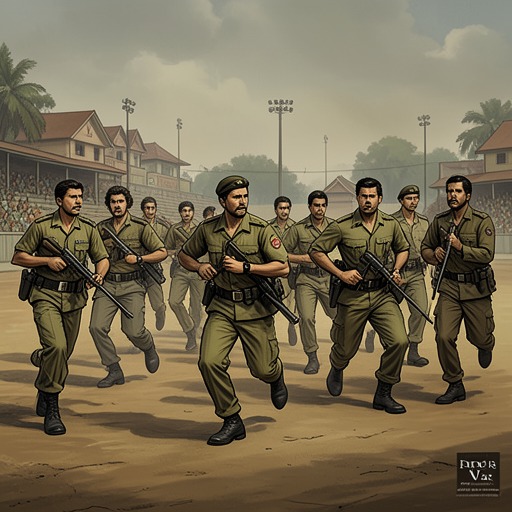
The Home Guard gives the community's anxiety a disciplined form. The local battalion consists almost entirely of young men from the village who are too young to join the regular forces, making it a youthful rather than paternal military body. At first the men have no uniform beyond Government-issued LDV armbands, mocked as meaning “Look, Duck & Vanish”; after the organisation is renamed the Home Guard, new armbands replace them. On the field behind the police station, where Pamela Wheeler/Fellows once played cricket, Sidney Wheeler drills them through repeated commands. The familiar recreational field is thus converted into a training ground, and the sound of military discipline carries through the open windows of the hotel.
Their material weakness sharpens rather than dissolves the seriousness of their role. With rifles in short supply, broom handles serve as substitutes during weapons practice. Plans for an emergency include shotguns, pistols left over from the previous war, and even pitchforks for confronting a German parachutist. Public donations eventually provide a large number of weapons, and America later sends rifles, but the group remains inadequately equipped for years. Nevertheless, its members patrol the hills at night, guarding Clent and the surrounding area against parachute landings. Sidney Wheeler sometimes sends Jack, the barman, up with a crate of beer, a comic gesture that also reveals how civilian hospitality and military vigilance coexist in the same household.
The patrols supply the observations that justify the alarm. The young men report the maid's repeated curtain movements as German planes approach, and from the high ground they notice the white roof below. Whether the roof is painted deliberately or by accident cannot be established, but the Home Guard treats uncertainty as a reason to act. The young men later move into the armed forces as they reach the required age; their service around the hills becomes an apprenticeship for the greater dangers ahead.
Internment, Condemnation, and Moral Ambivalence
The raid on the house ends the immediate uncertainty by removing the Germans from the village and sending them to prison. Pamela Wheeler/Fellows stands among jeering villagers at the front of the hotel as the group is driven away. The crowd shakes fists and celebrates the result, convinced that the danger has been dealt with. Yet the retrospective narrator refuses to leave the scene at that uncomplicated point. Many of those deprived of their freedom may have been working lawfully and acting with the best intentions; some may even have been Jewish and therefore hostile to Adolf Hitler. The law, she observes, uses a broad brush, and nationality becomes sufficient to erase individual circumstance.
This contradiction is central to the concept. The community's hostility is racist paranoia in its broadest form, but the narrative does not simply dismiss every suspicion as fantasy. Years later, at a Women's Land Army reunion in Worcester, Pamela Wheeler/Fellows meets someone from Pershore whose father, a policeman from Lye, had been sent to inspect the nursing home. He found radio transmitters hidden up the chimneys. The delayed revelation confirms that the house was connected to covert enemy activity, though it does not prove that every German resident was guilty or that the villagers' collective punishment was just. The episode leaves the reader with a difficult double truth: fear helped uncover a genuine threat, while the same fear indiscriminately harmed people whose only established offence was their origin.
From External Bombing to Internal Fear
The anxiety about hidden enemies intensifies because the wider war repeatedly demonstrates the scale of unseen danger. When Coventry is bombed on 14 November 1940, the fires can be seen from forty miles away. Wave after wave of bombers attacks the medieval city, killing many thousands in their homes. Hitler's use of an English travel guide to select beautiful cities extends the threat beyond military targets to architectural heritage and civilian identity; Bath, Canterbury, York, Norwich, and Exeter are also damaged. Families are divided when children are evacuated into the countryside, and some of those separations later damage family relations. Against this background, a curtain, a white roof, or a foreign language can seem to carry the same lethal significance as a bomber overhead.
The fear nevertheless exists alongside a contrasting wartime spirit. Radio broadcasts, Churchill's speeches, comedy programmes, music, and touring variety shows help people endure shortages and deprivation. Pamela Wheeler/Fellows describes war as binding strangers together: people offer lifts, converse as though they were old friends, and lower their usual reserve. The same emergency that creates suspicion can therefore create solidarity. Fear of the enemy within marks the darker limit of communal unity, showing how a society's impulse to protect itself can divide neighbours into the trustworthy and the condemned.
Its moral pressure persists even after the danger has moved beyond the village. Later losses among young men, including David's death and Max's death in his Sterling bomber, make the enemy a source of intimate grief rather than merely an abstract national threat. At VE-Day, public celebrations release hoarded food, flags, bunting, fireworks, and bonfires into the streets, but John Fellows's family cannot celebrate freely while Rex Fellows remains missing. The contrast between national victory and private uncertainty recalls the earlier structure of the fear: public emotion simplifies events into safety or danger, while individual lives remain complicated, unconfirmed, and vulnerable to verdicts made from incomplete evidence.