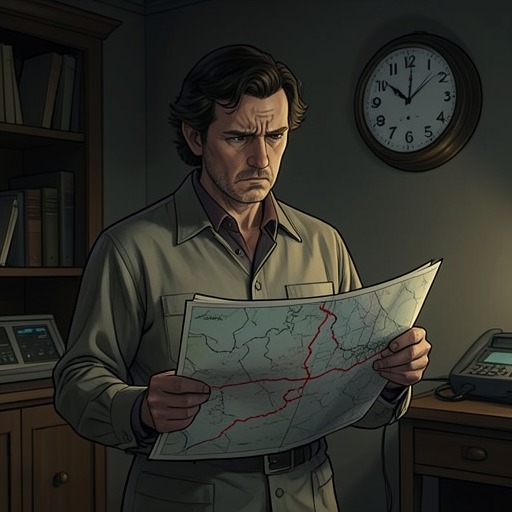
Internment of enemy aliens in Britain
Pamela's WarInternment of enemy aliens in Britain transforms wartime suspicion into imprisonment, separating people from ordinary work and community life because they are classified as potential enemies. The narrative follows that transformation at street level: an Italian shopkeeper loses his windows and freedom, while a group of German residents near Clent becomes the focus of surveillance, denunciation, police action, and public hostility. Its decisive significance lies in the tension between justified fear and collective prejudice: later evidence confirms that the German group concealed radio transmitters, but the narrator still recognises that many interned people may have been innocent, politically opposed to Adolf Hitler, or even Jewish refugees from the regime they were accused of serving.
Nationality Made Suspicious
Not long after the war begins, Googleomo’s ice-cream shop is attacked because he is Italian. The local population no longer wants Italians in the town, however good the ice cream may be, and every pane of glass in his shop is smashed. When Italy enters the war, the hostility acquires official force: Googleomo is imprisoned with other Italians in an internment camp because Italians have become enemy nationals. The immediate consequence is not merely the loss of a business but the destruction of a familiar social ritual. The coffee and ice cream that had represented carefree youth and pleasure come to an end.
This episode establishes internment as a process that begins before the police arrive. Public feeling first turns a neighbour into an outsider, then accepts his confinement as the logical consequence of his passport. The narrative does not suggest that Googleomo’s conduct has changed; the change is in the political meaning imposed upon his identity. A shop once judged by the quality of its goods is reinterpreted through the nationality of its owner.
The Clent Suspicions
A second and more elaborate case develops around a large property on the hills opposite the hotel lane. The house is understood to be operating as a nursing home, and its extensive grounds produce vegetables for sale to the local public. A small group of men comes down the lane at the same time each evening, orders drinks in English, and then sits quietly talking in its mother tongue. Their repeated movements, the secluded setting, and the foreign language make them objects of attention.
The men’s language reminds Pamela Wheeler Fellows’s father of the guttural sound he heard during his war service in France, especially his time on the Somme. He knows it is not French, and after listening carefully he realises that the men are speaking German. Their identity is therefore inferred through sound, memory, and atmosphere before any concrete evidence is found. The hotel, normally a place of hospitality, becomes an observation point from which ordinary behaviour is recoded as possible espionage.
The surrounding landscape intensifies the suspicion. The house stands among fields, with its grounds pressed against the wooded Clent Hills, and its position offers concealment as well as access to the countryside. Pamela Wheeler Fellows begins clandestinely counting the heads of the people going into the property. After several attempts, those opening the door forbid her from returning to the house and direct her to make purchases from the shop in the lane. The ban confirms the atmosphere of secrecy without explaining it, leaving her to wonder whether the residents have something to hide.
Surveillance and Arrest
The fear of an enemy within reaches a higher pitch when a German maid employed by an elderly woman is seen opening and closing curtains at night. Although warned to stop, she continues and is jailed. At the same time, one of the large flat roofs at the big house appears to have been painted white. The villagers speculate that it might be a signal for bombers attacking nearby cities and aircraft factories, or a marker intended to help enemy parachutists land after dark. These interpretations show how blackout conditions and nightly bombing make small visual details carry enormous weight.
Pamela Wheeler Fellows’s father is by then leading the local Home Guard battalion. Using his influence, he reports the nearby group of Germans to the authorities because he believes they pose a danger. The Home Office responds quickly. Police cars rush past the front of the hotel and up the lane to the large house, converting suspicion into a public operation and the secluded property into a scene of official intervention.
The arrest is witnessed by a jeering, fist-shaking crowd gathered outside the hotel. The Germans are driven away to be imprisoned, and the villagers greet the result with happiness. The scene makes the community’s participation in internment unmistakable: confinement is not only administered by the state but emotionally ratified by neighbours who experience the removal of the suspected enemy as a communal victory.
Doubt, Confirmation, and Moral Unease
The retrospective narrator complicates the villagers’ certainty. From the distance of later years, Pamela Wheeler Fellows worries that many people deprived of freedom solely because of their country of birth may have been working legally and acting with the best intentions. Some may have been Jews who hated Adolf Hitler as intensely as the British did. The law, she observes, uses a broad brush, and the memory of the cheering crowd becomes morally uncomfortable even though the younger community had considered the outcome entirely satisfactory.
The narrative then introduces a delayed confirmation. At a Land Army reunion in Worcester many years later, Pamela Wheeler Fellows meets someone from Pershore who remembers hearing about Clent. The woman’s father, a policeman from Lye, had been sent to inspect the nursing home and had found radio transmitters up the chimneys. This discovery means that the fears surrounding the house were not wholly paranoid: the property did conceal equipment consistent with enemy communication or espionage. Yet the later revelation does not erase the earlier ethical problem. Evidence that one group was dangerous cannot prove the guilt of every foreign national, nor can it make the crowd’s pleasure at collective punishment innocent.
Internment within the Home Front
The Clent episode belongs to a wider wartime system in which civilian spaces are repeatedly reorganised around detection and defence. The hotel stands directly opposite the police station, and Pamela Wheeler Fellows can see over the top sash window from the elevated bar to the moment when the Sergeant puts on his helmet. That visual advantage allows the staff to cover the beer pulls, lower the shutters, and persuade remaining customers to finish drinking before the officer crosses the road to enforce licensing hours. In the same setting, the bar’s view over the lane also makes it a place where unusual visitors can be watched and interpreted.
The Home Guard reinforces this atmosphere of local vigilance. Clent’s battalion consists largely of young village men too young to join the armed forces. Initially they wear armbands marked LDV, mocked as “Look, Duck & Vanish,” before the organisation is renamed the Home Guard. Pamela Wheeler Fellows hears her father drilling them on the field behind the police station, where she once played cricket. Their weapons are scarce: broom handles substitute for rifles, while shotguns, pistols left from the previous war, and even pitchforks are imagined for emergencies. Despite their inadequate equipment, they patrol the hills at night against the possibility of enemy parachutists. Internment thus emerges from a culture in which vigilance is both a practical duty and a habit of mind.
That culture also contains forms of mutual aid that contrast with the treatment of foreign civilians. When young soldiers operating a searchlight half a mile from the hotel struggle to cook their rations, Pamela Wheeler Fellows’s mother offers to prepare their meat in the hotel kitchen. The soldiers march across the field, eat together at a large table, and drink at a licensed establishment. Such hospitality expresses the wartime spirit of care within the imagined national community, while internment marks those defined as outside it. The same war that encourages strangers to help one another can make nationality a sufficient reason to withdraw trust.
Fear’s Lasting Consequences
The pressures surrounding internment form part of a broader emotional landscape shaped by bombing, secrecy, and separation. When Coventry is bombed on 14 November 1940, the glow of the fires can be seen forty miles away, and the destruction of cities such as Bath, Canterbury, York, Norwich, and Exeter is understood as an assault on both people and national heritage. Evacuation divides families, while radio broadcasts, Churchill’s speeches, comedy, and music are used to sustain morale. Against this background, reports of transmitters, suspicious curtains, or a white roof acquire the force of possible life-and-death warnings.
Yet the narrative repeatedly shows that wartime solidarity is inseparable from loss. The original group of twenty young men who gather for drinks dwindles as members disappear, are reported missing, or are killed. David’s death overwhelms Pamela Wheeler Fellows with a foreboding she experiences at a wedding in Dudley on 5 September 1941, and Max later dies in his Stirling bomber over Germany. The community’s shared grief can draw people together, but shared fear can also make public cruelty feel like patriotism.
The celebrations on VE Day provide a final contrast. Street parties, bunting, Union Jacks, sandwiches, trifles, jelly, cake, fireworks, and bonfires express the release of a population that believes the tyranny it feared has been defeated. But at John Fellows’s parents’ home there is no uncomplicated celebration: John is safe, while Rex Fellows has been missing for months, and a telegram addressed to Rex’s father threatens the kind of official message that usually announces that a loved one is missing or dead. The juxtaposition captures the central moral pattern of internment: national events are experienced through private uncertainty, and official language can turn a person into a category—enemy alien, missing soldier, or casualty—before the family has recovered the human story behind it.