John Fellows and Rex Fellows's brotherhood
Pamela's WarJohn Fellows and Rex Fellows's brotherhood is a family bond repeatedly exposed to the pressures of the Second World War. John remains close to civilian life, working on aircraft and dreaming of flying, while Rex enters the fighting and becomes one of the young men whose survival cannot be taken for granted. Their relationship therefore links two forms of wartime participation: the dangerous work of the home front and the direct physical peril of military service.
Brothers in a Wartime Family
John’s position is initially defined by what he has not yet become. He is not in the services, because he is occupied with constructing aeroplanes, although he has ambitions to fly them. His contribution is part of a wider family war effort, in which different relatives serve the national struggle in different ways. Rex, by contrast, is later presented as a soldier whose courage carries him into the most exposed forms of combat. The brothers consequently embody a contrast between technical and military service without the narrative treating either as insignificant.
The family’s emotional world is shaped by the knowledge that wartime work can still lead to death, even when the danger is not visible at home. The bombing of Coventry on 14 November 1940, with its fires visible from forty miles away, establishes the scale of the violence surrounding them. The attacks are intended to break the population’s spirit, but shared suffering draws people closer together instead. Within the Fellows family, that collective wartime spirit becomes intensely personal: the safety of each brother matters not only to himself but to the health and stability of the household.
John’s Improvised Loyalty
John’s relationship with Rex enters the plot through an act of impulsive appropriation. While pursuing Pamela Wheeler Fellows and determined to make her his girl, John borrows Rex’s motorbike without asking. The act is reckless but also revealing: John’s courtship proceeds in the middle of danger, and Rex’s property becomes part of John’s attempt to move through a world where ordinary plans are constantly interrupted by war.
The consequences arrive when German bombs make the borrowed vehicle impossible to return on schedule. After the night’s raid, Rex comes looking for his missing motorbike, furious that John has taken it and anxious to recover his property. John’s intention had been to return it before its absence was noticed, but the bombing prevents him from doing so. The episode gives the brotherhood a comic and practical surface—one brother has taken the other’s transport without permission—while placing that quarrel inside a landscape of shattered windows, broken glass, unusable lifts, and sleepless shock. Familial irritation survives because ordinary attachments survive, even when the surrounding city has become dangerous and unstable.
John’s own wartime experience also acquires a new dimension through this episode. After the raid, he and Pamela cannot return to their flat and spend the rest of the night on the ground floor of the block. The next morning John goes upstairs with Father to inspect the damage, reaching the top floor only with extreme caution through the stairwell’s shards of blown-out glass. Rex is absent from this scene, but his motorbike and the conflict over it keep him materially present. The brother who is away or elsewhere in the war is represented through an object that has suddenly become the cause of an urgent domestic confrontation.
Rex as Soldier and Hero
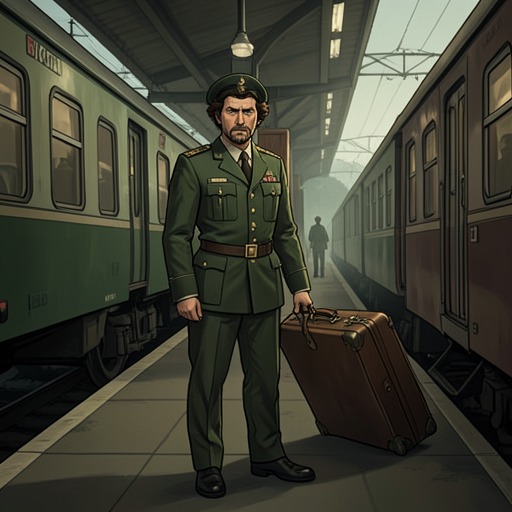
Rex’s later history gives the brotherhood a heroic asymmetry. At only nineteen, he leads his men in the capture of a German bunker without regard for his own safety. He is mentioned in dispatches and receives medals, while John remains associated with aircraft construction and the desire to fly. Rex’s bravery is not merely an abstract family boast: it is attached to a specific age, a specific military action, and the prospect of lasting recognition.
That courage also makes Rex vulnerable. During the final stages of the war, John is still safe in the desert, where he spends his leisure time making sand yachts to satisfy his need for speed. Rex, however, has been fighting with his unit at the heart of the battle somewhere in Europe, and his whereabouts are unknown. The family knows that John is safe, but that knowledge cannot produce uncomplicated relief because Rex has disappeared from communication. The brothers’ contrasting positions—John alive and accounted for, Rex heroic but missing—turn the family’s victory into a crisis of private uncertainty.
The Missing Brother and the Telegram
On VE-Day, the country celebrates with street parties, bunting, Union Jacks, fireworks, bonfires, sandwiches, trifles, jelly, and cake. Hoarded food is brought out to make a communal feast, and the public mood expresses freedom from the tyranny that had been feared for so long. At John’s parents’ home, however, the celebrations are suspended. The household can confirm John’s safety, and Derek is known to be all right, but Rex has not been heard from for months.
The arrival of a telegram concentrates the family’s fear into a single object. Addressed to W. B. Fellows, Rex’s father, it is recognized as the form of communication dreaded by wartime families because it commonly announces that a loved one is missing or dead. The telegram is carried into the dining room and placed on the bureau, where everyone stares at it without opening it. The family’s inability to act is itself part of the ordeal: opening the message may replace uncertainty with bereavement, while leaving it sealed prolongs the agony.
Rex’s apparent disappearance makes the meaning of victory unstable. The family’s thoughts turn from national triumph to the question of what victory is worth if it has taken the youngest child or a younger brother. Megan eventually decides that the letter must be opened, but the message does not confirm the feared death. Instead, a brief communication from Rex states that he is on his way home. The next day, the sound of boots in the entry announces his return, and the missing hero comes home safe and sound.
Return and Lasting Cost
Rex’s return resolves the immediate crisis in the most joyful possible way. His parents and family are overjoyed, and the brotherhood that had been placed under the shadow of disappearance is restored to physical presence. Yet the narrative refuses to make the reunion a simple erasure of fear. The mother’s worry over the wartime wellbeing of her two soldier sons has taken a terrible toll, and her health never fully recovers from the strain.
John and Rex therefore remain connected not only by affection or shared family identity but by the different kinds of damage the war leaves behind. John’s civilian life is repeatedly touched by bombardment and by the risks surrounding his family, while Rex’s military heroism exposes him to disappearance and death. Their story shows how wartime spirit can bind strangers and nations together, yet also how that collective solidarity cannot prevent intimate suffering. The brotherhood survives the war, but its survival is marked by the knowledge of how narrowly it might have been lost.