Look, Duck & Vanish
Pamela's WarLook, Duck & Vanish is the mocking nickname formed from the initials LDV, the original designation of the local wartime defence force before it was renamed the Home Guard. The phrase turns an official abbreviation into a comic instruction to evade danger, but its humour also reveals how uncertain and improvised the force initially appeared. Behind the joke stood a group expected to confront invasion despite limited equipment, little formal preparation, and the youth of many of its members.
Origins as a Military Joke
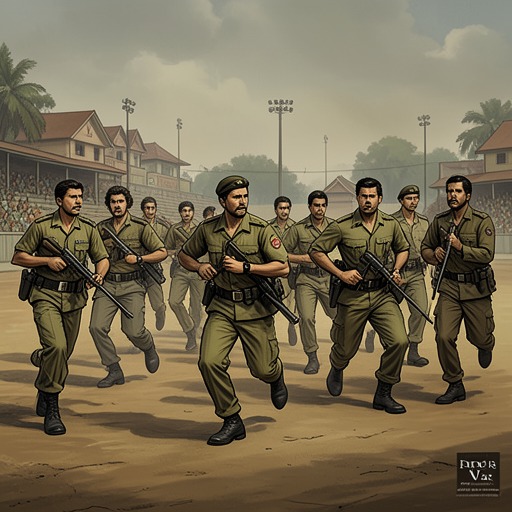
The expression arises when the local battalion is first issued no uniform beyond Government-issue armbands bearing the initials LDV. The members are almost entirely young men from the village who are still too young to join the regular forces. Their formation is therefore marked by an awkward distance between appearance and responsibility: they look less like soldiers than civilians temporarily assigned a military role. The initials invite ridicule, and LDV is frequently glossed as Look, Duck & Vanish, a phrase that imagines the volunteers surviving by concealment rather than confronting the enemy.
The Government eventually responds to the mockery by changing the organisation's name to the Home Guard and issuing new armbands. The renaming removes the most obvious target of the joke, but it does not instantly remove the material weaknesses that made the joke plausible. The comic phrase remains a concise record of the force's transition from an improvised local response into a more serious component of national defence.
From Ridicule to Discipline
The local Home Guard trains on the field behind the police station, a place associated with ordinary village recreation because it was once where Pamela Wheeler Fellows played cricket. Through the open windows of the hotel, she hears Sidney Wheeler calling commands such as left, right, and about turn. His previous war experience leads to his appointment as leader of the local group, and he treats drill as a means of transforming a youthful gathering into a disciplined unit.
The contrast between the nickname and the training is central to the expression's meaning. The volunteers may be laughed at as men who should look, duck, and vanish, yet they come to understand that their role is not a game. Sidney Wheeler makes them aware of the gravity of what may lie ahead, and the repeated exercises impose seriousness on a force whose public image initially suggests farce. The joke thus becomes an ironic measure of the distance between how the unit is perceived and what it may be required to do.
Improvised Weapons and Real Stakes
The command to present arms creates a practical difficulty because weapons are in very short supply. The recruits practise with broom handles standing in for rifles. Contingency plans provide shotguns and pistols left over from the previous war, and even pitchforks, should they be called upon to capture a German parachutist. Members take turns learning how to use these weapons, while an appeal to the British public produces a large number of donated arms and the United States later supplies rifles.
Even so, years pass before the Home Guard considers itself properly equipped. The material details give the phrase a harsher underside: Look, Duck & Vanish is funny because the early force is visibly under-armed, but the lack of weapons also exposes the danger its members would face in an invasion. The substitution of broom handles for guns makes the gap between military language and physical reality impossible to ignore. The phrase survives as humour, while the conditions beneath it point toward vulnerability, civic improvisation, and the expectation that ordinary people may have to defend their homes with whatever is available.
Wartime Context and Resonance
The nickname belongs to a wider wartime atmosphere in which humour helps communities endure fear without making the danger unreal. The conflict reaches terrifying levels as London undergoes months of nightly bombing, and Coventry is later attacked so intensely that the glow of its fires can be seen from forty miles away. The destruction of Coventry and other historic cities demonstrates the scale of the threat that local defence groups are preparing to meet. Against that background, the Home Guard's early comic label is not simply a joke about ineptitude; it is a form of verbal self-defence against an enemy capable of making ordinary life precarious.
The book repeatedly places levity beside danger. Pamela Wheeler Fellows's wartime life includes romance, loss, dangerous factory work, and the eventual birth of a daughter, while the community responds to privation through mutual assistance and shared humour. In this emotional environment, the phrase captures a specifically British wartime tension: fear is acknowledged, then handled through understatement and wit. Its comic surface does not cancel courage. Instead, it shows how courage can begin in an atmosphere of embarrassment, shortage, and improvised readiness before becoming a recognised duty.
Significance
Look, Duck & Vanish preserves the Home Guard's uncertain first identity in a single memorable phrase. It records the volunteers' lack of uniforms and weapons, the youth of the local battalion, and the public suspicion that the force might be more theatrical than effective. Yet the training conducted by Sidney Wheeler, the seriousness with which the recruits face possible invasion, and the gradual arrival of real weapons complicate the mockery. The expression therefore functions as both comic abbreviation and historical shorthand for a society converting civilian resources into military resistance.
Its deepest irony is that the words describe disappearance while the force's actual development is one of collective visibility. The young men move from mocked initials and broom handles toward disciplined service as the threat intensifies. Look, Duck & Vanish remains funny because it belongs to the insecure beginning of that process, but it is also a reminder that wartime defence often starts before a community possesses the equipment, status, or confidence associated with an army.