Mobilization of the Women's Land Army
Pamela's WarMobilization of the Women's Land Army was the wartime transfer of women into agricultural labor to replace men called up to fight. In Pamela Wheeler Fellows’s experience, it was not a symbolic patriotic gesture but a physical reordering of daily life: khaki dungarees replaced smart clothes, bicycles replaced curtailed bus services, and planting, hoeing, and harvesting replaced the dangerous production of aircraft parts. The work made visible how the British war effort depended not only on soldiers and factories but also on women, horses, food production, and the sustained labor of rural communities.
Recruitment and a Change of Direction
Miracle of miracles, Pamela Wheeler Fellows was interviewed for a place with the Land Army after her factory employment ended. The interview took her from Halesowen by bus and then along the long drive to a farm in Broome near Clent, almost back to the countryside around her former home. She arrived in a smart suit and high court shoes, dressed as though she were applying for office work. Mr Pheysey, the farmer, evidently had reason to doubt whether an overdressed townswoman would endure farm labor, and he warned that the work would be hard, physical, and tiring.
The practical requirements immediately exposed the distance between Pamela’s previous identity and the role she was about to undertake. Asked whether she owned flat brogue shoes, she had to admit that she did not. Her Father supplied the necessary footwear, and by the following Monday she was equipped with flat shoes, dungarees, and a cotton shirt. Like the other women, she wore a headscarf to keep hair from her eyes and corn from her hair. The transformation was material as well as occupational: the uniform prepared her for mud, weather, machinery, and long hours rather than for the controlled appearance expected in an office or hotel.
The timing also mattered. Pamela had been dismissed from the factory after her marriage because the management claimed that her hours would conflict with the domestic demands of her new role as a wife. Her militancy over pay and working conditions had made her an inconvenient employee, and both sides were glad to end the arrangement. The Land Army therefore offered not merely another job but a different relation to wartime service: it allowed her to remain economically active after an employer had treated marriage as grounds for withdrawal from industrial work.
Work, Equipment, and Rural Discipline
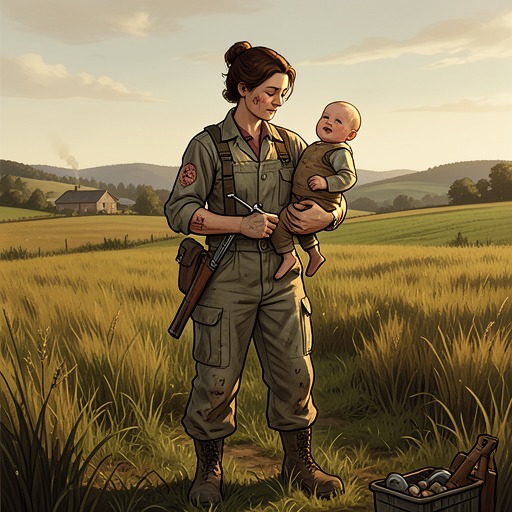
The Land Army consisted of women drafted into farm work because the men had been called up for military service. On Pamela’s farm, almost all the remaining male labor was concentrated in the farmer and men too old for military service. Their authority rested less on numbers than on experience; they taught the women the skills required to manage the land. The women worked in khaki dungarees, used an outside privy, and washed at a cold-water pump in the yard. These details define the mobilization as a bodily regime, one that demanded adaptation to primitive facilities as readily as to agricultural techniques.
The farm also preserved older methods because wartime shortages made fuel-consuming machinery undesirable. Two working horses pulled tractors and carts, linking the women’s labor to animal power and reducing the need for petrol. The arrangement placed the Land Army within a wider economy of scarcity: transport was restricted, fuel was short, and productive work had to be organized around whatever human and animal resources remained available.
The hours were long and the weather offered no protection. Pamela planted, hoed, and harvested, discovering immediately that field labor required a different understanding of hunger and endurance. On her first day she ate her sandwich lunch by eleven o’clock because she was so famished, a mistake she learned not to repeat. The episode turns an apparently minor detail into a measure of the work’s intensity: agricultural labor consumed energy faster than her previous occupations and forced her to learn through her own body.
Travel to the farm became part of the labor as well. The bus timetables from Halesowen had been dramatically curtailed because of wartime petrol shortages, and the available services did not begin early enough for her shift. Pamela therefore cycled to work, adding the journey to already strenuous days. The Land Army did not simply assign women to farms; it required them to reorganize clothing, transport, meals, and physical capacity around the needs of production.
Contrast with Factory Labor
Pamela’s experience in the Birmingham aircraft-parts factory provides the clearest contrast with her agricultural service. There she wore thick trousers and as many layers as possible against bitter cold, while a knotted headscarf protected her from machinery. The job was dirty, smelly, and dangerous. She performed a man’s job in an otherwise exclusively male unit, replacing a predecessor who had been called into the army and matching his output within the same timescale, yet she received only a woman’s rate of pay and no piecework payment.
The factory also made gender conflict explicit. Hot swarf drilled from components flew into Pamela’s eyes and burned her badly enough that she was sometimes taken to hospital. The men resented her presence, while she resented the refusal to pay her properly. Talk of union involvement appealed to her, and her militancy became part of the reason the management was happy to see her leave. A dead rat placed on her chair by male colleagues tested both her fear of mice and her determination not to reveal it. She answered the intimidation with calculated bravado, demanding that the men remove the animal and threatening to report them to the bosses.
The Land Army remained hard labor, but Pamela’s response to it was different. On the farm she loved the work. The difference cannot be reduced to comfort: farming involved cold washing, an outside privy, long hours, bad weather, cycling, and physical exhaustion. What changed was the relation between labor and recognition. In the factory, Pamela’s contribution was measured against male output and undervalued through unequal pay. On the farm, the work placed her directly within a cooperative process of planting, tending, and harvesting, where the usefulness of her effort was immediate and tangible.
Consequences for Marriage and Motherhood
Pamela entered the Land Army while saving every penny from her wages toward the home she hoped to establish when her husband, John Fellows, returned permanently from the war. Their marriage had been arranged at short notice because John was due to leave for further training; the wedding required a special licence, and a suitcase of clothes was delivered to a local resident so that Pamela could satisfy the residency requirement for marriage at St Kenelm’s Church in Romsley. After the ceremony, however, she still lived with her parents, possessed few belongings, and saw John only rarely when he came home on leave.
The Land Army therefore sustained a future domestic plan that the war kept postponing. Pamela’s savings were intended for a home, although she later discovered that they would be spent on a car when John returned. The point of the saving was nevertheless clear: agricultural wages connected wartime labor to the imagined stability of postwar married life. Her work was simultaneously national service, personal independence, and preparation for a household that did not yet exist.
By the end of that summer Pamela was tanned, supple, and fit, but she was also expecting her first baby. Advancing pregnancy forced her to retire from the Land Army, and her sister-in-law, Megan, took over her position on the farm. Her departure marks the limit imposed by reproductive expectations even after women had demonstrated their capacity for strenuous work. The mobilization opened a field of public usefulness, but it remained bounded by the body and by the social role assigned to a future mother.
Pamela’s baby girl was born on April 10 in a local nursing home. John did not attend the birth, in keeping with the practice of the time, though he received a week’s leave to see mother and child. The family still had no home of its own, and Pamela continued to live with her parents. The Land Army had ended before the birth, yet its significance continued through the material conditions it helped sustain: a family with few possessions, wartime rationing, intermittent reunion, and hope that the conflict was nearing its end.
Significance on the Home Front
The mobilization of the Women's Land Army reveals the war as a system that redistributed work across gender, age, landscape, and species. Men disappeared into military service; women entered fields; older men transmitted agricultural knowledge; horses substituted for petrol-driven machinery; and families adapted their plans around rationing, restricted transport, and uncertain military schedules. Its history is therefore not separate from the history of combat. The farm’s output depended on the same national emergency that sent John Fellows away and eventually shaped Pamela’s marriage, savings, pregnancy, and family life.
Pamela’s trajectory also complicates any simple opposition between masculine war and feminine domesticity. She was monitored by her Father when young men visited the hotel, fell in love with David before his death in the air war, worked in a male factory unit, confronted unequal wages, married John Fellows, entered agricultural labor, and left it because of pregnancy. Her experience joins desire, grief, paid work, marriage, and motherhood in one continuous wartime history. The Land Army gave her a temporary but decisive public role, and the farm allowed the narrative to show women not as passive recipients of wartime change but as the people who physically maintained the country’s productive life while the men were away.