Nazi racial ideology
Pamela's WarNazi racial ideology is depicted as a political and racial doctrine that turns an imagined standard of Aryan perfection into a demand governing women’s bodies, appearance, and ultimately the right to live. In the wartime narrative, its importance lies in the brutal distance between the polished ideal it imposes and the camps, starvation, murder, and dehumanization that the regime’s violence produces.
The Aryan Ideal and Control of Appearance
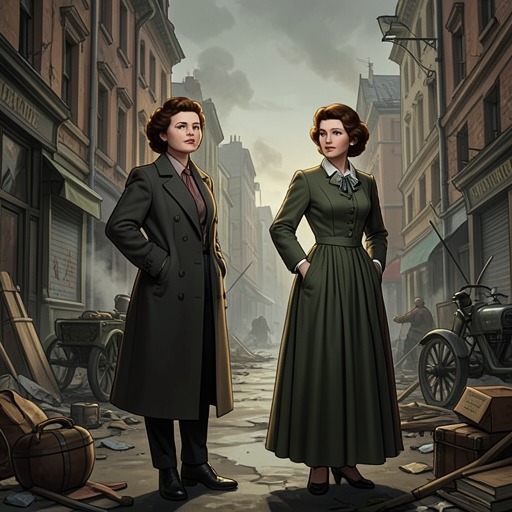
The ideology insists that women of the supposedly superior Aryan race should appear entirely natural and disciplined. Adolf Hitler is described as detesting anything artificial: women are expected to wear no makeup, lipstick, or nail varnish, and are forbidden to dye or perm their hair, wear high heels, or diet to lose weight. The rules make personal appearance into a political display. Femininity is not treated as an individual choice but as evidence of racial belonging and obedience, shaped into a well-scrubbed, tightly regulated ideal.
The narrative gives that ideal a deliberately old-fashioned visual emblem, calling it a Brunhilda-like appearance. The image suggests a woman whose body is made to signify national purity rather than pleasure, experimentation, or self-expression. Nazi racial ideology therefore operates not only through laws and institutions but through ordinary habits of dress and grooming, presenting coercion as the proper appearance of a supposedly superior race.
Red Lips as Defiance
Against this prescribed naturalness, wartime British women cultivate glamorous makeup, especially vivid red lipstick. The narrator later recognizes that the British obsession with red lips, called “victory lips,” could hardly have been a more pointed reaction to the appearance demanded by Adolf Hitler. The contrast is not merely cosmetic. Makeup becomes a small, visible refusal of the racial and gendered discipline represented by the Aryan ideal.
This defiance is grounded in material wartime ingenuity. When supplies run short, used lipstick stubs are melted together and remade, while cosmetics replace the Government’s suggested gravy browning for creating the appearance of stockings. The resulting lipstick may be greasy, uneven in coverage, or an odd mixture of colours, but its imperfection strengthens its symbolic force: women continue to mark their faces with colour even under scarcity and even against an enemy ideology that demands unadorned conformity. Their resistance is domestic and playful rather than militarily organized, yet it directly rejects the visual code imposed by the Nazi regime.
From Racial Hierarchy to Extermination
The book places the rules about women’s appearance beside the far more lethal consequences of the same ideological logic. After the liberation of Bergen-Belsen, Richard Dimbleby broadcasts from the concentration camp and reports conditions in which thousands of people, many of them Jewish, have been held in extreme inhumanity. People are transported by train from across Europe, robbed of their possessions, and systematically murdered by the Nazis through gassing or starvation. Bodies remain unburied, while survivors are reduced to barely recognizable skeletons.
The narrative identifies these crimes as Hitler’s “Final Solution”: a plan to remove from the earth anyone judged not to deserve life because they do not fit the regime’s idea of Aryan perfection. The connection between bodily regulation and mass murder is consequently not presented as accidental. The same ideology that classifies women according to a racialized appearance also classifies entire populations as pollutants or biological failures. Once human worth is made dependent on conformity to an invented racial standard, exclusion can become dispossession, and dispossession can become extermination.
Witness, Evidence, and Historical Judgment
The horror becomes known through testimony and images. Someone known to the narrator visits the camp not long after its liberation and says little about what was witnessed because the memory is too terrible to share; even the advancing army is said to have detected the stench of death from many miles away. Richard Dimbleby’s broadcast supplies public words for what private witnesses cannot easily express, while later film footage exposes the conditions to viewers able to endure watching it.
The German population is also forced into cinemas to see what Adolf Hitler and his henchmen have done. This compelled witnessing reverses the regime’s propaganda spectacle: the people are made to confront the physical evidence of an ideology presented as glorious, orderly, and racially purifying. The camps strip away that veneer of civilization. What remains is not Aryan perfection but deliberate hunger, murder, bodily ruin, and the destruction of ordinary moral boundaries.
Significance in the Wartime Narrative
Nazi racial ideology functions as the dark principle connecting apparently minor cultural contrasts with the central catastrophe of the war. Red lipstick, nail varnish, hair, and high heels belong to the everyday field of appearance; the camp belongs to the field of organized extermination. Yet the narrative makes their relationship legible by showing that both are governed by the regime’s insistence that bodies must be ranked, controlled, and judged against an imposed racial norm.
The narrator’s retrospective recognition turns cosmetic practice into historical irony. Women working under rationing may have only improvised lipstick and wobbly stocking seams, but those imperfect acts refuse the “Brunhilda-look” and affirm a freedom the Nazi ideal seeks to erase. The later revelation of Bergen-Belsen gives that refusal its full gravity. The war’s outcome is remembered as a narrow escape: the ideology had not merely been unpleasant or authoritarian, but had threatened to determine the future of everyone under its rule. Its defeat leaves behind the obligation to judge the ideal by its consequences, and those consequences are the camps, the dead, the survivors, and the evidence that the regime tried to conceal.