Pamela Wheeler Fellows
Pamela's WarPamela Wheeler Fellows is the central figure of the wartime memoir, and her decisive significance lies in the speed and pressure of her transformation. Living at The Woodman Hotel when war is declared, she begins as a fifteen-year-old protected by her parents and ends the war as a married woman with a baby, an absent husband posted overseas, and a sharply enlarged knowledge of loss, labour, danger, and collective endurance. Her story makes the Second World War legible not only through battles and political announcements but through the remaking of a young woman’s body, work, family, loves, and sense of home.
Identity and Early Life
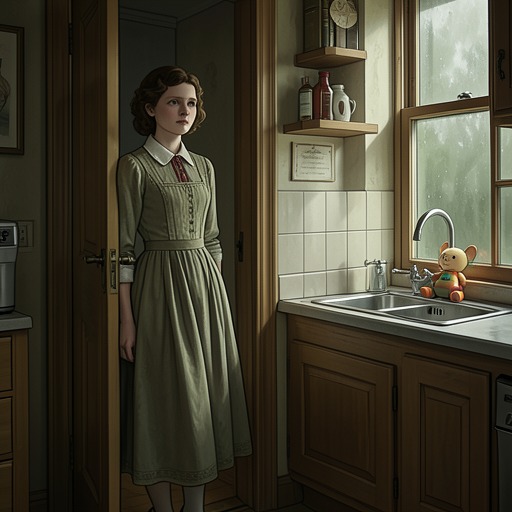
Pamela is born on August 18, 1924, at a local nursing home and grows into a serious, dark-skinned, brown-eyed child with straight brown hair. As the only child, she is doted on, indulged, and somewhat spoiled. Her mother treats her like a large doll, assembling an exceptionally coordinated wardrobe that includes a white fur coat and matching hat, while Pamela generally demands and receives her own way. Even the woman charged with caring for her during the day is subjected to Pamela’s favourite childhood pastime: biting deeply into her arm with her baby teeth.
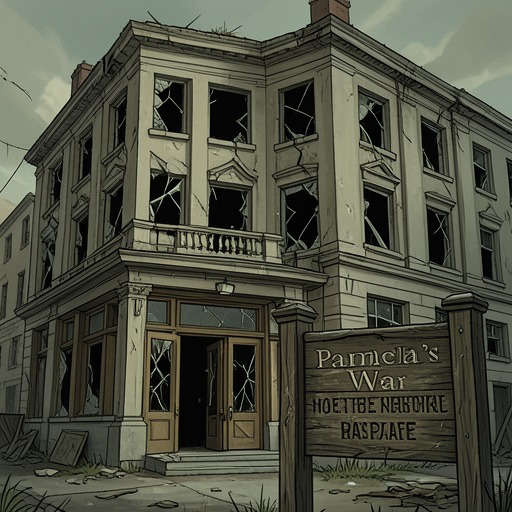
By the time war is announced, Pamela is fifteen years and sixteen days old and living with her parents at The Woodman Hotel in Clent. The hotel is both her home and the setting of her first understanding that ordinary life can be overturned in an instant. On Sunday, September 3, 1939, the radiogram is switched off shortly after eleven in the morning. A room previously full of farm workers, businessmen, wives, servants, and kitchen activity falls into a deathly hush as the family and hotel community receive news that will change their lives forever.
Her father’s immediate response reveals the atmosphere in which Pamela is growing up. He loads a gun with three bullets, one for Pamela, one for his wife, and one for himself, and is prepared to kill his family if German forces invade. Pamela accepts his judgment without protest. The episode establishes both the extremity of wartime fear and the authority governing her early life: she is loved, but that love is expressed through protection, discipline, and the assumption that her father must decide what survival requires.
War, Work, and the Loss of Innocence
The war first reaches Pamela through the hotel’s changing social world. The property opposite the hotel includes a large house understood to be operating as a nursing home, with extensive vegetable grounds backing onto the wooded Clent Hills. Groups of men arrive each evening from the lane, order drinks in English, and then speak quietly in their mother tongue. Pamela’s father listens from behind the bar, recognising the guttural sound from his experience in France and on the Somme. The hotel thus becomes a place where local hospitality, surveillance, military memory, and suspicion overlap.
The same wartime setting turns the hotel into a tightly watched space. Because it stands directly opposite the police station, the licensing laws threaten the family’s livelihood if alcohol is served outside permitted hours. Pamela works from an elevated part of the bar and can see over the police station’s top sash window. When the Sergeant stands and puts on his helmet, she and the staff know that he is about to cross the road. They call time, cover the beer pulls with towels, pull down the shutters, and urge remaining customers to finish. The policeman’s visible preparation becomes an accidental warning system, allowing the hotel to evade immediate punishment while preserving its business.
War also reorganises the grounds around the hotel as military space. Pamela’s father drills the local Home Guard on the field behind the police station, where she once played cricket. His commands carry through the hotel’s open windows. The young men initially have no uniforms and wear armbands marked LDV, a designation mocked as “Look, Duck & Vanish,” before the unit is renamed the Home Guard. Weapons are scarce, so broom handles substitute for rifles; shotguns, pistols left over from the previous war, and even pitchforks are imagined as possible weapons against parachutists. Despite these deficiencies, the group patrols the hills at night, taking seriously its responsibility for protecting Clent and the surrounding area.
The presence of airmen brings Pamela into direct contact with both wartime glamour and wartime death. After a Stirling bomber flies almost level with the hotel chimneys, she can see the faces of the pilot and crew and waves when they wave to her. Her father identifies the pilot, Max, demands an apology for the foolhardy display, and later sees Max die on a raid over Germany. The young men who fill the hotel with drinking, joking, and flirtation are therefore never merely romantic figures or customers; they are a generation whose lives can vanish between one visit and the next.
Pamela’s own wartime labour completes the break with her protected childhood. Called up to a factory job in Birmingham after her family moves to Halesowen, she works in an exclusively male unit producing aircraft parts. The job is dirty, dangerous, and physically punishing. Hot swarf enters her eyes and burns them badly enough that she is sometimes taken to hospital for treatment. Although she replaces a man and produces the same output in the same time, she receives only a woman’s rate of pay. The resentment runs in both directions: the men resent her presence, while Pamela resents the unequal wage and becomes increasingly militant, welcoming the possibility of union involvement.
Her resistance is expressed through performance as well as confrontation. One morning she finds a dead rat placed on her chair by male colleagues, knowing that they are exploiting her terror of mice. She refuses to reveal fear, instead threatening to report the men to the bosses unless the creature is removed. Her bravado succeeds. The episode is comic on the surface, but it marks a practical change in Pamela: the daughter once governed by her father’s rules now protects herself through nerve, anger, and strategic acting in an institution that undervalues her labour.
Love, Bereavement, and Wartime Emotion
Pamela’s father imposes especially strict rules when young airmen begin visiting the hotel. She is not allowed to walk out onto the car park with them and must never be alone with a young man. Yet she becomes captivated by David, a regular visitor to her cocktail bar who appears in his Royal Air Force uniform. Because she knows her father will disapprove, she and David arrange to claim that she is going out with Gloria, concealing the existence of the airman from him.
Their relationship develops within the hotel’s restricted spaces. After Pamela prepares and serves a meal for David and his friends upstairs, the tables are pushed aside and David sweeps her into a dance. They declare that their feelings are mutual, and Pamela decides that he is the person with whom she wants to spend the rest of her life. At the end of the evening, despite her father’s surveillance, she reaches the car park to say goodnight. David is twenty-four and Pamela is seventeen. They kiss once while his friends wait in the car, beneath a late-summer sky and the faint sound of dance music. The kiss is both a romantic beginning and a scene already shadowed by war: they promise to take care of themselves, but circumstances soon prevent David from keeping his side of the bargain.
On September 5, 1941, Pamela attends friends’ wedding in Dudley with Gloria. During the service, she is overwhelmed by an unprecedented feeling of doom so powerful that it makes her physically ill. She tells Gloria that David has just died, though she cannot explain how she could know. The narrative presents her certainty as absolute, and she is proved right. Pamela receives only the briefest details of the death, as wartime secrecy is officially justified as a means of keeping information from the enemy and is also understood as a means of protecting morale.
The loss is not isolated. Of the original group of twenty young men who come to the hotel for drinks, the number diminishes week by week. They disappear one by one, known to be missing or dead, while the family and customers are forbidden to discuss the circumstances in detail. Pamela’s grief therefore belongs to a wider pattern of interrupted lives, but it does not become impersonal. David’s laughing smile and carefree manner remain in her heart, and she thinks her heart will break. The death of Max shortly afterward reinforces the cruel arithmetic of the air war: young men with their whole lives ahead of them are reduced to fragments of official information and memories held by those left behind.
Pamela’s emotional experience develops alongside a wider wartime “structure of feeling.” Radio broadcasts, Churchill’s speeches, comedy programmes, music for factory workers, and touring variety shows help communities endure shortages and fear. Strangers speak like old friends, offer lifts, and lower the reserve that usually separates them. Pamela’s private sorrow is never erased by this collective spirit, but it is held within it. The same society that cannot give her a full account of David’s death creates public rituals and shared habits through which people continue living.
Displacement, Marriage, and Motherhood
The war eventually destroys Pamela’s physical security as well as her emotional one. After a bombing attack, her new home is wrecked: every window is gone, curtains hang in tatters against broken glass, and a cabinet containing her mother’s china and glass lies on its side with its contents smashed. The blast has destroyed the air-raid shelter, blown a large hole in the side of the block, and removed part of the roof. The building is no longer habitable.
Pamela and her family can rescue only suitcases that they have not even had time to unpack. Her worldly possessions are reduced to a few clothes, a pair of shoes, some books, and letters. The loss converts them into refugees, making displacement a literal continuation of the war’s assault on private life. The shaking that follows lasts for a very long time, an involuntary bodily aftermath that contrasts with the defiant composure she displays in the factory.
When John returns from Scotland with news that he will be posted to Canada for further training, his ambition to fly brings marriage forward under military pressure. The wedding must be arranged quickly and requires a special licence. Pamela wants to marry at St Kenelm’s Church in Romsley, although she and John live in Halesowen outside the church’s official catchment area. A suitcase full of clothes is therefore delivered to the home of a willing local resident so that Pamela can technically qualify as a resident of the village.
Rationing and shortage shape the wedding’s appearance. There is no time for a white dress, so Pamela and her mother collect coupons and buy a pale blue woollen Berketex suit, tan hat, and tan shoes. She wears a corsage of pink roses rather than carrying a bouquet, while John appears in his Royal Air Force uniform. Pamela’s mother likes John and enjoys his company, but her father is reluctant to lose his daughter and urges her, even during the taxi journey to the church, to turn back. Pamela refuses. Not much more than half an hour later, she has made her vows and become Mrs Pamela Edith Fellows.
The marriage is immediately marked by wartime improvisation and family comedy. Pamela’s mother, impaired by champagne, signs the church register in her maiden name and announces the mistake loudly to the congregation and guests, prefacing it with the inappropriate oath “JESUS CHRIST!” With no official wedding photographer available, Pamela and John travel afterward to a photographer’s studio in Halesowen, where the occasion is recorded because ordinary wartime arrangements cannot provide the customary record.
Motherhood follows while the war continues. Pamela receives orange juice and cod liver oil, a green ration book entitling her to a full pint of milk, first choice of fruit, and a double ration of eggs, and medical advice to drink stout to maintain her iron levels. She gathers a hand-me-down cot, bedding, a new pram, and knitted clothing made by relatives and friends. On April 10, she gives birth successfully to a baby girl at a local nursing home. John is not present at the birth, in keeping with the practice of the time, but receives a week’s leave to see mother and child. Pamela still lives with her parents, owns few possessions, and has no home of her own, yet the birth gives her a future-oriented hope just as the war approaches its end.
Change, Ending, and Narrative Significance
Pamela’s trajectory is a compressed coming-of-age story in which each apparent arrival contains another form of uncertainty. The hotel begins as a secure family world and becomes a place of military anxiety, secret romance, and repeated bereavement. The car park holds both the first and last kiss with David; the factory turns national mobilisation into unequal female labour; the destroyed flat turns a young family into refugees; St Kenelm’s Church transforms a hurried wartime arrangement into marriage; and the nursing home becomes the setting for a child’s arrival amid the collapse of the Nazi regime.
Her experience also exposes the gendered structure of wartime life. As a daughter, Pamela is watched and restricted by her father. As a worker, she is expected to perform a man’s industrial job for a woman’s wage. As a bride, she must negotiate shortages, military postings, and hurried arrangements. As a mother, she receives special food and medical provisions while remaining materially dependent on her parents and separated from her husband’s military career. The war expands her responsibilities faster than it expands her formal power, forcing independence through conditions she did not choose.
The end of the war does not erase what Pamela has lost. On VE-Day, streets fill with parties, bunting, Union Jacks, sandwiches, trifles, jelly, cake, fireworks, and bonfires, and hoarded food is released for communal celebration. Yet the joy is uneven. At John’s parents’ home, the family cannot celebrate freely because Rex has been missing for months, despite knowing that John is safe in the desert and that Derek and Megan are at home. The telegram at the door carries the familiar threat of official confirmation that a loved one is missing or dead. Pamela’s wartime world therefore ends not with a simple triumph but with celebration interrupted by uncertainty, just as her youth was interrupted by war.
In the framing narrative, Pamela is eighty-five when she revisits The Woodman Hotel with the recorder of her memories. The building has become The French Hen, filled with French antiques and bric-a-brac, and she is unimpressed by the transformation. She remembers the hotel in its 1930s prime: freshly decorated, newly carpeted, full of customers drinking, smoking, laughing, and listening to dance music on the radiogram. At the back door, she identifies the car park as the place where she saw David for the last time. The elderly Pamela thus returns to the precise threshold at which the young Pamela’s future seemed to open and then disappeared.
Her recollections exceed the expected couple of hours and a few foolscap pages, continuing through page after page of memories. That abundance is itself part of her characterisation. Pamela is not reduced to the girl who lost David, the worker who endured discrimination, the refugee, the bride, or the mother; she is the survivor who carries all these selves simultaneously. Her life demonstrates how wartime history is made durable by private memory, where national events remain attached to rooms, uniforms, wages, letters, suitcases, food, kisses, and the names of young people who never returned.