Pamela Wheeler·Fellows and Marie Wheeler's mother-daughter relationship
Pamela's WarPamela Wheeler/Fellows and Marie Wheeler's mother-daughter relationship is one of the central continuities in Pamela's account of the Second World War: Marie begins as the mother who treats her only child like a beloved doll and becomes the practical, inventive companion who helps her daughter endure bereavement, danger, marriage, and impending motherhood. Their intimacy is expressed less through declarations than through clothing, shopping, food, household protection, and the repeated effort to make ordinary life possible under extraordinary conditions.
Identity and Early Bond
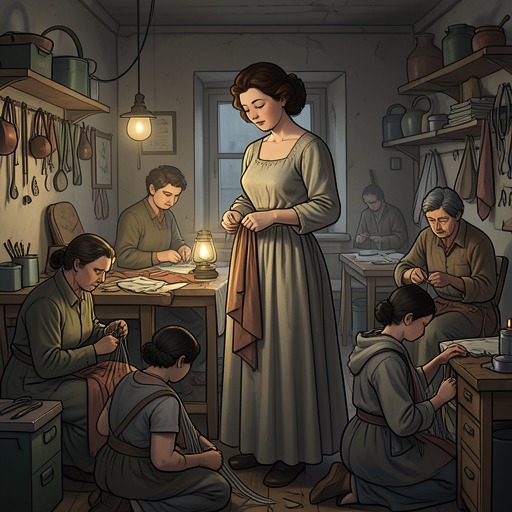
Marie Wheeler is introduced as one of three children: pretty, vivacious, and good company, with an older sister, Edith, and a younger brother, Fred. She is also a highly skilled seamstress who served an apprenticeship as a milliner with Madame De Leats in Edgbaston and could design and make beautiful hats. Her charm and practical artistry establish the qualities that later define her motherhood. She is not merely affectionate; she is capable of turning taste and technical skill into forms of care.
Pamela is born on August 18, 1924, at a local nursing home. As an only child, she is greatly cherished by the whole family, while Marie treats her rather like a large doll. Pamela possesses an exceptionally beautiful wardrobe of clothes and shoes, including a white fur coat with a matching hat, all carefully coordinated. The clothing gives material form to Marie's delight in her daughter and to Pamela's position at the centre of the family. Pamela is doted on, indulged, and somewhat spoiled, usually demanding and obtaining her own way; the relationship begins in abundance, protection, and maternal attention rather than austerity.
Shared Life at The Woodman Hotel
The hotel business consumes much of the family's time, so shopping in Birmingham becomes a valued space in which Marie and Pamela can be together away from work. They enjoy Lewis's, Greys and Marshall, and Snelgrove, as well as the city's independent milliners and shoe shops. Marie takes particular pleasure in spoiling Pamela and buying her lovely things, making these outings precious to both of them. The shopping is not simply consumption: it is a temporary release from the demands of running The Woodman Hotel and a ritual through which Marie maintains pleasure, femininity, and closeness for her daughter.
Their domestic world is increasingly altered by war. The Woodman Hotel stands opposite a lane leading towards the Clent Hills, near a large house operating as a nursing home and surrounded by grounds where vegetables are grown and sold. As travel declines and customers become fewer, the hotel gives more attention to those who remain; it also becomes a place of observation, sociability, and wartime work. From the bar, Pamela can watch the police station opposite, while her father drills the local Home Guard in the field behind it. Marie's motherhood is therefore enacted within a public, militarised setting in which family space, business space, and wartime space overlap.
Marie contributes to the household's emotional economy as well as its material one. The family experiences the bombing of Coventry, the destruction of cities, separation caused by evacuation, and the gradual disappearance of young men from the hotel community. Pamela's later grief over David's death is part of this wider climate of threatened attachment. The mother-daughter bond offers continuity while the war repeatedly turns familiar places and relationships into sites of danger or loss.
Resourcefulness Under Rationing
When clothing coupons become inadequate and the national campaign urges people to Make Do and Mend, Marie's dressmaking skills acquire a new wartime purpose. She is described as always bandbox smart, yet fabric is difficult to find. Remnant sales provide some material, and limited quantities of parachute silk are available, although parachutes are cut on the cross and their bias creates a difficult curve. Marie responds by designing a blouse pattern that uses very little fabric. She calls the resulting garments “fronts”.
The fronts reveal the particular character of Marie's care. She does not accept shortage as a reason to abandon beauty or self-presentation, nor does she treat fashion as an indulgence detached from practical necessity. Instead, she converts scarcity into ingenuity. For Pamela, her mother's example offers a model of adaptation in which skill preserves dignity and pleasure. Marie's competence also makes the household less dependent on what the rationing system can provide, allowing maternal care to continue through making rather than buying.
Her contribution extends beyond her own family. A battalion of young soldiers is posted in a field roughly half a mile from the hotel to operate a searchlight against German bombers. Their ration cooking is so poor that the young men, newly away from homes where their mothers had cooked for them, struggle to eat properly. When Marie learns of their difficulty, she offers to prepare their food if they deliver it to the hotel kitchen. The soldiers bring joints of meat; Marie cooks them, and the men arrive at the appointed time to eat together around a large table, with drink consumed as well. This is explicitly presented as her contribution to the war effort, showing motherhood transformed into communal service without losing its domestic form.
Protection, Danger, and Growing Independence
Marie and Pamela face danger together when the family leaves the relative safety of The Woodman Hotel for a top-floor mansion flat about half a mile from Birmingham city centre. The move takes them into a more exposed urban environment as bombing intensifies. The new apartment is elegant and spacious, with high ceilings, cornicing, and views over Islington Row, but the bombed buildings encountered on the journey make its apparent comfort uncertain. Marie's taste makes the new home lovely despite wartime shortages, yet the domestic ideal is immediately tested by the air raid.
When the shelter is inaccessible and bombing begins, residents gather on the ground floor. Pamela's father orders everyone onto the floor with their hands over their ears, and obeying him saves their lives; shrapnel holes later show that anyone standing would probably have been struck at waist or head height. Marie's role in this scene is not separated from the family unit. The mother's household, the father's military discipline, and Pamela's vulnerable position converge in a moment when survival depends on collective obedience. The episode clarifies why Marie's care is so valuable: it exists within a family that must repeatedly turn domestic routines into protective measures.
At the same time, Pamela's adolescence brings pressures that Marie cannot entirely control. Pamela's father imposes draconian rules when many young airmen visit the hotel, forbidding her to walk out onto the car park with them or to be alone with a young man. Pamela nevertheless falls in love with David, an attractive Royal Air Force visitor, and plans a dance with him while pretending to be going out with Gloria. Marie is not identified as the author of these restrictions; her position is instead part of the protected domestic world from which Pamela is beginning to move outward. Pamela's romance, followed by her certainty that David has died on September 5, 1941, marks a painful passage from cherished girlhood into adult knowledge of loss.
Motherhood, Continuity, and Meaning
After David's death, Pamela's grief unfolds against the wartime destruction of an entire generation. David's carefree smile remains in her heart, while Max later dies in his Sterling bomber and the original group of twenty young men who once came for drinks diminishes week by week. The silence surrounding the men's deaths makes the losses worse. Marie cannot prevent Pamela's heartbreak, but the continuing mother-daughter relationship provides the familial setting in which grief can be endured rather than erased.
By January 1945, Pamela is preparing for a new baby. Marie's earlier care of Pamela as a child now echoes in Pamela's preparation to care for her own child. Pregnancy is managed through wartime provisions: Pamela receives a green ration book instead of the ordinary beige one, entitling her to a full pint of milk, first choice of fruit, and double rations of eggs; she drinks half a pint of Guinness daily on her doctor's advice to maintain her iron levels. Maternity clothing is limited, but a wraparound top and a swagger-cut winter coat accommodate her changing body. These details place maternal experience inside the rationing system while showing how family ingenuity makes that system bearable.
The family rallies around the expected baby. A hand-me-down cot and bedding are acquired, a new pram is purchased, and relatives knit matinee jackets, hats, bonnets, bootees, and mittens. Marie's earlier ability to create garments from scarce materials becomes part of a broader intergenerational provision. The baby girl is born on April 10, while Pamela remains living with her parents, without a home of her own and with few possessions. Her husband, John Fellows, is absent from the birth because of wartime circumstances but receives a week's leave to see mother and child. Pamela's dependence on her parents has not vanished, yet it has changed: the daughter who was once dressed and indulged by Marie is now a mother herself, receiving support while beginning a new family.
The relationship's significance is heightened by the contrast between public celebration and private anxiety on VE-Day. Across the country, street parties, bunting, Union Jacks, fireworks, bonfires, sandwiches, trifles, jelly, and cake express collective relief, with hoarded food released for a communal feast. Yet at John Fellows's parents' home, the family cannot celebrate freely because Rex Fellows has been missing for months. Marie's relationship with Pamela belongs to this same emotional structure of wartime life: joy is real but never secure, domestic abundance is improvised from shortage, and maternal care persists beside the knowledge that a telegram may transform celebration into mourning. Through Marie, Pamela learns that survival is not the restoration of an untouched past but the continuous making of shelter, beauty, nourishment, and hope within history's violence.