Wartime refugee and homelessness
Pamela's WarWartime refugee and homelessness is both a social condition created by the bombing of Birmingham and a decisive personal rupture in Pamela Wheeler Fellows’s family story. It begins with civilians escaping the nightly raids for the countryside and culminates in the family’s own home being destroyed almost as soon as it has been occupied. Refuge becomes a crowded hotel bar, a surviving small car, a café above which several people are squeezed together, and finally another uncertain roof; the changing spaces show how war repeatedly turns ordinary places into shelters, workplaces, surveillance points, and zones of danger.
The Wartime Geography of Flight
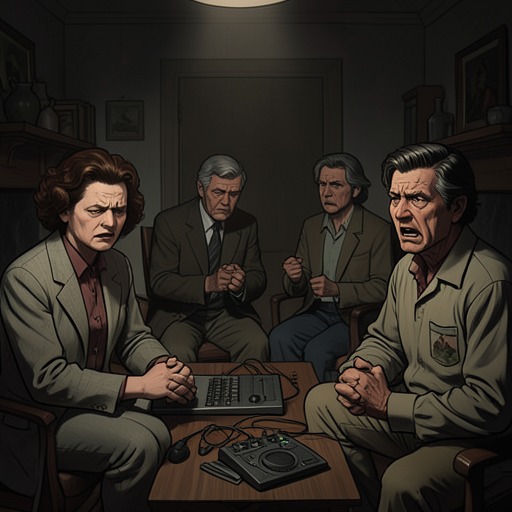
The condition emerges from the strategic importance of Birmingham, whose factories produce aeroplanes, bombs, and guns. By this stage, the nightly bombing of Birmingham and its suburbs has reached terrifying proportions, although official radio reports conceal the city’s identity by referring only vaguely to an air raid in a Midlands town. The resulting uncertainty intensifies civilian fear: the public knows that raids are occurring but is denied a clear account of their scale, while William Joyce’s broadcasts from Radio Hamburg offer more information than the British Government and therefore make the danger feel still more immediate.
Those who can no longer endure the raids leave the city when they possess both a car and enough fuel. They drive into country lanes with blankets and thermos flasks and sleep in their vehicles, judging this safer than remaining in the city. Their alternative is often an Anderson shelter: a corrugated-iron structure supplied in kit form, covered with soil and able to resist nearby shrapnel but not a direct hit. Damp, cold, noisy, and liable to fill with water despite its drainage sump, it offers protection without comfort. The later Morrison shelter, an indoor metal cage with a solid steel top, addresses the danger of falling masonry for households without gardens, but its narrow interior is only just large enough for two adults to lie side by side.
Hospitality at The Woodman Hotel
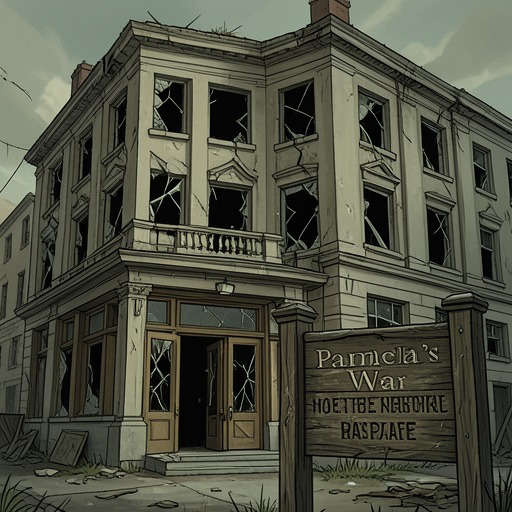
The Woodman Hotel becomes a temporary refuge for people displaced by the raids. Pamela Wheeler Fellows’s Mother allows those who have driven from Birmingham to sleep on the carpeted floor of the hotel bar without charge. Milk is heated for babies, while adults receive free tea and coffee. The arrangement is generous but also practical: in the morning, some refugees buy a ham-and-egg breakfast before returning to their jobs in the city. The hotel therefore becomes an improvised civilian shelter, but not a permanent solution; the family does not yet understand that it will soon share the refugees’ condition.
This hospitality belongs to a broader wartime transformation of the hotel’s spaces. With fewer customers able to drive and few within walking distance, the remaining patrons receive unusually close attention. The lane opposite the hotel leads towards the Clent Hills and a large house whose grounds include a nursing home and extensive vegetable gardens. The hotel bar also functions as a watchpoint: from its elevated position, Pamela Wheeler Fellows can see the top sash window of the police station opposite and detect the Sergeant putting on his helmet before he crosses the road to enforce licensing hours. In wartime, apparently ordinary sightlines acquire new meanings, linking refuge, regulation, suspicion, and survival.
The family’s contribution to the war effort likewise depends on repurposing hospitality. A battalion stationed about half a mile away operates a searchlight against German bombers, but its young soldiers cannot cook their rations effectively. Pamela Wheeler Fellows’s Mother offers to prepare their joints of meat in the hotel kitchen. The soldiers march across the field in single file, eat around a large table, and consume beverages in the licensed premises as well. The hotel becomes a place where military labour is sustained through domestic and commercial care, even as the same wartime pressures gradually destroy the business itself.
From Relocation to Bombing-Out
The hotel eventually becomes financially untenable. Fuel rationing and the shortages created by the war progressively damage the business, and the family leaves The Woodman Hotel behind. Sidney Wheeler secures the lease of a top-floor mansion flat roughly half a mile from Birmingham city centre. The move is an attempt to find a new home, but it is also a movement away from the relative safety of the countryside and into the city that is being bombed. The flat is elegant and spacious, with high ceilings, cornicing, and views over Islington Row; Marie Wheeler furnishes it attractively despite wartime shortages.
The appearance of domestic stability lasts scarcely long enough to become familiar. When the air raid begins, the residents cannot enter the shelter and gather instead on the ground floor of the block. Sidney Wheeler orders everyone onto the floor with their hands over their ears, drawing on his experience as an officer. The instruction saves their lives: after the bombing, shrapnel holes are found mostly at waist or head height, where anyone standing would have been struck.
The shelter itself is destroyed. The blast tears a sizeable hole in the side of the building and removes part of the roof, making the block uninhabitable. Every window in the family’s flat is gone, the curtains hang in tatters against the broken glass, and Marie Wheeler’s cabinet of china and glass lies overturned with its contents smashed. The contrast is stark: a carefully furnished home is reduced in moments to wreckage, while the only possessions that can be rescued are the suitcases not yet unpacked.
Becoming Refugees
The family’s displacement is defined by radical material reduction. Pamela Wheeler Fellows is left with a few clothes, a pair of shoes, some books, and letters; the family owns little more than what it is wearing. The narrative marks this not as an abstract inconvenience but as the moment when they too become refugees. Her physical response is prolonged shaking, suggesting that the danger continues after the raid has ended and that homelessness is accompanied by a delayed bodily shock.
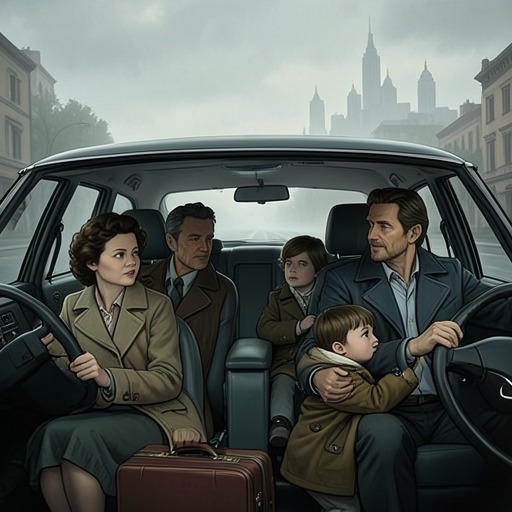
The surviving little car offers the first means of escape. Although parked close to the flat, it survives the bombing, allowing the family to load their remaining possessions and seek refuge for several nights. Their next shelter comes through friendship. Jim and Renee Parkes, friends of Pamela Wheeler Fellows’s parents, run a café in Quinton and take the bombed-out family into the tiny accommodation above it. The family is shoehorned into the space and camps there for several weeks. This improvised household demonstrates how social relationships compensate, however temporarily, for the destruction of formal housing.
Homelessness also exists alongside military separation and the redistribution of wartime labour. John Fellows enlists, begins Royal Air Force training in Scotland, and later prepares to leave for further training in Canada. While his ambitions advance through military institutions, Pamela Wheeler Fellows works in a Birmingham factory producing aeroplane parts. The factory is dirty, smelly, and dangerous; she performs a man’s job in an otherwise exclusively male unit, receives a woman’s rate despite matching her predecessor’s output, and suffers burns from hot swarf that sometimes require hospital treatment. Her experience shows that displacement does not remove people from the war effort: it pushes them into unstable combinations of work, dependence, and temporary accommodation.
Temporary Roofs and Endurance
A further roof is eventually secured in Halesowen, partly because Pamela Wheeler Fellows has been called up for factory work in Birmingham. The move provides necessary housing but not restored normality. She travels to dangerous employment in heavy clothing and a knotted headscarf, while the family remains marked by the loss of its former home and possessions. The sequence from the hotel, to the city flat, to the car, to the café above it, and then to Halesowen makes shelter appear provisional at every stage.
Even marriage and childbirth occur under the pressure of this unsettled existence. John Fellows’s posting to Canada forces the wedding to be organised at short notice, and a suitcase of clothes is placed with a willing local resident to create the appearance of residence required for the ceremony at St Kenelm’s Church. Later, Pamela Wheeler Fellows gives birth to a daughter on April 10 while still living with her parents, without a home of her own and with few possessions. The birth introduces hope into a life still structured by displacement, but it does not erase the conditions that produced it.
Wartime refugee and homelessness therefore links public catastrophe to private reorganisation. The bombing turns Birmingham residents into country-lane sleepers, converts The Woodman Hotel into a free night shelter, destroys a newly furnished flat, and forces one family to depend on a surviving car and the cramped generosity of friends. Yet the condition also reveals forms of collective endurance: food is cooked for soldiers, strangers are given floors on which to sleep, babies receive warm milk, and friends make room above a café. Refuge is never secure, but it is repeatedly made possible through improvised spaces and acts of care.