Winston Churchill
Pamela's WarWinston Churchill is presented as the central voice of British resistance during the most terrifying phase of the Second World War. For the narrator, his importance is not merely constitutional or military: he becomes the leader whose speeches make defeat imaginable as a temporary ordeal rather than an inevitable end, helping a frightened population endure bombing, loss, shortages, and uncertainty without surrendering its sense of shared purpose.
Identity and Wartime Position
Churchill enters the narrative at a moment when the war has become relentlessly destructive. Battles are being lost, London is enduring months of nightly bombing, and the German attack has turned from the capital toward provincial cities. The bombing of Coventry on 14 November 1940 is visible from forty miles away as an immense glow in the night sky; the bombardment continues for hours, wave after wave of bombers setting the medieval city ablaze and killing many thousands in their homes. The attacks are intended to break the population’s spirit, yet the suffering instead draws people closer together.
Churchill has succeeded Neville Chamberlain as Prime Minister. The narrator credits him with having recognized Adolf Hitler’s motives before the war began, when others dismissed him as a warmonger. The unfolding conflict retrospectively proves Churchill right: his warnings were not reckless alarm but an accurate reading of the threat. His political identity is therefore defined through foresight as well as leadership, because the crisis confirms the judgment that had earlier isolated him.
The Voice That Sustains Resistance
Churchill’s public image is sharply and repeatedly recognizable. He is almost always associated with a cigar and a two-finger V sign, a compact visual emblem of defiance. More important than the emblem, however, are his speeches. His oratory is described as legendary, and his words offer reassurance precisely when the news is worst and the possibility of victory seems most remote.
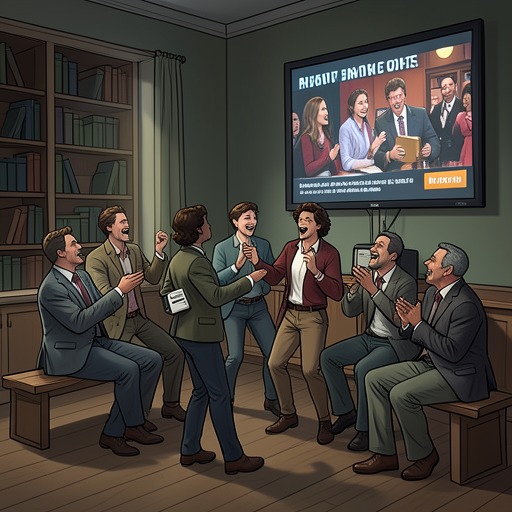
Whenever a speech is announced, the Radiogram in the hotel is turned to full volume. Conversation gives way to hushed attention as people in every room listen together. This is more than a broadcast being consumed by isolated individuals: the machine becomes a gathering point, and Churchill’s distant voice creates a temporary public community inside the hotel. His rhetoric reaches the narrator personally, filling the speaker with confidence that Britain will defeat Hitler, while also reaching the wider nation through the same ritual of listening.
The speeches do not erase danger. Instead, they give suffering a form that can be endured. The narrator accepts that the country may have to pay in blood, toil, tears, and sweat, and insists that Britain will fight on the beaches and in the hills and never surrender. The final assertion that Britain does not surrender turns Churchill’s language into lived historical experience: the promise is not left as rhetoric but is measured against the population’s continuing endurance.
Leadership and Collective Spirit
Churchill’s role is set beside the guidance and kind words of the narrator’s Father, creating a relationship between intimate and national forms of authority. The Father steadies the family, while Churchill steadies the country. One speaks within the household; the other speaks through the Radiogram to a nation under attack. Together, these figures show how wartime confidence is transmitted through both personal care and public leadership.
His influence also belongs to a larger emotional system sustained by radio. Churchill’s stirring addresses share the airwaves with Charles Hill’s health advice and with comedy programmes such as ITMA and Hi Gang. Music While You Work carries singing across factory floors despite the machinery, while Workers Playtime brings variety entertainment from factory to factory. In this environment, Churchill’s speeches are not isolated political statements. They form part of a national effort to keep fear from becoming paralysis, alongside humour, music, practical instruction, and the ordinary willingness to help strangers.
The narrator explicitly identifies a wartime spirit in which a common enemy lowers the usual British reserve. Complete strangers speak like old friends and offer lifts to people they have never met. Churchill’s speeches give that solidarity a language of determination, but the response belongs to ordinary people as well. His leadership is effective in the narrative because it meets a population already converting shared misery into mutual assistance.
War, Secrecy, and the Material of Victory
Churchill’s leadership is also connected with projects whose significance is hidden from the people carrying on the war at home. One such project is PLUTO, the pipeline designed to transport fuel beneath the sea from England to France. The scheme involves lengths of steel pipe reeled from a ship and sunk to the seabed, while pumping stations on the British coast and the Isle of Wight are disguised to resemble their surroundings.
The narrator learns only later that PLUTO becomes so successful that the pipeline is extended across Europe as far as Berlin, supplying the lorries and tanks of the victorious forces. Churchill regards the project as critical to winning the war, even though its importance is concealed at the time by strict secrecy. This hidden infrastructure complicates the image of victory as something produced by speeches alone. Churchill supplies the words that sustain morale, while engineers, workers, soldiers, and secret wartime schemes provide the material means by which those words can become reality.
Narrative Role and Significance
Churchill functions in the memoir as a mentor-like national presence: he does not enter the family’s physical world, but his voice crosses into it at moments of maximum fear. The narrator’s admiration is shaped by hindsight, yet it is also rooted in the immediate experience of listening in silence while the hotel waits for reassurance. His authority rests on a convergence of prediction, rhetoric, symbolism, and consequence: he foresaw Hitler’s danger, became Prime Minister when the crisis demanded decisive direction, spoke in language the public could remember, and helped sustain the refusal to submit.
His significance therefore extends beyond the portrait of one statesman. He becomes the narrative embodiment of the wartime belief that morale is itself a form of resistance. The bombing of cities, the deaths of children, the disappearance of young airmen, and the anxiety surrounding families such as the Fellows household reveal the terrible cost of that resistance. Yet even amid private grief and public catastrophe, Churchill’s voice helps organize fear into endurance. The later celebrations of VE-Day, with street parties, bunting, Union Jacks, released food, fireworks, and bonfires, are the distant social answer to the nights when people gathered around the Radiogram. The nation’s joy does not cancel the losses, but it confirms the power of the collective resolve that Churchill had helped articulate.