Women's Land Army
Pamela's WarThe Women's Land Army is presented as one of the central institutions through which wartime Britain transfers essential work from absent men to women. Its members replace agricultural laborers who have been called up to fight, working with limited equipment, long hours, and the instruction of the older men who remain on the farms. For Pamela Wheeler Fellows, joining it marks a decisive movement away from an exploitative factory job and toward work that she finds physically arduous but meaningful and enjoyable.
Purpose and Wartime Structure
The Women's Land Army exists because the war removes working-age men from farms as well as from factories and the armed forces. Women are drafted into their place, preserving agricultural production while the country is under military pressure and facing the wider demands of the British wartime effort. The organization therefore gives women responsibility for work that is indispensable but traditionally coded as male: planting, hoeing, harvesting, and managing the physical routines of a farm.
The farm where Pamela works has almost no available male labor. The only men left are the farmer himself and men considered too old to be called up. Their role is not to perform all the work in the women's place, but to transmit the experience needed to make the arrangement function. The women learn from them, while the organization turns female workers into a practical replacement workforce. This combination of emergency necessity and inherited expertise defines the Land Army's method: wartime labor is reorganized without abandoning the knowledge on which farming depends.
Pamela's Recruitment and Adaptation
Pamela reaches the Women's Land Army after her Birmingham factory employment ends. That earlier job had placed her in an otherwise exclusively male unit making parts for aeroplanes. She had performed the same output in the same timescale as the man she replaced, yet received only a woman's rate of pay; hot metal swarf repeatedly entered her eyes and burned them, sometimes requiring hospital treatment. Her male colleagues resented her presence, while she became increasingly militant about the unequal pay and was willing to involve the union. When the factory dismisses her after her marriage on the grounds that a wife's working hours will conflict with domestic duties, the departure suits both sides: Pamela hates the dangerous, dirty job, and the management is relieved to lose an increasingly outspoken employee.
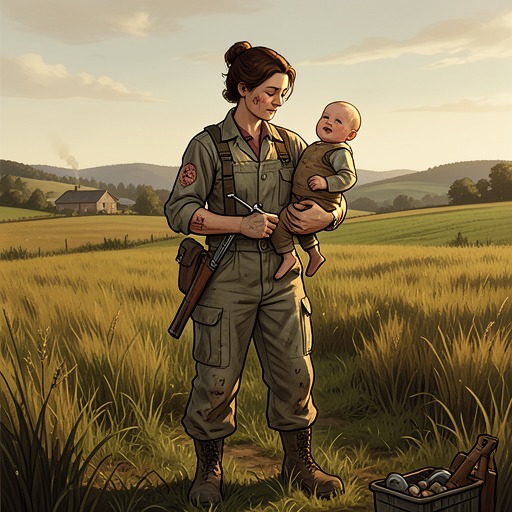
The Land Army interview begins with a visual mismatch between Pamela's appearance and the work required. She travels from Halesowen to the farm at Broome near Clent wearing a smart suit and high court shoes, dressed as though applying for office employment. The farmer, Mr Pheysey, asks whether she has flat brogue shoes because such footwear is necessary for work on the land. Pamela does not own any, but her resourceful Father provides them, allowing her to begin the following Monday. Her new outfit consists of flat brogues, dungarees, a cotton shirt, and a headscarf, the last worn by the women to keep hair out of their eyes and corn out of their hair. Clothing thus becomes part of her passage from town-based respectability into agricultural labor.
Conditions, Skills, and Daily Work
The organization offers none of the comforts associated with domestic or office employment. The women wear khaki dungarees, use an outside privy, and wash at a cold-water pump in the farmyard. Their work continues for long hours in every kind of weather. They plant, hoe, and harvest, and the physical rhythm of the farm quickly changes Pamela's body and sense of capability. On her first day, she is so hungry that she eats her packed lunch by eleven o'clock, learns from the mistake, and does not repeat it.
The farm also reflects wartime shortages and the effort to avoid dependence on petrol. Two working horses pull tractors and carts, so the work does not rely on petrol-consuming machinery. This detail places the Land Army within a broader economy of conservation: women supply labor, animals supply traction, and the farm must produce under conditions shaped by military mobilization and scarcity. The organization's importance lies not only in employing women, but in sustaining the material systems that keep the country fed.
Pamela's response to the work is notably different from her response to the factory. The factory makes her angry because it is dangerous, socially hostile, and unfairly paid. Farm labor is equally demanding, but she loves it. By the end of the summer she is tanned, supple, and extremely fit, evidence that the Land Army has made physical work a source of strength rather than merely an imposed burden. The contrast is important: the narrative does not treat all wartime labor as interchangeable. The organization gives Pamela a form of competence and bodily confidence that the factory, despite its contribution to aircraft production, fails to provide.
Marriage, Savings, and Withdrawal
Pamela's Land Army service occurs within the uncertain circumstances of her marriage to John Fellows. While working at the factory, she saves all her earnings toward the home she imagines establishing when her husband returns permanently. John is allowed home on leave, but she sees him only rarely, making their brief meetings precious. Although married, she continues to live with her parents and accumulate money, still without a household of her own. The savings will eventually be spent on a car when John comes back from the war, not on the domestic arrangements she has imagined, but at this point she knows only that the nest egg must grow and that she needs employment.
Her time in the Land Army ends through pregnancy rather than through a loss of commitment to the work. By the end of the summer she is expecting her first baby, and her advancing pregnancy forces her to retire from the farm. Megan, her sister-in-law, takes over the position. The transfer preserves the continuity of the work even as Pamela's body can no longer sustain it, showing how the organization depends on a succession of women rather than on a single worker's permanent attachment to one post.
Historical and Narrative Significance
The Women's Land Army gives the wartime home front a distinctly female labor history. Pamela is controlled by Father's rules when she is seventeen, restricted from walking out of the hotel with young men; later, marriage is used by the factory as a reason to remove her from paid employment; and finally pregnancy determines when she must leave agricultural work. Across these stages, female movement, desire, wages, work, and reproduction are all shaped by institutions and family authority. Yet the Land Army also creates room for agency. Pamela chooses to apply, accepts the practical demands of the farm, acquires the required clothing and equipment, learns unfamiliar skills, and discovers pleasure in work that places her directly inside the national effort.
The organization therefore complicates any simple division between male combat and female support. The young men around Pamela are being sent away, and many do not return; John Fellows's hoped-for path to the controls of a Spitfire is redirected to postings in Anglesea and Aden. Against this background, the Land Army is not passive waiting. It is a disciplined, exhausting form of wartime service whose results are measured in crops rather than victories in the air. Pamela's eventual withdrawal to prepare for the birth of her daughter does not erase that contribution. It reveals instead how wartime production, marriage, and the next generation are bound together, with women's labor moving between farm, factory, household, and maternity according to the changing pressures of the war.