horses
Pamela's WarThe horses in the memoir form a recurring animal presence through which leisure, friendship, wartime improvisation, and labor are brought into the same frame. They carry novice riders up the Clent Hills, give Pamela Wheeler Fellows a cherished education in riding, propel a comic escape from a pub, replace petrol-driven machinery, and pull the agricultural equipment on which wartime production depends. Their usefulness is real, but so are their habits and independent impulses: they race when they recognize the galloping meadow, hurry home when food or rest is near, and turn human plans into comic uncertainty.
Recreational Horses and the Perils of the Home Run
The horses first appear as part of the popular outings to the Clent Hills, a fifteen-minute walk from the hotel. For workers from Lye, where factories, poor housing, and tight finances make seaside holidays impossible, the hills offer an accessible day away for men, women, and children. Small ponies can be hired for half an hour around the pony ring, and no previous riding experience is required because the animals know the circuit without guidance. Their reliability creates an apparently safe introduction to riding, yet it also prepares the riders for a reversal.
The ascent is a slow, reassuring amble. The real danger comes on the return journey, when a pony rounds the last corner, sees home, and recognizes the possibility of food or rest. The measured pace becomes a trot, notoriously difficult for a novice to remain seated through. Many ponies dislodge their unwanted cargo before returning alone, converting a harmless family amusement into a small contest between human balance and animal purpose. The scene gives the horses a practical intelligence that does not depend on human instruction: they know the route, the destination, and the reward awaiting them.
The outing also exposes the unequal ways people use the same recreational space. After the pony rides, visitors inclined toward drink can stop at the Hill Tavern and the Fountain Inn before reaching the hotel, which is the last stop before the bus home. By then some are so intoxicated that they dance on tables or must be arrested by the local policeman and held overnight. The horses belong to this unruly holiday world, but they are not the cause of its disorder; their instinctive rush home merely mirrors the human visitors’ own impatient pursuit of pleasure.
Alf Joseph and Pamela Wheeler Fellows’s Riding Education
Horses become more than a public amusement through Pamela Wheeler Fellows’s relationship with Alf Joseph. Alf and Leah Joseph are childless family friends, and Alf takes Pamela under his wing. He pays for her lessons at the local riding school, teaches her what he knows, and later accompanies her on hacks through the lanes and along the bridle paths. The horses therefore mediate an adult-child bond based not on abstract instruction but on shared practice, attention, and trust. Alf’s generosity gives Pamela access to a skill and a form of freedom that would otherwise remain unavailable.
After several months, Pamela learns to find her seat, rise to the trot, and control her mount. Confidence comes through repeated bodily adjustment: the rider must understand the horse’s movement rather than simply command it. The later hacks begin at Stakenbridge and cross a broad grass meadow before reaching any road. There, Alf and Pamela let the horses have their heads and gallop. Pamela’s little mare is fast and feisty, and despite having much shorter legs than Alf’s seventeen-hand horse, she keeps pace and often wins the race. The episode gives the mare a distinct temperament and ability, while making Pamela’s growing competence visible through action.
The meadow is not a neutral backdrop but a place with an established meaning for the animals. The two horses know it as the place where they are allowed to race, and once one sets off, both go. Their shared habit overrides the riders’ failure to anticipate what will happen. The animals’ memory of place becomes the decisive force in the scene: the gallop is not initiated by a human plan so much as released by the horses’ recognition of their customary freedom.
Max Wall’s Unplanned Gallop
The horses also generate one of the memoir’s clearest comic reversals when Max Wall, a famous hotel guest known for his unusual appearance and funny walk, insists on joining Alf and Pamela. His lack of riding experience is treated as irrelevant, although the animals’ established routine makes that confidence hazardous. Once the group enters the meadow, the horses take off at full speed, bits between their teeth, and prove difficult to stop.
Max’s mount follows the others. Hanging on for grim death, he shouts, “The brakes! The brakes! Where are the brakes? How do you stop the bloody thing? Where the hell are the brakes? HELP!” By the time Alf and Pamela pull their own horses to a halt, Max has managed to stay aboard, but he is out of the saddle and hanging around the horse’s neck near its ears. The horse’s momentum transforms the comedian’s cultivated public appearance into an even more extreme spectacle. Yet the humor depends on the animal’s agency: the horse does not perform according to Max’s expectations, and the riders regain control only when the experienced pair bring their mounts to a stop.
Horses as Wartime Transport and Improvised Technology
During the war, horses move from recreation into the practical economy of shortage. When Jim Parkes cannot obtain petrol for business or leisure, he acquires a pony and trap to carry himself and Renee to the pub and the shops. The arrangement is an improvised replacement for motor transport, showing how animal power re-enters ordinary travel when fuel is unavailable. The pony is not presented as a sentimental relic; it is working transport, integrated into the household’s response to wartime restrictions.
A quarrel at a pub reveals both the usefulness of the arrangement and its comic vulnerability. Jim wants to leave after an evening’s drinking, while Renee wants another drink and orders him not to take the trap without her. He complies literally. Hooves are later heard on the tarmac outside, and the family discovers the trap and its traces propped against the pub wall: Jim has detached the pony, left the trap for Renee as requested, and ridden the pony home bareback. Renee must walk the mile home. The pony enables Jim’s escape, but its presence also exposes the absurd precision of obeying a domestic command while defeating its intended purpose.
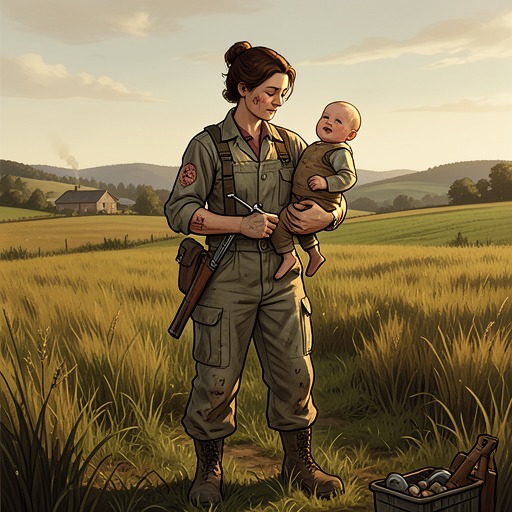
The same wartime practicality appears on the farm where Pamela joins the Women’s Land Army. The women replace men called up to fight, work long hours in all weather, and plant, hoe, and harvest under austere conditions. Two working horses pull tractors and carts, eliminating the need for petrol-consuming machinery. In this setting, the horses are part of the farm’s productive infrastructure, converting their strength into food production at a moment when fuel and labor are both constrained. Pamela’s enthusiasm for the work, despite exhausting hunger on her first day, places the animals within a broader collective effort rather than treating them as decorative companions.
Animal Life Amid Shortage and Rationing
The horses’ wartime role sits within a larger system in which animals are tied to food, transport, property, and survival. The memoir records food scraps being collected to fatten the nation’s pigs, scrap metal being melted into aircraft or bombs, and a new baby’s pram being commandeered to bring food to a family deprived by rationing. In this economy, animals are neither outside the war nor untouched by it. Their bodies and labor are drawn into national demands, while their owners improvise around the loss of petrol and the disappearance of familiar foods.
That contrast matters because the horses retain forms of preference and behavior that cannot be reduced to their economic function. The riding horses recognize the meadow and race without waiting for permission; the ponies on the hills accelerate toward food and shelter; Jim’s pony becomes the means of a bareback departure that no one planned. Their usefulness makes them valuable, but their habits make them consequential. The memoir’s animal world is therefore both materially embedded and vividly resistant: horses help people endure scarcity, yet they also redirect human intentions through appetite, memory, speed, and instinct.